• 3 min read
Wildfires reach NASA’s Spanish space observatory
Wildfires reached NASA’s Spanish deep-space communications complex, forcing an evacuation and shifting spacecraft support to California.
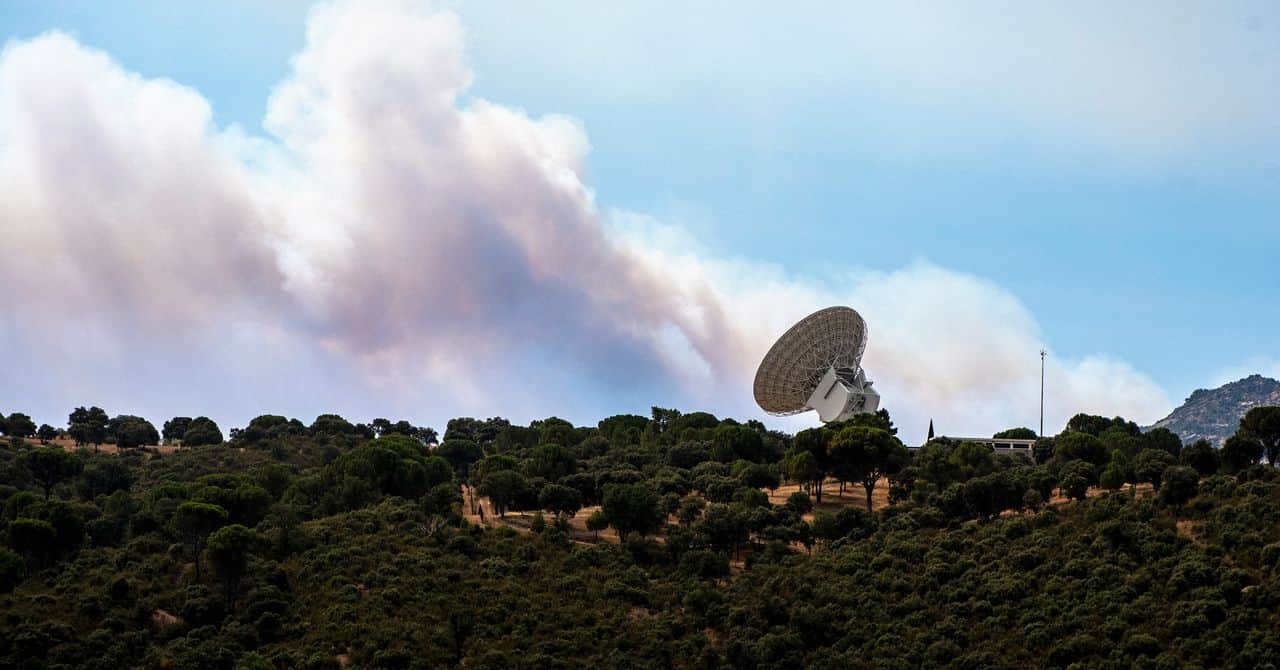
Image: Wired
A wildfire has reached one of NASA’s three Deep Space Communications Complexes, forcing the evacuation of its personnel and raising questions about possible damage to equipment used to communicate with spacecraft across the solar system.
Spain declared a wildfire emergency on Friday as several blazes burned out of control near Madrid. Evacuation orders covered 60,000 people in the affected region, including Robledo de Chavela, the municipality near NASA’s Spanish complex.
News photographs showed the facility’s radio telescopes surrounded by smoke and flames. A NASA spokesperson told WIRED by email that all personnel were evacuated safely. The fire has since passed through the observatory complex, but the agency does not yet know whether sensitive equipment was damaged.
“Any potential damage will be assessed when it is safe to do so.”
If conditions permit, NASA said a site assessment could begin as soon as Saturday. In the meantime, the agency has “seamlessly transitioned support for mission operations to the Goldstone Deep Space Communications Complex in California,” maintaining spacecraft communications without interruption.

Recommended reading
SpaceX launches Starship with V3 Starlink satellites
NASA’s deep-space communications network
The Spanish site, together with facilities in Canberra, Australia, and Goldstone, California, forms what NASA calls the “largest and most sensitive scientific telecommunications system in the world.” The network sends commands to spacecraft and receives data from missions including Voyager 1, the James Webb Space Telescope, and the recently completed Artemis mission around the Moon.
Voyager 1 is the most distant human-made object in the solar system. The facilities also support radio astronomy observations, making the Spanish complex a critical link for both space missions and scientific research.
Wildfires spread across Europe
Spain is not the only country facing an escalating wildfire crisis. Fires were also burning out of control in France, where beachgoers reported orange skies and ash washing ashore as crews battled flames near Bordeaux, the capital of the country’s wine region.
“We learned in the middle of the afternoon that, following the wind shift, it had become a large, self-sustaining fire that is extremely difficult to bring under control. It is now moving east, toward the Bordeaux metropolitan area. We are going to reorganize our response so we can fight it from the ground and prevent it from advancing.”
Roughly 200,000 people have been told to evacuate across Spain and France. Europe has experienced record high temperatures this summer, fueled by repeated heat domes over the continent and the UK, as well as climate change. Dry vegetation can ignite easily, and similar fires have recently affected Ontario, Canada, and the US Pacific Northwest.
Cooler weather expected in the Mediterranean over the weekend could help firefighters contain the blazes. But temperatures are forecast to rise again on Monday and climb throughout the week, reaching as much as 10 degrees Celsius (18 degrees Fahrenheit) above normal—potentially worsening existing fires or helping start new ones.
Frontier Editor
Dan is our resident futurist, covering electric mobility, space exploration, and the smart home. He's interested in atoms just as much as bits. Whether it's a new battery chemistry, a reusable rocket, or a protocol that finally makes IoT devices talk to each other, Dan breaks down the engineering that pushes humanity forward.
via Wired