• 2 min read
Lilac-3 flying-saucer satellite reaches orbit
China’s Lilac-3 satellite has reached orbit, testing an ultraflat disk design and capturing its first video from very low Earth orbit.
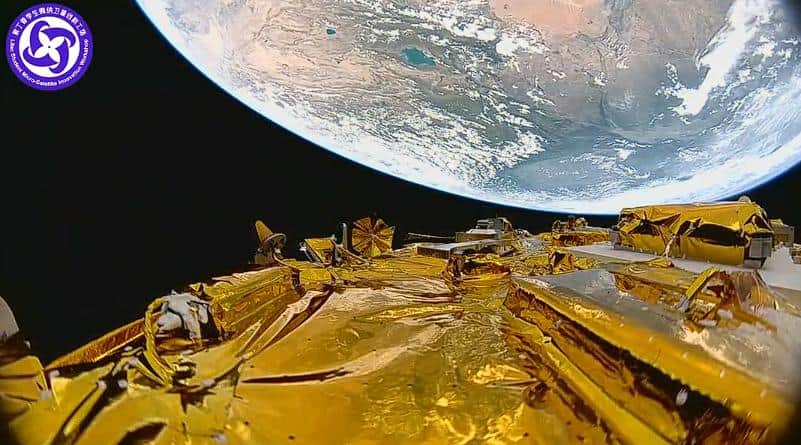
Image: iXBT
China launched nine satellites into their designated orbits on July 22 using the Gravity-1 Y4 carrier rocket from waters east of Shanghai. Among them was Lilac-3, a student-built spacecraft from the Harbin Institute of Technology shaped like a “flying saucer.”
Lilac-3 is a new type of ultraflat, disk-shaped satellite. Its main structure is 1 meter in diameter, no more than 5 centimeters thick, and weighs about 30 kilograms. The design is intended to support multi-satellite launches and orbital networks while delivering high power density.
The spacecraft can also adjust its attitude and orbit by changing its position in the rarefied atmosphere. Lilac-3 is the first vehicle to conduct an orbital test of several key technologies, including an ultraflat configuration and aerodynamically controlled attitude adjustment in very low Earth orbit.
Its primary payload is a scientific instrument designed to detect low-frequency electromagnetic waves. The device will be used to study ionospheric plasma waves and how artificial extremely low-frequency emissions propagate from space to Earth.
Lilac-3 also carries a student-designed payload called the “popularization windmill.” Once in very low orbit, the satellite can rotate under the influence of the thin atmosphere and record video. It has already captured its first footage and transmitted the data back to Earth.

Recommended reading
SpaceX may catch Starship on its next flight
Frontier Editor
Dan is our resident futurist, covering electric mobility, space exploration, and the smart home. He's interested in atoms just as much as bits. Whether it's a new battery chemistry, a reusable rocket, or a protocol that finally makes IoT devices talk to each other, Dan breaks down the engineering that pushes humanity forward.
via iXBT