• 2 min read
Psyche spacecraft captures rare time-lapse of Mars
NASA’s Psyche spacecraft used its Mars flyby to test its instruments and capture rare time-lapse views of the Red Planet.
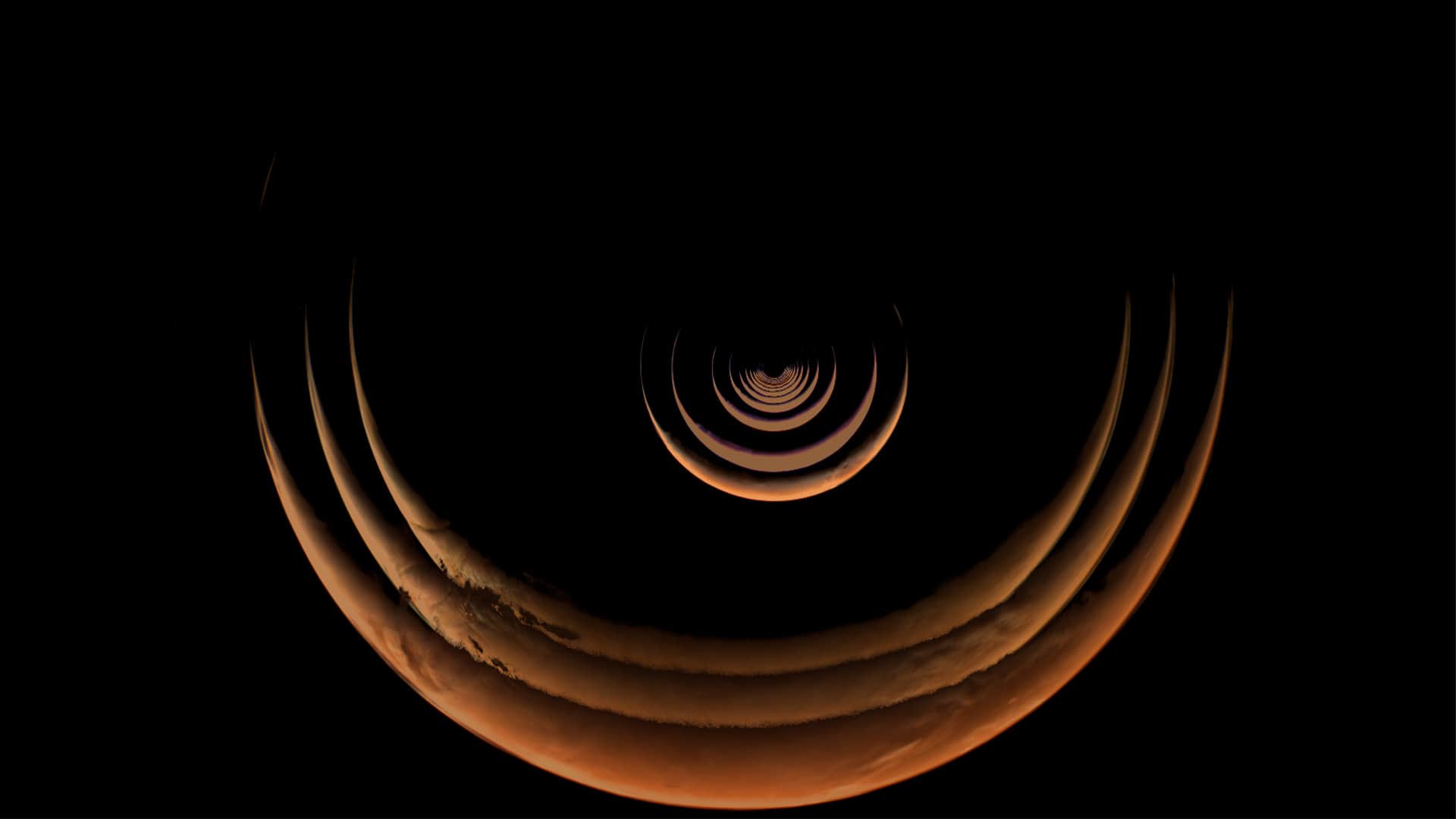
Image: NASA/JPL-Caltech/ASU
NASA’s Psyche spacecraft used its May 15 flyby of Mars for more than a gravitational assist. On its way to the asteroid belt, the probe turned every instrument toward the Red Planet and returned a set of striking images, including a distinctive eye-shaped view created by its approach angle.
The spacecraft captured daily images as it neared Mars, then combined them into a time-lapse. It also recorded the planet continuously from May 2 through May 31, compressing the month-long sequence into a 1-minute, 15-second video.
“Coming in at such a high phase crescent, only about 4% of Mars was illuminated, and with that, we could see the atmosphere around it glowing.”
Psyche continued photographing Mars as it left the area and headed toward the asteroid belt. NASA/JPL-Caltech/ASU
Psyche’s instruments test Mars
The flyby also gave NASA a chance to test the spacecraft’s science systems in a planetary environment. Psyche measured Mars' atmosphere as it interacted with solar winds and detected neutrons striking the planet’s surface through its thin atmosphere.
The imager, magnetometer, and gamma-ray and neutron spectrometer teams all collected data, even though the instruments were not specifically designed to study a planet. NASA did not expect major discoveries because Mars has been examined extensively, but the observations will help researchers evaluate the instruments and improve their understanding of the planet.

Recommended reading
24-foot inflatable drone targets 10-hour flights
“The mission’s imager, magnetometer and gamma-ray and neutron spectrometer teams worked overtime to make full use of this planetary encounter, and all instruments delivered great results.”
Many spacecraft have photographed Mars' surface, and Psyche is now among them. NASA/JPL-Caltech/ASU
The imaging system was the standout performer. It captured distant views of Mars' moons, Phobos and Deimos, while testing calibration and sensitivity to scattered light. That exercise will support the search for possible moonlets around asteroid Psyche.
“Besides the obvious beauty of the photos, we were also able to fully test its calibration and sensitivity to scattered light, including picking out the Martian moons Phobos and Deimos from very far away as a part of a practice for the satellite search that we’ll use at the asteroid Psyche to look for any moonlets there.”
Psyche is expected to reach the Psyche asteroid in August 2029.

Frontier Editor
Dan is our resident futurist, covering electric mobility, space exploration, and the smart home. He's interested in atoms just as much as bits. Whether it's a new battery chemistry, a reusable rocket, or a protocol that finally makes IoT devices talk to each other, Dan breaks down the engineering that pushes humanity forward.
via CNET