• 2 min read
3D thermal cloak redirects heat from infrared cameras
Researchers demonstrated a 3D-printed thermal cloak that redirects heat around objects and keeps them difficult to distinguish with infrared cameras.
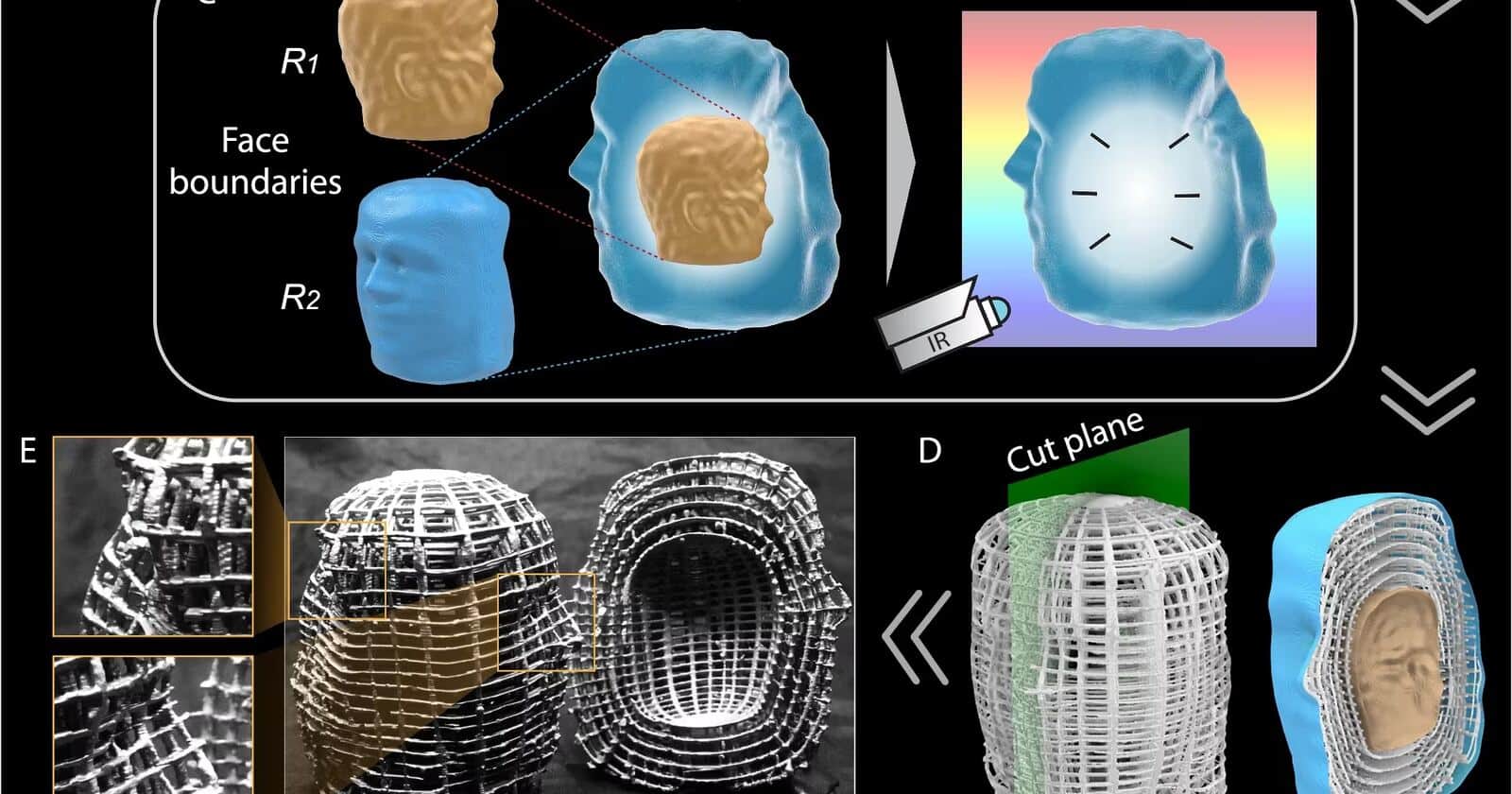
Image: ITzine
A 3D “thermal cloak” can keep a concealed region at nearly constant temperature while heat moves around it, according to a study published in Nature Communications. The researchers tested the system between a heat source and a cooled area: the thermal flow bypassed the hidden object, while the surrounding temperature pattern remained almost unchanged.
The team also tested complex shapes, including a model of a human head. The effect held when heat was applied from different directions—an important difference from earlier designs that worked only with one-sided heating.
How the 3D thermal cloak works
The device is built from a lattice combining materials with sharply different thermal properties:
- 3D-printed aluminum, which conducts heat efficiently;
- Polymer elements with low thermal conductivity, which act as insulation.
This arrangement controls where heat travels quickly and where it is redirected around the object. Rather than simply blocking or suppressing heating, the structure reshapes the thermal flow in three dimensions. To an infrared camera, the result resembles a carefully reconstructed background.
Recommended reading
German team finds two ways to break down PFAS
Related concepts have been studied in physics and materials science for years, but earlier thermal cloaks were typically two-dimensional or limited to heating from a single direction. Real objects are rarely heated uniformly, and sensors may view them from different angles. The three-dimensional design addresses part of those constraints.
Potential uses and next steps
Infrared cameras are used in industrial diagnostics, energy systems, drones, and surveillance. The approach could also matter for thermal management in chips and servers, where workloads driven by AI are increasing. Controlling the geometry of heat flow, rather than only removing heat, could give the technology practical value.
The researchers' next goal is to develop versions that can conceal not only cold or passive objects, but also objects that generate heat themselves. If the structures can be scaled, they could be used to protect sensitive electronics while reducing their visibility to infrared sensors.

Frontier Editor
Dan is our resident futurist, covering electric mobility, space exploration, and the smart home. He's interested in atoms just as much as bits. Whether it's a new battery chemistry, a reusable rocket, or a protocol that finally makes IoT devices talk to each other, Dan breaks down the engineering that pushes humanity forward.
via ITzine