• 2 min read
Google open-sources AI model for earlier hurricane warnings
Google is open-sourcing WeatherNext, an AI model that predicts cyclone track and intensity for up to 15 days in under a minute on a TPU.
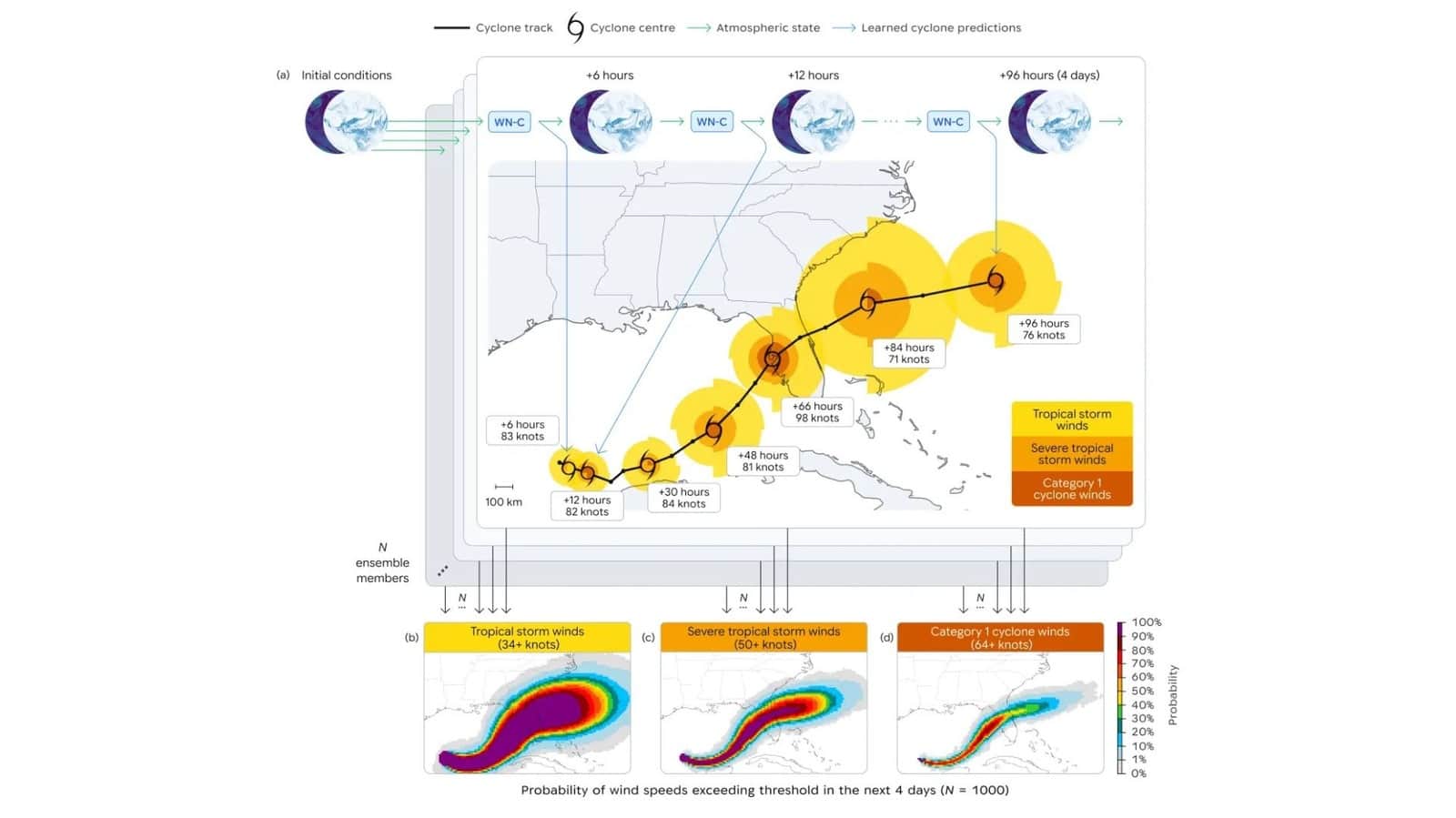
Image: Engadget
Google is releasing the code and model weights for WeatherNext, an AI weather system designed to predict a tropical cyclone’s track and intensity in a single 15-day forecast. The company says the model could help forecasters issue earlier warnings for hurricanes and typhoons.
The release will be available on GitHub, allowing researchers and weather agencies to examine and build on both the model and its implementation. Google DeepMind and Google Research developed WeatherNext with contributions from the National Hurricane Center, the Cooperative Institute for Research in the Atmosphere, the UK Met Office and other agencies worldwide.
How WeatherNext predicts cyclones
Tropical cyclone forecasting has traditionally split the problem between different types of models. Coarse global models are better suited to analyzing the atmospheric currents that influence a storm’s path, while specialized local models focus on thermodynamic processes in the storm’s core to estimate intensity.

Recommended reading
IBM commits $50 million to AI-led quantum research
WeatherNext instead uses one model for both tasks. It was trained on nearly 20 terabytes of global atmospheric data, along with historical storm records from the International Best Track Archive for Climate Stewardship.
The researchers say the system can generate a complete 15-day forecast in under a minute on a TPU. That speed is intended to let forecasters assess the probability distribution of potentially severe but less likely outcomes, rather than waiting for a slower prediction cycle.
“We can now generate a single 15-day forecast in less than a minute on a TPU, empowering forecasters to quickly evaluate the probability distribution of potentially devastating tail-risks.”
Research release, not a finished warning system
A study of WeatherNext has been published in Nature, while Google also released a less technical explanation in a company blog post. The company introduced the second generation of WeatherNext last year and has separately explored AI forecasting for flash floods.
The reporting does not provide specific accuracy figures, a comparison with named operational forecasting systems, or a release date for any public warning service. That leaves the practical impact unsettled: the open code and weights make the system useful for research, but the available information does not establish that it will outperform existing forecasts in real-world hurricane operations. Its most substantial change is architectural—the attempt to combine track and intensity prediction in one fast model—rather than a demonstrated replacement for established warning systems.
Frontier Editor
Dan is our resident futurist, covering electric mobility, space exploration, and the smart home. He's interested in atoms just as much as bits. Whether it's a new battery chemistry, a reusable rocket, or a protocol that finally makes IoT devices talk to each other, Dan breaks down the engineering that pushes humanity forward.
via Engadget