• 4 min read
KAIST cuts giant-battery production time by 67%
KAIST researchers cut vanadium flow-battery electrolyte production time by 67%, targeting a key barrier to large-scale AI data-center storage.
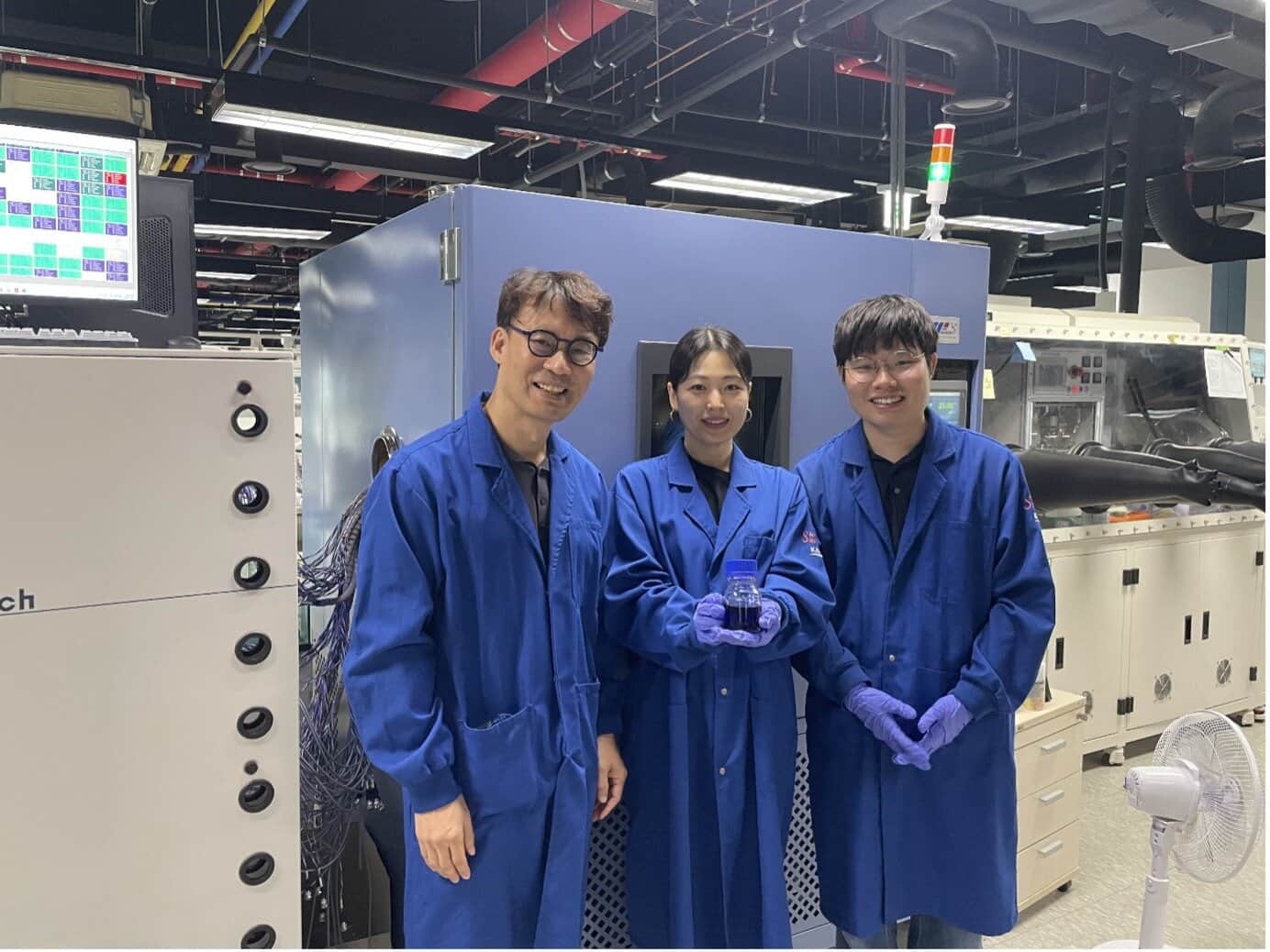
Image: TechXplore
A KAIST research team says it has cut production time for a key material in vanadium redox flow batteries (VRFBs) by 67%, addressing a major manufacturing barrier for the large-scale storage systems increasingly being considered for AI data centers.
The work targets the production of the batteries' vanadium electrolyte, which stores energy in liquid form. The findings were published in Advanced Energy Materials in 2026 under the title “Streamlined V 3.5+ Electrolyte Production by Leveraging Chemical and Catalytic Reductions.”
Why VRFBs fit data-center storage
AI data centers operate continuously and require reliable power. Large energy-storage systems can store electricity generated by intermittent sources such as solar and wind, then supply it when needed. Recent projects are also exploring alternatives for powering data centers, including the battery systems covered in Electric Era’s shift toward data-center storage.
VRFBs use nonflammable, water-based electrolytes, giving them a lower fire risk than many conventional battery systems. Their storage capacity can also be increased by adding more electrolyte to external tanks, rather than redesigning the battery stack itself. Those properties have made the technology a candidate for ultra-large storage installations serving data centers and renewable-energy infrastructure.
The challenge has been producing electrolyte with an average vanadium oxidation state of 3.5+, the standard starting composition for VRFB operation. The conventional process first uses chemical reduction, in which a reducing agent adds electrons to vanadium ions. It then applies electrochemical reduction to fine-tune the ions' electron state.

Recommended reading
WindBorne raises $37 million for AI weather forecasts
That second stage requires a costly VRFB stack and substantial electrical energy. The result is a process with higher capital costs, greater operational complexity and a production rate that has limited commercial scaling.
The bottleneck at +4.1
KAIST researchers led by Hee-Tak Kim of the Department of Chemical and Biomolecular Engineering found that the chemical-reduction route has its own previously unidentified slowdown. The reaction rate drops sharply when the average vanadium oxidation state reaches approximately +4.1, an intermediate point on the way to the desired V3.5+ electrolyte.
The team compared the reaction to traffic backing up at a sudden highway bottleneck. Instead of allowing the chemical reduction to continue through its slowest stage, the researchers switched to a platinum-on-carbon (Pt/C) catalytic reduction process at roughly +4.1.
The approach builds on earlier work by the group, which replaced the conventional electrochemical adjustment step with catalytic reduction and prevented leftover electrolyte from being wasted. In the new process, the catalyst is extended into the bottleneck region of the oxalic-acid-based chemical reduction process.
That change produced three concrete results:
- 67% less production time for V3.5+ electrolyte compared with the conventional process.
- Elimination of residual oxalic acid, an impurity that can degrade battery performance.
- More than 2,500 catalyst reuses without a notable decline in performance.
The catalyst’s repeated use is particularly relevant to industrial economics, because a process that reduces reaction time but requires frequent catalyst replacement would weaken the commercial case. The source reports the reuse result as evidence of industrial-scale viability, but does not provide production costs, output volumes or results from a commercial manufacturing facility.
“This study combined reaction engineering principles with thermodynamic predictions to identify the rate-determining step in the chemical reduction and redesigned the electrolyte production process to overcome this major bottleneck to the commercialization of large-scale batteries.”
Kim added that the team identified conditions under which the catalyst remains stable without degrading in the electrolyte environment, calling the result a solution to an industry-relevant production bottleneck.
A faster process, not yet a deployed battery
The research addresses a specific weakness in VRFB manufacturing rather than introducing a new battery architecture. Its significance is that it reduces the time and energy burden of making the electrolyte needed by the existing design, while removing an impurity and retaining catalyst performance through thousands of cycles.
The paper was led by Kyunghwa Seok, a Ph.D. candidate at KAIST, with Minseong Kang as second author. The study’s DOI is 10.1002/aenm.71029.
The source does not announce a product, commercial partner, deployment, price or release date. On the evidence reported, the 67% reduction makes large-scale VRFB production more plausible, but it is still a manufacturing advance—not proof that giant flow batteries are ready for immediate installation at AI data centers.
Frontier Editor
Dan is our resident futurist, covering electric mobility, space exploration, and the smart home. He's interested in atoms just as much as bits. Whether it's a new battery chemistry, a reusable rocket, or a protocol that finally makes IoT devices talk to each other, Dan breaks down the engineering that pushes humanity forward.
via TechXplore