• 5 min read
Falcon 9 Moon crash could be visible from Earth
A spent Falcon 9 stage is expected to hit the Moon on August 5, potentially producing a telescope-visible plume and new data on lunar dust.
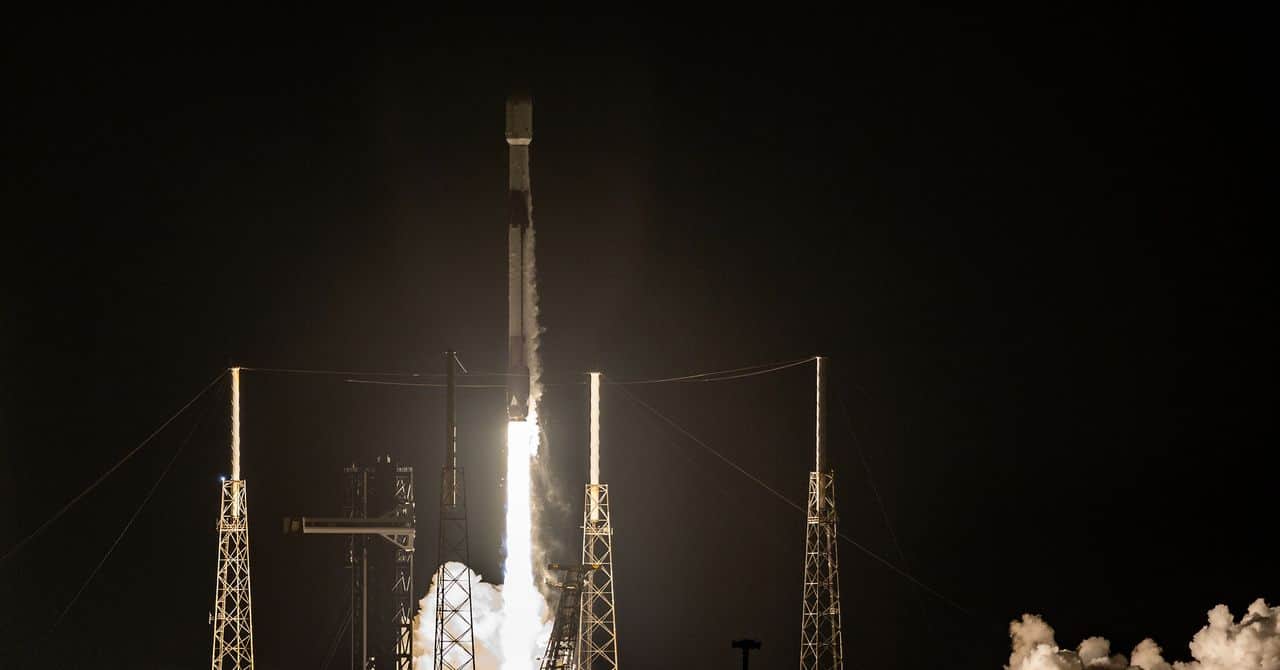
Image: Wired
A spent SpaceX Falcon 9 upper stage is expected to hit the Moon on August 5 at around 6:34 am UTC, striking the sunlit western limb near Einstein crater at more than 5,400 mph. With a sufficiently powerful telescope, observers on Earth may be able to see the resulting debris plume.
If the impact occurs as forecast, it would mark the first recorded impact flash on the Moon’s sunlit face. The collision could briefly create a plume bright enough to stand out against space, although scattered moonlight and atmospheric turbulence will make it difficult to observe.
How the Falcon 9 stage will hit the Moon
The forecast is based partly on two new preprint studies, including one posted to arXiv on July 27 and led by William Jo, a doctoral candidate at the University of Texas at Austin’s Cockrell School of Engineering.
Jo’s team used a high-resolution physics simulation to model what might happen when approximately 3,900 kilograms of hollow metal strikes the lunar surface. That makes the event different from a solid meteorite impact. The Falcon 9 stage is more like a shell, with a denser rocket engine at one end.

Recommended reading
NASA opens aerodynamic complex for Mars missions
“It’s like an empty eggshell, because it had all the fuel in it, and there is a rocket engine at one end that’s denser,”
Instead of penetrating the ground like a cannonball, the stage is expected to collapse inward from its edges. The simulation predicts a broad, low curtain of soil extending as far as 183 kilometers, along with a thinner, faster spike traveling nearly straight upward. In total, the collision could displace about 12,700 kilograms of debris.
The model is also notably optimistic. It is two-dimensional and axisymmetric, meaning it can simulate the stage arriving straight down, engine-first—essentially like dropping a pin onto its head. The real object, a spent Falcon 9 stage that carried two landers to the Moon in January 2025, is more likely to arrive at an angle. A glancing impact would probably produce a smaller, dimmer plume and might not generate the large vertical spike.
“I would view our study as the most optimistic in terms of generating sprays,”
Can a telescope see the impact plume?
Whether the plume is visible from Earth remains uncertain. Laurence Trafton, an astronomer at UT Austin, says its size should not be the main obstacle. A plume reaching 50 kilometers beyond the lunar limb would span about 28 arc seconds—roughly one-sixtieth of the Moon’s apparent width—and should be resolvable with a small telescope.
The new study provides an estimate of where observers should aim. The bigger challenge will be contrast: The plume is expected to be 30 to 300 times fainter than the bright Moon beside it. Scattered moonlight could further obscure it, so Trafton says observers will need “a very steady mount.”
Timing may help. The plume is expected to reach its maximum roughly 90 seconds after impact, giving observers enough time to see it if they are already tracking the correct location.
Geography will matter, too. The best viewing conditions are expected in the US Southeast, according to Trafton. For observers north of a line running from Massachusetts to Texas, the Moon will be so low in the sky that they will be looking through more than three times the usual thickness of atmosphere. That murky, turbulent air could wash out the plume.
Why scientists want to watch the crash
Several scientists, including Bill Gray of Project Pluto, who first flagged the impact, have published an observation plan encouraging both professional and amateur astronomers to monitor it.
The event is more than an opportunity to witness an unusual collision. Researchers have deliberately crashed spacecraft into the Moon to study material ejected from its surface. In 1999, NASA drove its Lunar Prospector probe into a crater in an attempt to detect water; the results were negative. In 2009, NASA sent a spent rocket into a similar south polar region and detected water ice in the resulting plume.
A 2022 impact was initially widely described as a Falcon 9 collision, but Gray and other researchers later said the object was almost certainly a discarded Chinese booster—a likely case of mistaken identity. That collision, like the upcoming one, was unplanned.
The debris from the Falcon 9 impact could help researchers estimate how far and how forcefully lunar material is thrown by falling hardware. That information may become increasingly relevant as NASA aims to return astronauts to the Moon within a few years and eventually build bases there, while China is also racing to put humans on the lunar surface.
“We’re going to be colonizing the moon apparently pretty soon. Those particles that come out will be coming out at maybe 300, 400 meters per second. And moon rock is also very abrasive,”
The concern is not limited to the impact site. Fast-moving, abrasive lunar dust could threaten astronauts and equipment. David Goldstein compared the problem with the Apollo missions, whose astronauts returned to their lunar modules visibly coated in dust.
“If you look at the old pictures of Neil and Buzz reentering the lunar module, you can see they were dirty—covered in dirt. Dust control during lunar operations is going to be one of the biggest problems that’s faced.”
For observers, the plan is simple: aim a good telescope at the Moon’s bright edge before 6:34 am UTC on August 5, keep the mount steady, and hope the atmosphere—and the clouds—cooperate.
Frontier Editor
Dan is our resident futurist, covering electric mobility, space exploration, and the smart home. He's interested in atoms just as much as bits. Whether it's a new battery chemistry, a reusable rocket, or a protocol that finally makes IoT devices talk to each other, Dan breaks down the engineering that pushes humanity forward.
via Wired