• 2 min read
AMD challenges Nvidia with Helios AI racks
AMD’s Helios AI rack system will ship later this year, with Microsoft, OpenAI, Meta, Oracle, and Anthropic planning deployments.
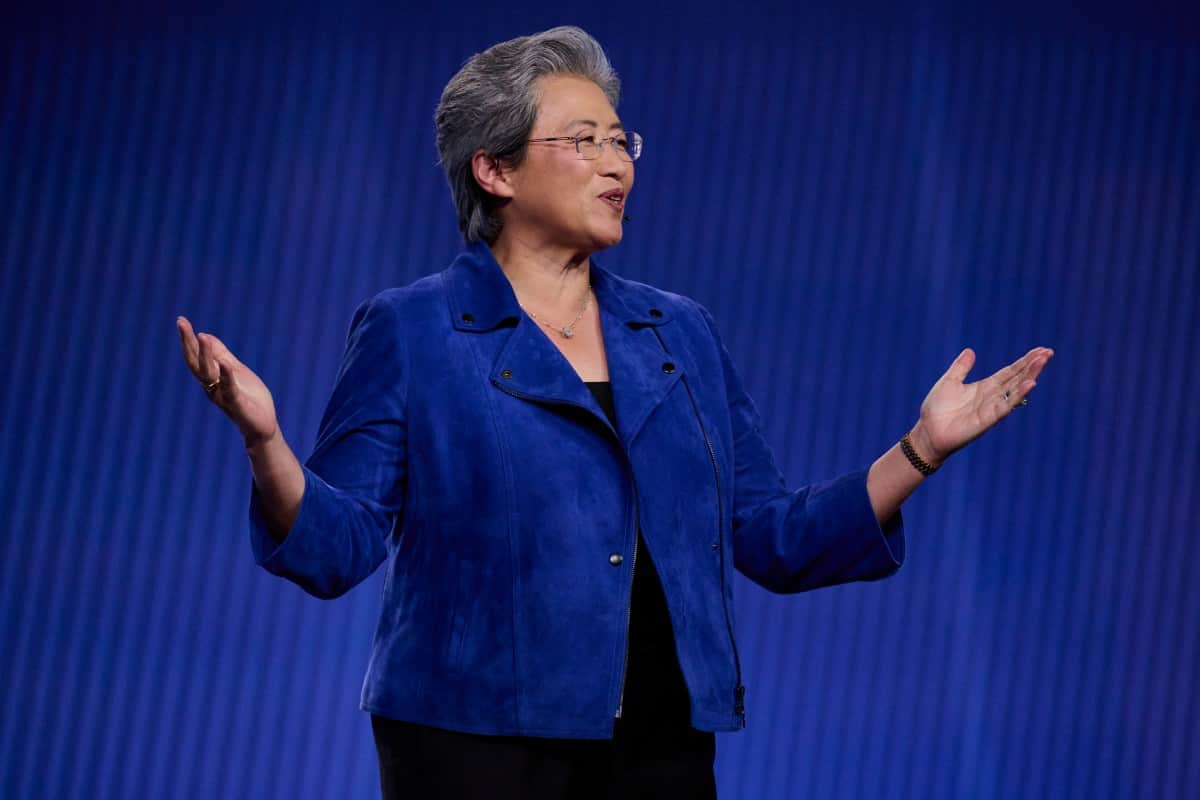
Image: TechCrunch
AMD is challenging Nvidia’s grip on large-scale AI infrastructure with Helios, a rack-scale system that combines multiple processors into a single high-powered unit for data-center workloads. The company plans to begin shipping Helios later this year.
At AMD’s sold-out Advancing AI conference in San Francisco on Thursday, Chair and CEO Dr. Lisa Su presented Helios alongside a growing customer list that includes Microsoft, OpenAI, Meta, Oracle, and Anthropic. The companies have plans to deploy the system, including at gigawatt scale, AMD said.
AMD Helios targets Nvidia’s rack systems
Rack-scale systems are designed to train and run AI models and other compute-intensive workloads. Nvidia has historically dominated this segment with its Vera Rubin and Grace Blackwell systems, but AMD is positioning Helios as a direct competitor.
Su called Helios the technology industry’s “highest performance AI rack,” saying it was built to train and run “the most demanding frontier models in the world at massive scale.” Performance metrics reported by The Register indicate that Helios beats Vera Rubin on several measures.
AMD first revealed Helios in 2025 and showed the system onstage at CES 2026 in January. Microsoft CEO Satya Nadella said Monday that Microsoft would expand its Azure infrastructure with Helios. On Wednesday, Anthropic and AMD announced a strategic partnership to deploy up to two gigawatts of GPUs through the new rack system.

Recommended reading
ChatGPT and Codex hit partial outage
Venice-X and AMD’s $1.4 trillion accelerator forecast
AMD also introduced Venice-X, a data-center CPU designed for high-computing workloads. The chip is expected to launch in 2027.
Su said the growth of agentic AI is driving a “step change in compute demand,” because agents can require dozens of steps involving reasoning, tool calls, data access, and repeated processing before completing a task.
“We’re now expecting that by 2030, the AI accelerator market is going to reach about $1.4 trillion. What that means is, by the end of the decade, the AI accelerator market is going to approach the size of the entire semiconductor market today.”
Su added that GPUs are expected to make up the vast majority of that market because AI algorithms remain in their infancy, workloads continue to change, and those conditions favor programmability across the silicon ecosystem.

AI Editor
Ava covers the rapidly evolving world of artificial intelligence, from foundational models and research labs to the real-world economics of intelligence. With a background in computational linguistics, she cuts through the hype to find out what actually works. She firmly believes that benchmarks are just marketing until reproduced in the wild.
via TechCrunch