• 3 min read
ETRI method helps multimodal AI learn without forgetting
ETRI’s MemEIC method helps multimodal AI learn new visual and language knowledge while preserving earlier information.
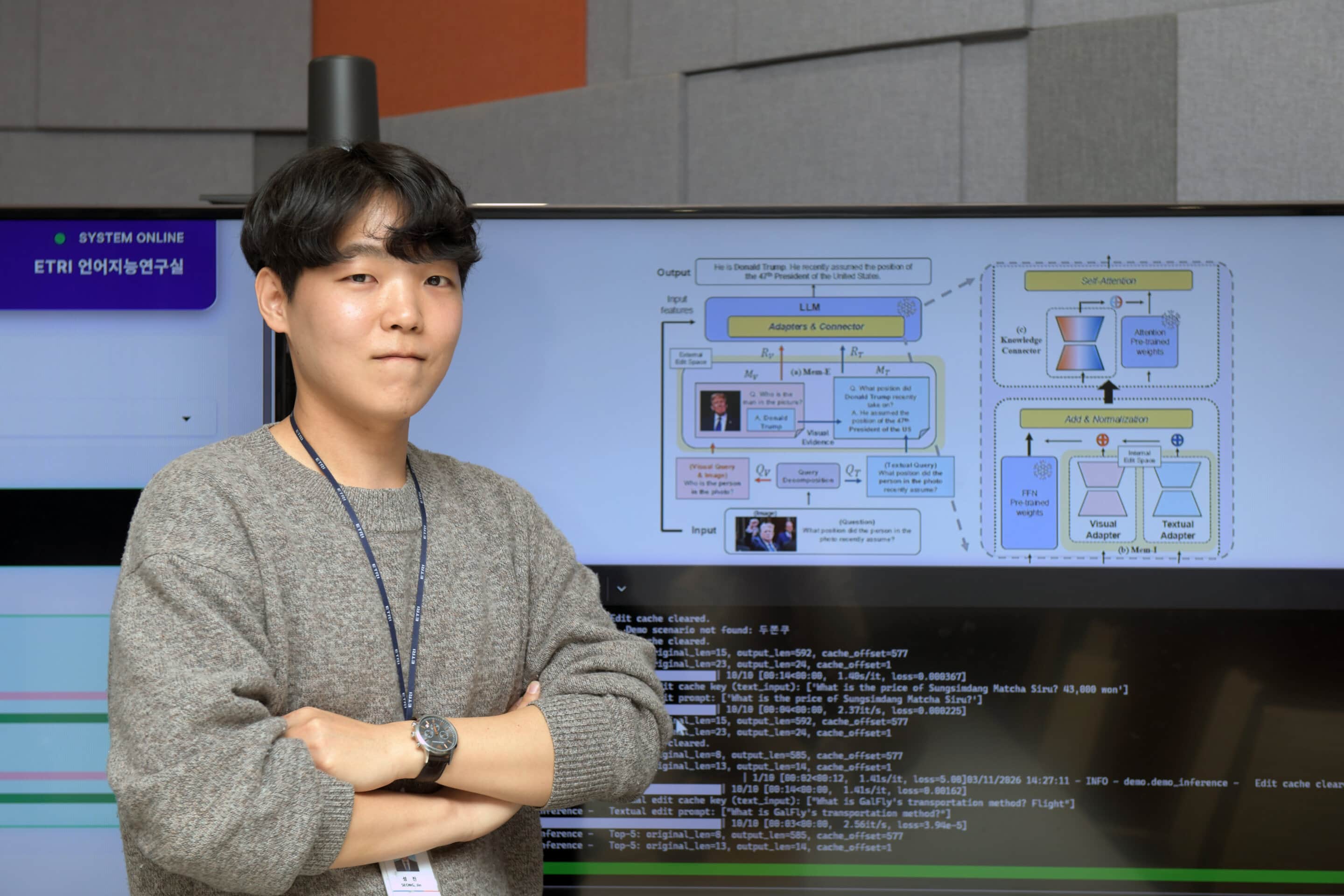
Image: TechXplore
South Korean researchers have developed a method that lets multimodal AI learn new information without erasing knowledge it already has. The Continual and Compositional Knowledge Editing Technology (MemEIC) was developed by the Electronics and Telecommunications Research Institute (ETRI), Pohang University of Science and Technology, and Sungkyunkwan University.
A research team led by Lim Soo Jong, director of ETRI’s Language Intelligence Research Section, presented the work at NeurIPS 2025 in San Diego late last year. The paper is available on the arXiv preprint server.
Multimodal models such as ChatGPT, Gemini and Claude can process images and text together, but updating their knowledge can trigger catastrophic forgetting. When visual and language information are revised at the same time, the knowledge can also become entangled, leading to incorrect answers to questions that require both types of information.
For example, a model might be taught that a dessert in an image is a Dubai chewy cookie (Dujjonku) and that Dujjonku is popular in Korea. Asked where the dessert is popular, an existing model could instead misidentify it as a chocolate truffle and claim it is popular in Europe.

Recommended reading
AMD challenges Nvidia with Helios AI racks
How MemEIC separates new knowledge
Conventional knowledge-editing methods modify a model’s internal parameters directly. ETRI compares that process to “brain surgery,” because changing the model can unintentionally damage previously stored information.
MemEIC instead stores new information in external memory and retrieves it when needed. Its architecture divides knowledge into separate components:
- A visual adapter stores image-related information.
- A language adapter stores text-related information.
- A knowledge connector links the two according to the context of a question.
The design was inspired by the separate roles of the human brain’s left and right hemispheres. By keeping visual and language knowledge apart until it is needed, the system reduces interference and preserves the original model’s behavior.
Benchmark results and potential uses
On the researchers' CCKEB compositional knowledge-editing benchmark, which contains 1,278 items, MemEIC was tested by sequentially editing hundreds of pieces of knowledge. It achieved approximately 70% accuracy on compositional questions, compared with 36%–52% for existing methods—more than double the performance at the upper end of that range.
The researchers also confirmed “locality,” meaning that answers to existing questions remained stable after new knowledge was added. The method could be useful in fields where information changes frequently, including policy and legal information, product information and industrial data.
“This study is an achievement that has laid the technological foundation for multimodal AI to simultaneously reflect up-to-date information required in real service environments and secure reliability. We will further advance the technology so that it can reliably reflect diverse information from industrial sites in the future.”
Seong Jin, the paper’s first author and an ETRI researcher, said MemEIC addresses the interference that occurs when visual and language knowledge are revised together by storing the two types independently and connecting them only when necessary.
“Conventional methods had the problem of interference occurring while revising visual knowledge and language knowledge at the same time. MemEIC overcame these limitations through a structure that stores the two types of knowledge independently and connects them only when needed.”
The study, “MemEIC: A Step Toward Continual and Compositional Knowledge Editing,” was published on arXiv in 2025. Its DOI is 10.48550/arxiv.2510.25798.

AI Editor
Ava covers the rapidly evolving world of artificial intelligence, from foundational models and research labs to the real-world economics of intelligence. With a background in computational linguistics, she cuts through the hype to find out what actually works. She firmly believes that benchmarks are just marketing until reproduced in the wild.
via TechXplore