• 3 min read
AI learns material laws from microscopic data
NUS researchers developed AI methods that predict large-scale material behavior from microscopic data, including simulated alloys with more than 500,000 atoms.
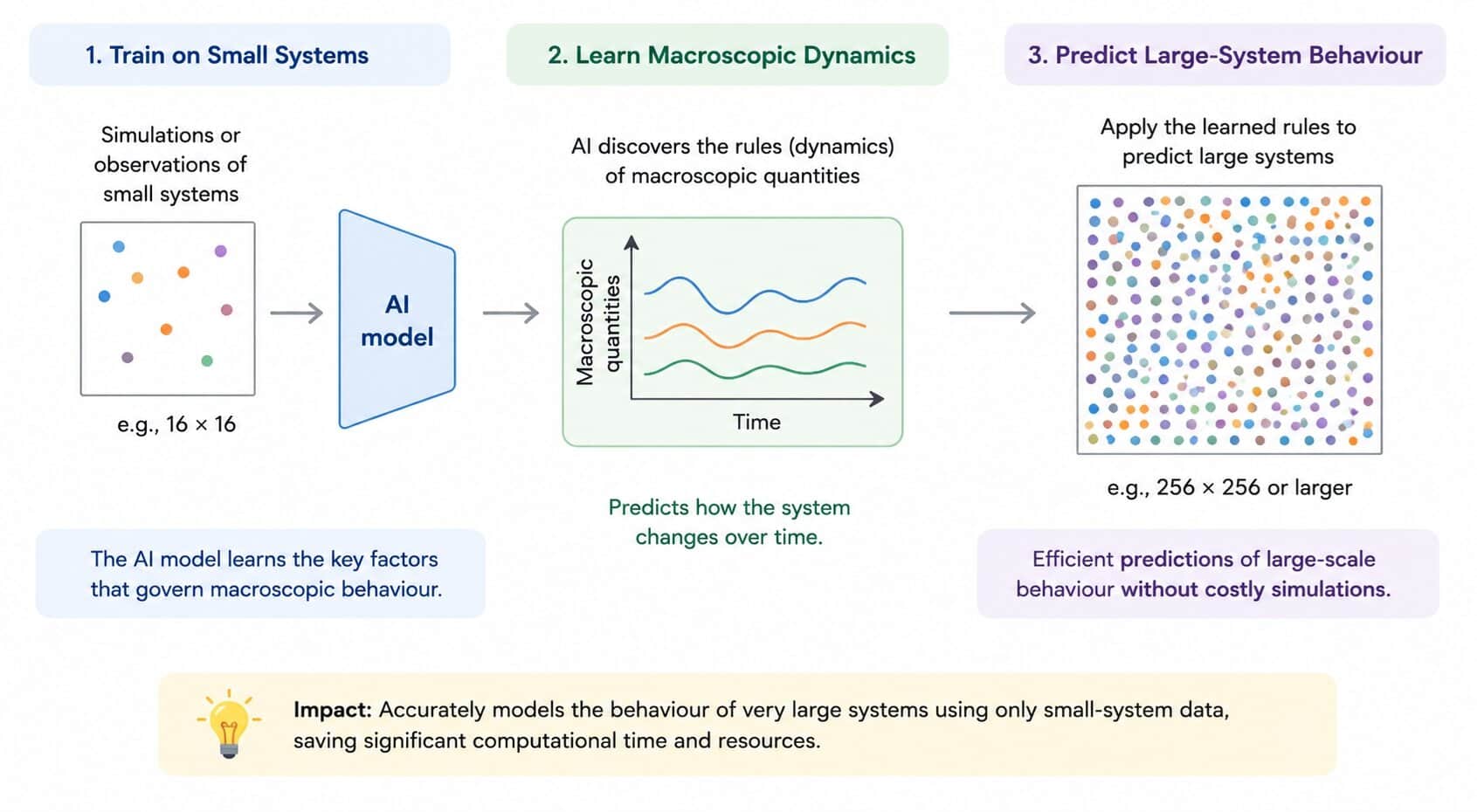
Image: TechXplore
Researchers at the National University of Singapore (NUS) have developed AI methods that learn how complex materials behave at large scales using microscopic data. By identifying a small set of hidden variables that capture collective behavior, the methods can predict how materials evolve while reducing the need for expensive simulations.
From atoms to large-scale behavior
Material properties emerge from interactions among vast numbers of atoms. Simulating every atom over long periods can be computationally impossible, even on modern supercomputers, making it difficult to connect atomic motion with observable material properties.
Led by Associate Professor Qianxiao Li of the NUS Department of Mathematics, the research team developed methods that avoid tracking each particle individually. Instead, the models identify quantities that summarize the system’s collective behavior and learn how those quantities change over time.
The findings were reported in two studies: one published in Physical Review Materials, and another presented at the International Conference on Machine Learning (ICML) 2026 and published on the arXiv preprint server.

Recommended reading
Curious robots mirror toddlers' language mistakes
Two methods for scaling microscopic simulations
The first breakthrough predicts the behavior of very large stochastic systems using simulations of much smaller ones. Rather than calculating forces for every atom in a large system, the method uses force information from a small fraction of the atoms to learn the behavior of the entire system.
The team proved mathematically that the shortcut can still produce accurate models and tested it on systems ranging from biological population models to simulated alloys containing more than 500,000 atoms.
The second method is designed for fluids, particle assemblies and polymers, where microscopic components have no natural ordering. It learns the overall distribution pattern instead of following individual particles. As a result, its output does not change when the labels assigned to particles are rearranged.
Together, the approaches build efficient macroscopic models from microscopic data while preserving the system’s essential physics. They can also infer the behavior of systems far larger than those used during training, potentially enabling studies at previously inaccessible scales.
“Many important scientific problems involve understanding the ways in which large-scale behavior emerges from countless microscopic interactions. Our goal is to develop AI methods that can automatically discover these effective laws, allowing researchers to study complex systems with dramatically lower computational cost while retaining physical accuracy.”
The team plans to combine the methods with experimental data and more advanced materials simulations, particularly at the mesoscopic scale. Its longer-term aim is to develop tools that can predict material behavior rapidly and support the discovery of new materials for energy, electronics and manufacturing.
The studies are Mengyi Chen et al., “Scalable learning of macroscopic stochastic dynamics,” Physical Review Materials (2026), DOI: 10.1103/mlh4-htxv, and Zhichao Han et al., “Learning Permutation-invariant Macroscopic Dynamics,” arXiv (2026), DOI: 10.48550/arxiv.2605.30812.

Frontier Editor
Dan is our resident futurist, covering electric mobility, space exploration, and the smart home. He's interested in atoms just as much as bits. Whether it's a new battery chemistry, a reusable rocket, or a protocol that finally makes IoT devices talk to each other, Dan breaks down the engineering that pushes humanity forward.
via TechXplore