• 4 min read
Curious robots mirror toddlers' language mistakes
OIST researchers gave virtual robots curiosity and saw faster language learning, play-like exploration and toddlers' U-shaped verb mistakes.
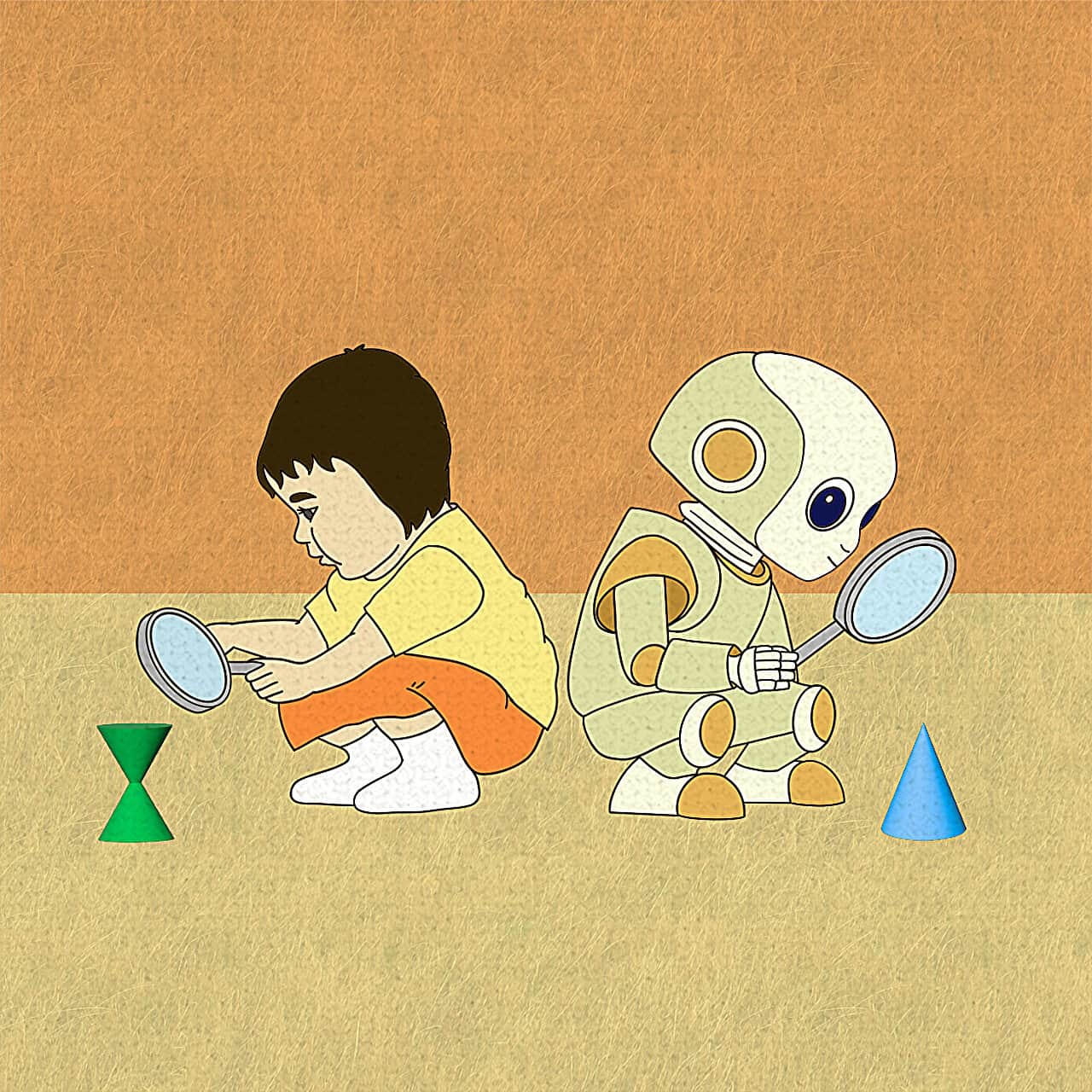
Image: TechXplore
A virtual robot developed by researchers at the Okinawa Institute of Science and Technology (OIST) learned to understand language faster when it was given an internal drive for curiosity. The system also developed play-like behavior and reproduced a pattern of mistakes seen in toddlers learning irregular verbs.
The findings, published in Science Advances, examine whether AI models understand the language they produce. The researchers exposed virtual robots to verb-adjective-object combinations in a physics-simulated environment, where a command voice instructed each task and a feedback voice narrated the robot’s actions.
“The curious robots achieve what appears to be a genuine understanding of language in half the time that their indifferent cousins do. And we were amazed by the play-like behavior and exception-handling performance that emerged independently during training.”
How curiosity changed robot learning
The robots used a predictive coding-inspired Variational Recurrent Neural Network (PV-RNN), an architecture based on theories of how the brain processes information. Unlike large language models, which generate statistically probable responses from vast datasets, PV-RNNs are trained to reduce “free energy” by balancing two goals: accurately predicting reality and minimizing changes to their internal beliefs.
Recommended reading
VR makes people perceive their bodies as larger
The team added reinforcement learning with two rewards:
- An external reward for completing the assigned task.
- An internal reward for curiosity, tied directly to the complexity of updating the robot’s beliefs.
This created a tension between preserving an accurate, stable model of the world and taking actions that produced surprising experiences. Midway through training, curious robots repeatedly experimented with actions unrelated to their assigned tasks, including knocking objects over. The researchers had not instructed them to play, but the behavior helped them generalize across task types.
“We didn’t tell the robot to play around like a child. We told it to learn. And yet, apparently, one activity leads to the other—play-like behavior, reinforced by curiosity, helped the robots understand language faster.”
Diverse language exposure improves generalization
The study builds on the researchers' earlier finding that success on previously unseen language tasks depends on the diversity of sentence constructions encountered during training. In the new experiments, curious robots exposed to 48 combinations achieved a 25% generalization rate, while those exposed to 180 combinations reached 85%.
The robots were evaluated over 60,000 epochs on tasks such as “be near green pillar” and “push left magenta dumbbell.” Curiosity produced the largest gains on complex tasks, which required identifying the correct shape and color, moving toward the object, and pushing it in the specified direction. The chart’s shaded regions represent 99% confidence intervals.
The results also address the “Poverty of the stimulus” problem, presented by Chomsky in 1980. Children acquire complex language despite receiving sparse, incomplete and sometimes erroneous examples. The researchers argue that curiosity combined with a rich and varied linguistic environment may help explain that rapid learning.
Robots reproduce toddlers' U-shaped mistakes
The team was surprised when the robots also reproduced the U-shaped exception-handling curve seen in children learning verb conjugation. Children initially repeat familiar forms such as “the dog ran” and “the boy went.” After learning the general rule of adding “-ed,” they may overgeneralize it, producing errors such as “the dog runned” and “the boy goed.” Performance later improves as they learn the exceptions.
The researchers created a similar challenge by swapping the meanings of two tasks. When the instruction was “watch magenta pillar,” the robot was rewarded for performing the unstated task “be near green pole,” and vice versa. Performance first improved, then declined as the robots learned broader rules, before recovering once they handled the exception.
“The fact that the robots mirrored children’s exception-handling performance came as a complete surprise to us, because there was nothing in the model to specifically address overgeneralization or exception-handling—they seemed to pick this up on their own.”
Unlike large models with trillions of parameters trained on massive datasets, PV-RNNs expose their hidden states, allowing researchers to track predictions and internal plans in real time. That transparency gives the OIST team control over which stimuli attract curiosity and how strongly.
“This abstract environment allows us to study the impact of curiosity within a very convincing model of how humans learn to process language.”
The study, “Curiosity-Driven Development of Action and Language in Robots Through Self-Exploration,” was published in Science Advances in 2026. DOI: 10.1126/sciadv.aee7533.

Frontier Editor
Dan is our resident futurist, covering electric mobility, space exploration, and the smart home. He's interested in atoms just as much as bits. Whether it's a new battery chemistry, a reusable rocket, or a protocol that finally makes IoT devices talk to each other, Dan breaks down the engineering that pushes humanity forward.
via TechXplore