• 3 min read
VR makes people perceive their bodies as larger
A University of Toronto study finds VR makes people perceive their bodies as larger, with the effect lingering after the headset comes off.
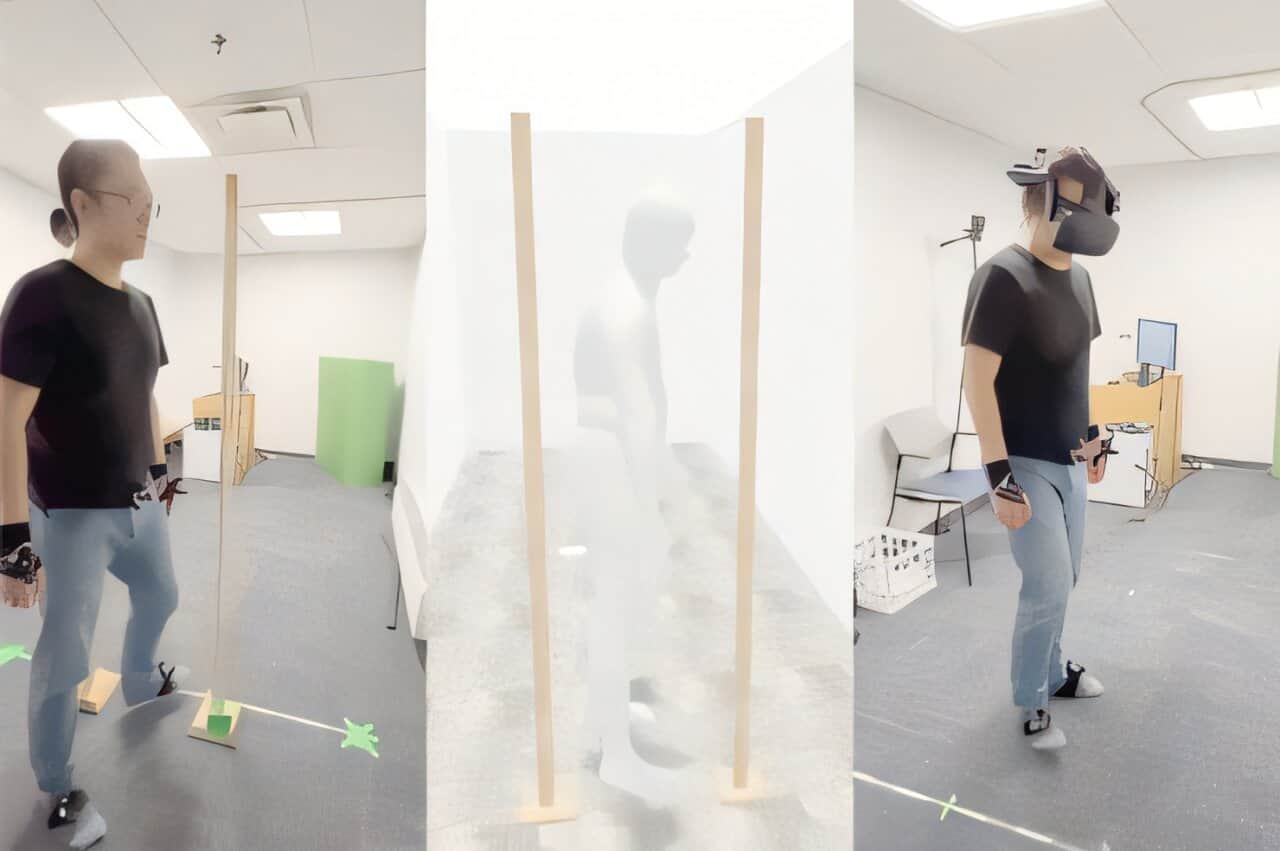
Image: TechXplore
Xiaoye Michael Wang, a research associate at KPE, estimates the minimum distance between two poles he can safely pass through in virtual reality. Credit: University of Toronto
A University of Toronto study finds that people perceive their bodies as larger in virtual reality than in the physical world—and that effect can persist after the headset is removed.
Researchers at the university’s Faculty of Kinesiology & Physical Education (KPE) asked participants to embody a life-sized avatar in a virtual environment designed to match the scale of the real world. They then estimated the minimum gap between two poles that they could pass through without hitting them.
Recommended reading
SpaceX’s Gigabay grows into a Starship factory
The study, recently published in the journal Virtual Reality, found that participants predicted they needed a wider opening in VR than they did outside it. Xiaoye Michael Wang, a KPE research associate and co-author with professors Tim Welsh and Catherine Sabiston, compared the experience to Gulliver’s Travels, in which Gulliver becomes a giant among smaller people.
“It was surprising to find how much larger people seemed to perceive their body in VR. People behaved as though their body had become larger relative to the world around them, even though nothing had actually changed in scale.”
Why VR changes spatial judgments
The distortion continued after participants returned to the physical world. They still judged that they needed slightly wider openings than they had before using VR, suggesting that the headset temporarily recalibrated their sense of the relationship between their bodies and surrounding space.
The researchers identified two main causes. Movement in VR was less precise, which may have encouraged participants to leave extra room. At the same time, the virtual opening appeared narrower than intended, leading them to believe they needed even more space.
Welsh, KPE’s associate dean of research, attributed much of the visual distortion to depth compression caused by the vergence-accommodation conflict. VR headsets provide mismatched depth signals to the visual system, which can make space appear compressed and openings look narrower than they really are.
“Our modeling suggested that a major source of this distortion was depth compression created by the VR headset, known as the vergence-accommodation conflict.”
Implications for training and body image
The findings could affect VR applications in training, education and rehabilitation, where users need to judge distances accurately and move safely. Performance in VR may partly reflect how well a person has adapted to the system’s distortions, and those adaptations may not transfer cleanly to the real world.
Mathematically correcting for VR-specific distortions brought participants' judgments much closer to what their bodies could do at real-world scale. Wang said this points to a path for making VR training more accurate, effective and transferable.
Sabiston also suggested that VR’s ability to shift self-perception could eventually support people dealing with body-related stigma, internalized weight bias or negative body-related emotions. The researchers are interested in whether interacting through a virtual body could change how people perceive and relate to their physical bodies.
The study, “Virtual reality alters perceived functional body size,” was published in Virtual Reality in 2026. DOI: 10.1007/s10055-026-01368-5.

Frontier Editor
Dan is our resident futurist, covering electric mobility, space exploration, and the smart home. He's interested in atoms just as much as bits. Whether it's a new battery chemistry, a reusable rocket, or a protocol that finally makes IoT devices talk to each other, Dan breaks down the engineering that pushes humanity forward.
via TechXplore