• 2 min read
A $100,000 Robot Dog Becomes an All-Terrain Wheelchair
A YouTube blogger converted Unitree’s $100,000 B2-W robot dog into a working wheelchair that climbs stairs and crosses rough terrain.
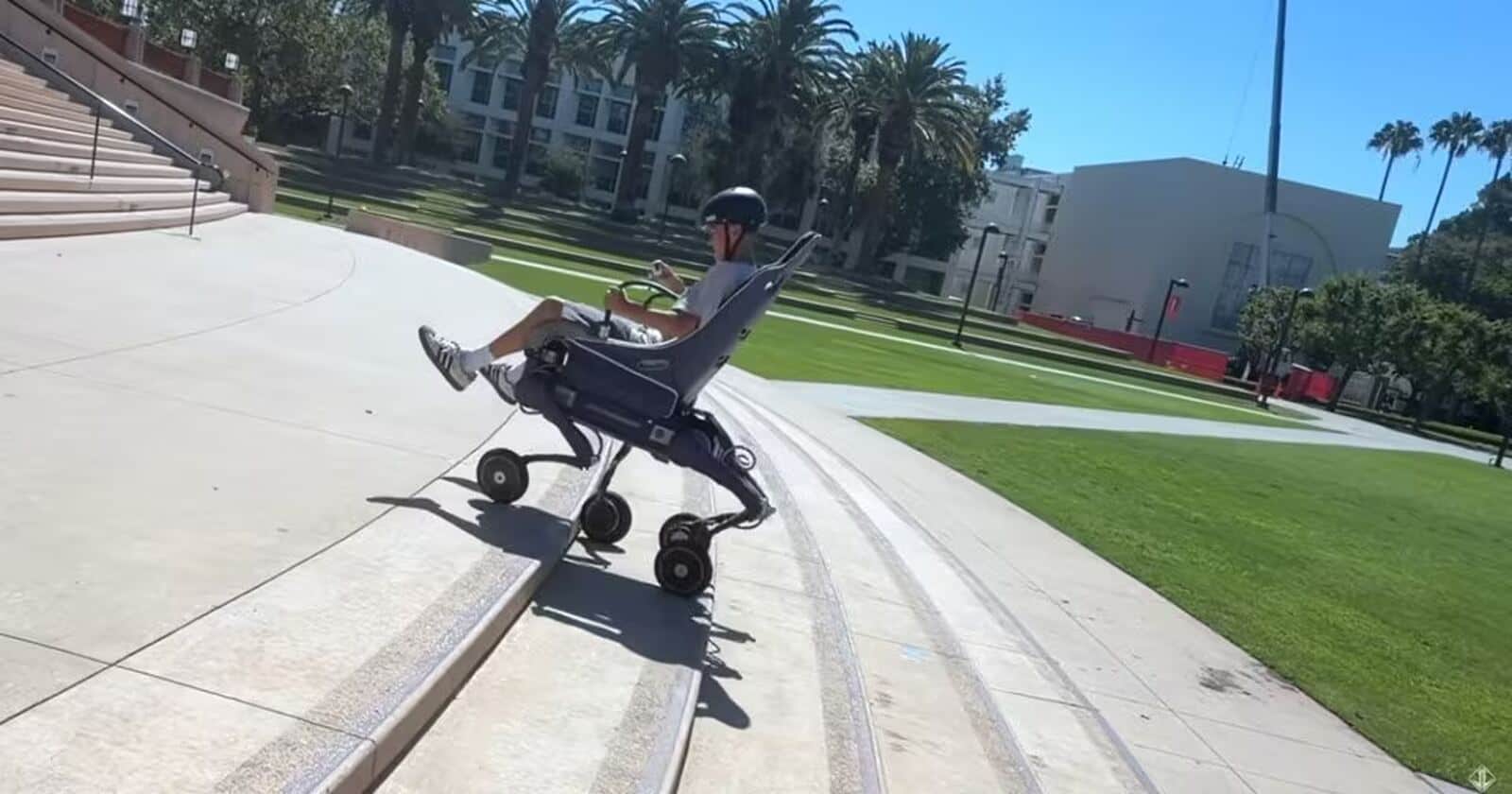
Image: nplus1
YouTube blogger Jake Lazer turned a Unitree B2-W robot dog into an all-terrain wheelchair for his father, who has multiple sclerosis. The result is not a polished exhibition concept: it is a working machine that travels across level floors, climbs stairs and handles terrain where a conventional wheelchair would struggle.
The platform is also far more expensive than a garage-built experiment. The robot dog alone costs $100,000.
Image source: nplus1

Recommended reading
Apple Car Keys may be coming to GWM Tank vehicles
How the Unitree B2-W wheelchair works
The project uses the commercial Unitree B2-W, a robot with wheels integrated into its legs and a payload capacity of up to 120 kilograms. That capacity must cover both the passenger and the demands of maintaining balance when the surface changes suddenly or the rider shifts position.
Lazer said the robot required software modifications. With a passenger on its back, it initially lost balance and tipped over several times during testing. The finished prototype was tested on stairs, rocks and through a ford.
From demonstration robot to mobility device
Unitree itself provided the initial inspiration. In one of the company’s videos, the B2-W carries a person on its back, effectively showing that the robot could support this kind of adaptation.
The concept also follows broader experiments in hybrid mobility. At Japan Mobility Show 2025, Toyota presented a concept for a four-legged robotic chair rather than a wheeled one. Lazer’s version is less of an exhibition mock-up and more of a functioning machine, despite its limitations.
The project shows how commercial robots can become platforms for uses their manufacturers did not originally package as products. As companies continue testing weight capacity, stability and autonomy, similar conversions could develop into a distinct category of mobility equipment.

Frontier Editor
Dan is our resident futurist, covering electric mobility, space exploration, and the smart home. He's interested in atoms just as much as bits. Whether it's a new battery chemistry, a reusable rocket, or a protocol that finally makes IoT devices talk to each other, Dan breaks down the engineering that pushes humanity forward.
via ITzine