• 3 min read
Solar Storms May Be Stronger Than Scientists Thought
A NASA-led study found no evidence of an upper limit on solar-wind energy reaching Earth, raising concerns about extreme storm forecasts.
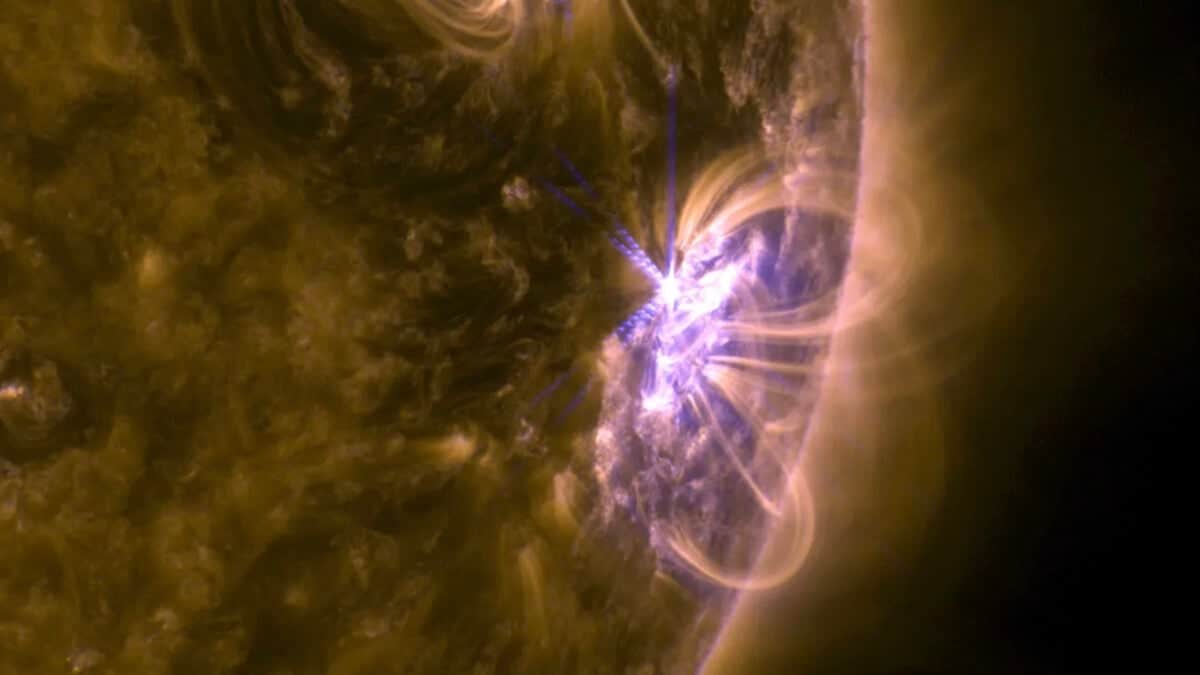
Image: Gizmodo
The most extreme solar storms may be far more powerful than current models suggest. A new study led by space physicists at NASA’s Goddard Space Flight Center in Maryland found no statistical evidence for an upper limit on how much solar-wind energy can reach Earth’s polar ionosphere.
That uncertainty matters because the largest storms, while rare, can disrupt modern infrastructure. The 1859 Carrington Event knocked out telegraph systems across Europe and North America and pushed the Northern Lights as far south as Florida. During the 2003 “Halloween Storms,” solar radiation disrupted a Federal Aviation Administration navigation system for 26 hours and prompted the FAA’s first advisory warning about excessive radiation doses on commercial flights.
The researchers' findings were published in Nature.
Why current solar-storm measurements may mislead
The study identifies a “problem of definition” in how scientists interpret space-weather data. Probes such as NASA’s IMAP operate a little under one million miles from Earth at Lagrange point one (L1), a gravitational balance point where the Sun’s and Earth’s pulls largely cancel out. Their position provides early warning of solar emissions heading toward Earth.

Recommended reading
York Space buys All.Space for $300 million
But readings taken at L1 do not fully capture what happens as high-energy particles travel through space and interact with Earth’s protective magnetosheath. The solar wind is altered by local plasma and magnetic-field conditions before reaching the ionosphere, meaning measurements near L1 can overestimate the solar wind that ultimately strikes Earth.
The researchers compared those readings with more than one million measurements from spacecraft closer to Earth, including NASA’s THEMIS all-sky imager, MMS, and DoubleStar. Their analysis found that the apparent upper limit may have been an artifact of measurement assumptions and statistical interpretation.
“We usually assume the truth may be around its measurement. But probability theory says it leans one way. That’s why space weather risks appear underestimated.”
Extreme events remain difficult to model
The team concluded that “there is currently no statistical evidence to suggest an upper limit to the energy transferred from the solar wind to the polar ionosphere.” In practical terms, scientists cannot yet rule out solar storms substantially more intense than those represented in existing models.
The limited number of extreme events makes the problem harder. Maria Walach, a study coauthor and space physics lecturer at Lancaster University, said researchers have too little data to determine what happens during a “one-in-a-thousand-year” storm.
“Fortunately, these very extreme cases are rare, but this also means we have limited data to work with and only time will tell what happens at the very extreme one-in-a-thousand-year kind of event.”
Walach added that models should account for the possibility that Earth’s response to the solar wind has no upper limit. Earth’s magnetic field protects against many space-weather effects, but extreme storms can cause satellites to fall back to Earth and disrupt communications and GPS signals. Until another major event occurs, the resilience of the magnetosphere under those conditions will remain difficult to predict.

Frontier Editor
Dan is our resident futurist, covering electric mobility, space exploration, and the smart home. He's interested in atoms just as much as bits. Whether it's a new battery chemistry, a reusable rocket, or a protocol that finally makes IoT devices talk to each other, Dan breaks down the engineering that pushes humanity forward.
via Gizmodo