• 3 min read
Solar panels that fold for hail boost output by nearly 40%
TU Graz says its FLAPTrack solar system raises output by nearly 40% on average while folding flat to protect against hail, wind, snow, and dust.
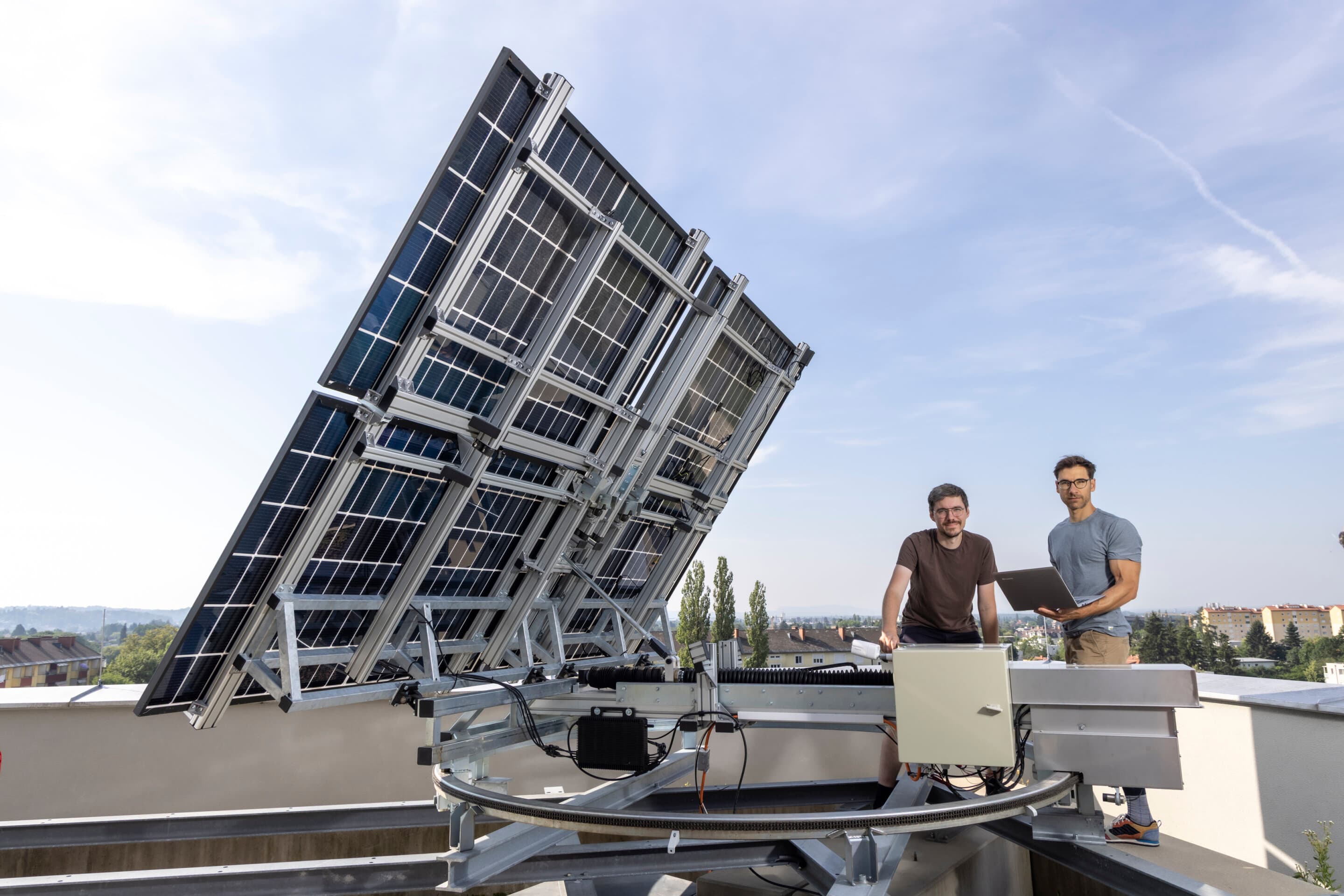
Image: TechXplore
Researchers at Graz University of Technology say they have built a photovoltaic system that does two jobs at once: it tracks the sun for higher output and folds itself into a protected position when bad weather hits.
The system, called FLAPTrack—short for Face-to-Face Lay-Down Anti-Degradation Protection—was developed by a team led by Armin Buchroithner from the Institute of Electrical Measurement and Sensor Systems at TU Graz. A 1.8 kWp demonstration unit is now running on the roof of an office building at the university’s Campus Inffeldgasse. The work was published in Renewable and Sustainable Energy Reviews.
According to TU Graz, FLAPTrack continuously aligns PV modules with the sun both horizontally and vertically. At night, or when storms approach, the modules automatically fold up. That protects them from damage and can also prevent shading from snow and dust.
Recommended reading
NASA’s small aircraft are speeding up flight tests
Buchroithner said the core innovation is a patented linear actuator that handles both sun tracking and folding.
“The system’s key innovation is a patented linear actuator that fulfills two functions: It tracks the sun and folds the panels to a protective stow position.” “This dual function enables us to save on installation and operating costs, thereby improving cost-effectiveness.”
TU Graz says the design delivers an average energy-yield increase of just under 40% compared with fixed PV modules, with gains reaching 56% on some days. The university argues that the bigger financial benefit comes in the morning and evening, when electricity demand is typically higher. In those periods, Buchroithner said, FLAPTrack can produce more than twice as much electricity as conventional systems because it keeps following the sun at low angles.
That effect is especially strong in winter and at higher latitudes, where the sun sits lower in the sky. The folding setup also helps keep modules free of snow, a common source of winter performance losses for standard installations.
The protective mode is aimed at two major solar risks: wind gusts and hail. Buchroithner said hail damage to silicon wafers can create hotspots, which raise internal resistance and drag down the efficiency of the whole module. In FLAPTrack, the system uses data from a local weather station and regional weather forecast models to fold the modules face-to-face and lay them flat on the ground during storms or hail. The backs of the modules can then be shielded with a low-cost hail net.
For long-term testing, the researchers added sensors to measure weather, energy yield, wear and tear, and wind forces. Those data will be used to further improve autonomous operation and cut weight through lightweight design.
The paper is: Armin Buchroithner et al, “The future of PV tracking? An interdisciplinary performance assessment of a novel design with panel protection,” Renewable and Sustainable Energy Reviews (2025). DOI: 10.1016/j.rser.2024.115287.

Frontier Editor
Dan is our resident futurist, covering electric mobility, space exploration, and the smart home. He's interested in atoms just as much as bits. Whether it's a new battery chemistry, a reusable rocket, or a protocol that finally makes IoT devices talk to each other, Dan breaks down the engineering that pushes humanity forward.
via TechXplore