• 2 min read
KAIST robot switches gaits on the fly outdoors
KAIST’s four-legged HOUND uses a single controller to walk, run, jump, and clear ledges across stairs, gaps, and forest trails.
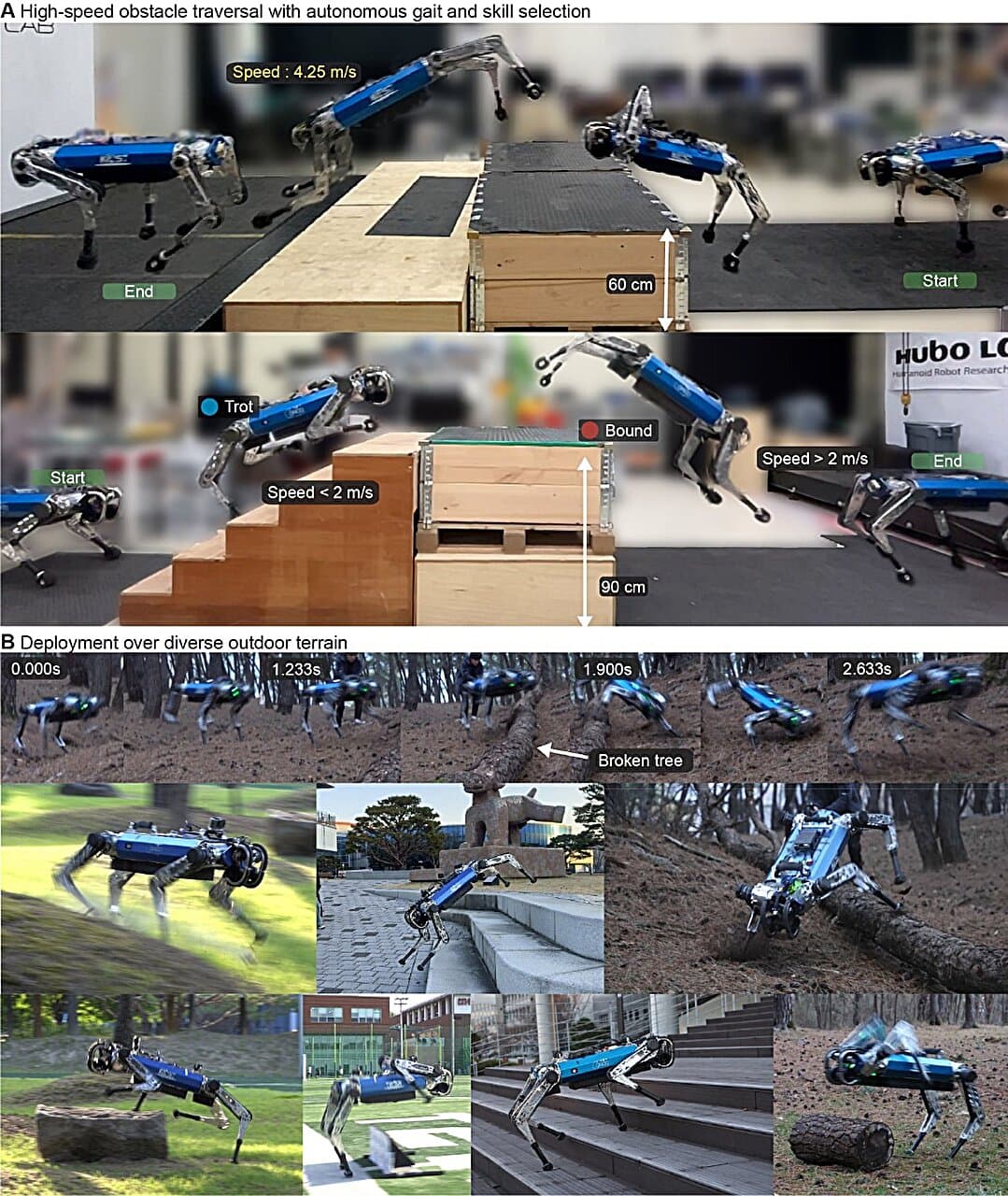
Image: TechXplore
A KAIST research team says it has built a four-legged robot that can decide how to move based on its surroundings, switching in real time between walking, running, jumping, and ledge-clearing. The work, led by Professor Hae-Won Park of The Korea Advanced Institute of Science and Technology (KAIST) Department of Mechanical Engineering, was published in Science Robotics.
The team’s core contribution is a control system called APT-RL, short for Action Pretrained Transformer-based Reinforcement Learning. Instead of relying on separate controllers for different gaits, the system uses a single controller that can select and transition among multiple locomotion skills as terrain changes.
That addresses a longstanding weakness in quadruped robots. While they generally outperform wheeled machines on rough ground, earlier systems often handled only flat terrain or simple obstacles well, and struggled to stay both fast and stable when stairs, ledges, gaps, stepping stones, and branches appeared in sequence.
To train the robot, the researchers generated 15.5 hours of gait data entirely in simulation in just eight minutes. The training used robot dynamics and trajectory optimization to teach baseline movement skills, then added reinforcement learning so the robot could choose and switch gaits for complex three-dimensional terrain.
Recommended reading
NASA’s small aircraft are speeding up flight tests
The system also combines a depth camera with LiDAR, letting the robot estimate its surroundings and target speed in real time before selecting the most suitable movement strategy.
In tests on the team’s robot, KAIST HOUND, the controller was evaluated on an indoor obstacle course and in outdoor settings including KAIST’s campus and forest trails. According to the researchers, the robot remained stable on stairs, grass, slopes, fallen trees, exposed roots, and leaf-covered paths.
In rugged terrain, KAIST HOUND reached a peak instantaneous speed of six meters per second—about 22 kilometers per hour. The experiments showed it could autonomously switch between a trot and a bound depending on terrain and speed demands.
“We expect this to become a foundational technology that expands the potential uses of physical-AI-based walking robots in rugged environments such as disaster sites, defense missions and industrial facility inspections.”
The paper is “Agile perceptive multiskill locomotion for quadrupedal robots in the wild” by Jun-Gill Kang et al, published in Science Robotics (2026). The DOI is 10.1126/scirobotics.adz7397.

Frontier Editor
Dan is our resident futurist, covering electric mobility, space exploration, and the smart home. He's interested in atoms just as much as bits. Whether it's a new battery chemistry, a reusable rocket, or a protocol that finally makes IoT devices talk to each other, Dan breaks down the engineering that pushes humanity forward.
via TechXplore