• 3 min read
Polish Coal Miners Are Training for Wind Jobs
Polish coal miners are retraining for wind-turbine jobs as coal declines, renewable generation expands and energy-transition employment grows.
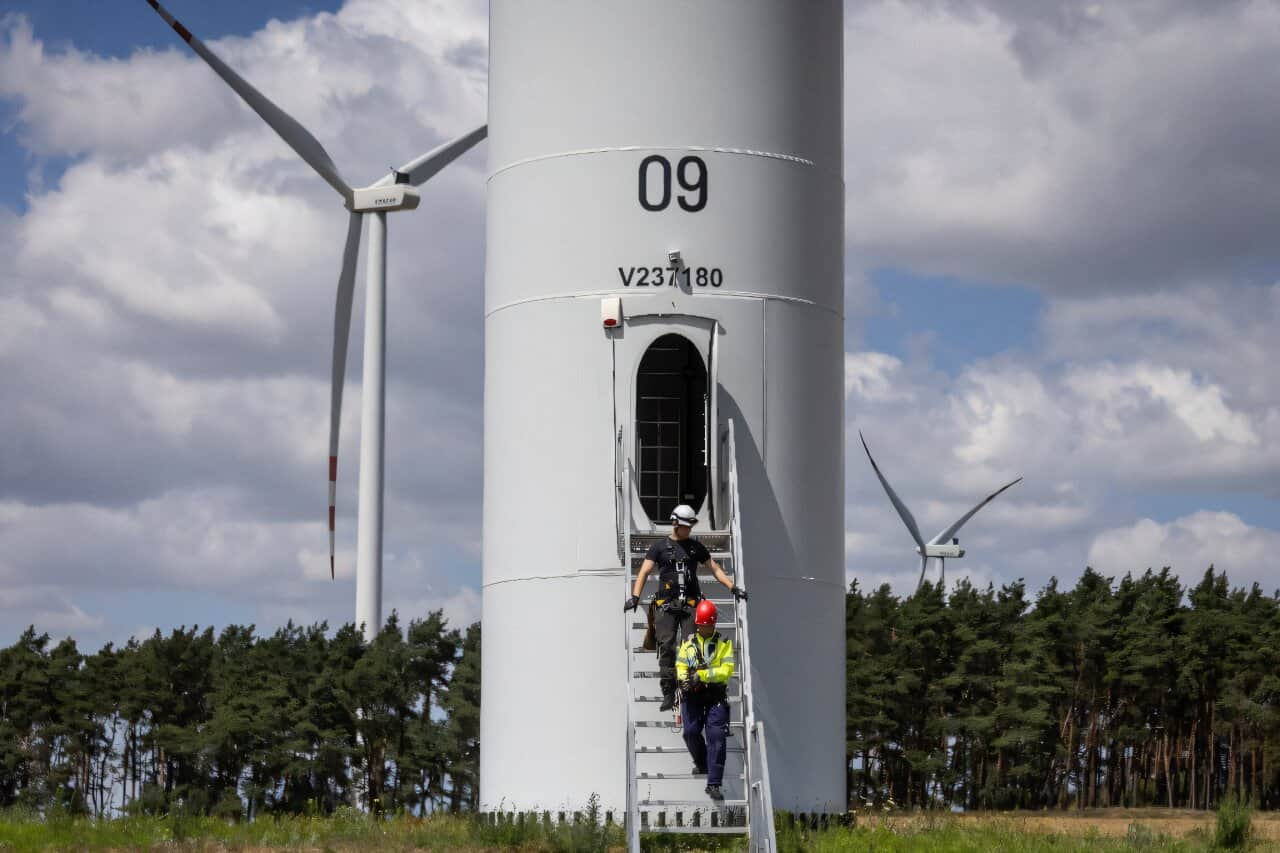
Image: TechXplore
From nearly 100 meters (330 feet) above the ground, coal miner Grzegorz Witek looks across the horizon from a wind turbine. The view is a sharp contrast with the depths of Silesia, Poland’s historic coal-mining region, where he still works after 14 years underground.
Witek traveled with seven other miners to the Gorzyca Wind Farm in western Poland for a retraining program run by EDF Power Solutions Poland. The course is designed to help coal workers move into the wind industry as Poland shifts toward cleaner energy.
“Down there it’s always dark, there’s no outside world, no sun.”
“With wind turbines, we’re moving up to the next level.”
From underground mines to wind farms
Before climbing operational turbines, the participants completed three weeks of training at the Vulcan center in Szczecin, a Baltic port city in northwestern Poland. They learned maintenance, safety procedures and how to evacuate a tower.

Recommended reading
Apple Targets 40 Former Employees at OpenAI
Instructor Michal Rak says the miners' experience in extreme environments gives them an advantage. Workers accustomed to traveling as deep as a kilometer underground are not easily intimidated by being hundreds of meters above the ground. Their awareness of danger also means they take safety seriously, he says.
For 29-year-old Patryk Paja, who has spent three years in the mines, the direction is clear. The tunnels at his mine reach 1,300 meters (4,300 feet) below the surface.
“The mining sector is dying out in Poland and you have to change something in your life.”
“We’re switching to green energy, coal is over.”
Poland’s shrinking coal industry
Coal still generates more than half of Poland’s electricity, the highest share in the European Union. It has also been a major part of Polish identity and a source of political influence for miners.
But the economics are deteriorating. Mining companies recorded losses despite 2.1 billion euros ($2.4 billion) in government support in 2024. Extracting a tonne of coal now costs nearly twice as much as importing it, while domestic production no longer fully meets national demand.
Coal’s share of electricity generation has dropped from around 90% in 2008 to nearly 50% today. Solar and wind now produce more than 30% of the country’s electricity. The government is targeting 50% by 2030 and up to 69% by 2040, while Poland’s first nuclear power plant is expected to begin operating in 2036.
The workforce has fallen from nearly 400,000 people at the end of the communist era to 70,000 today. At the same time, the government projects around 300,000 jobs linked to the energy transition by 2030.
Retraining miners for rising demand
EDF Power Solutions Poland has funded and organized retraining programs for the past three years. Around 50 miners have participated, and all have received job offers.
Demand for the program has grown. Mariusz Tomalik, spokesperson for the Mine Restructuring Company, says the first round drew five miners for 10 places. Over the years, applications have reached four times the number of available slots.
Alicja Chilinska-Zawadzka, president of EDF Power Solutions Poland, says recruitment needs in the wind sector will grow exponentially in the coming years.
Marek Mikolajczyk, 41, spent 10 years in the mines before retraining. He has now worked on wind turbines for a year and a half. The job, he says, is more pleasant, lighter and less dangerous, with higher pay, a better atmosphere and opportunities to travel. Its main drawback is extended separation from his family during assignments; he was speaking from Kosovo, where he was helping install a wind farm.
Paja hopes to make the same transition. “I surely won’t make it to retirement in the mine,” he says. “Instead of going down, we’ll be going up.”

Enterprise Editor
Marcus follows the money. He covers enterprise software, cloud architecture, and the tectonic shifts in Big Tech strategy. He translates dense earnings calls and complex M&A activity into actionable insights about where the industry is actually heading. If a tech giant makes a silent pivot, Marcus is usually the first to notice.
via TechXplore