• 2 min read
BrainCo demos robots controlled by human thoughts
BrainCo demonstrated a headset that lets users control robot arms with their thoughts, alongside a system for collecting embodied AI training data.
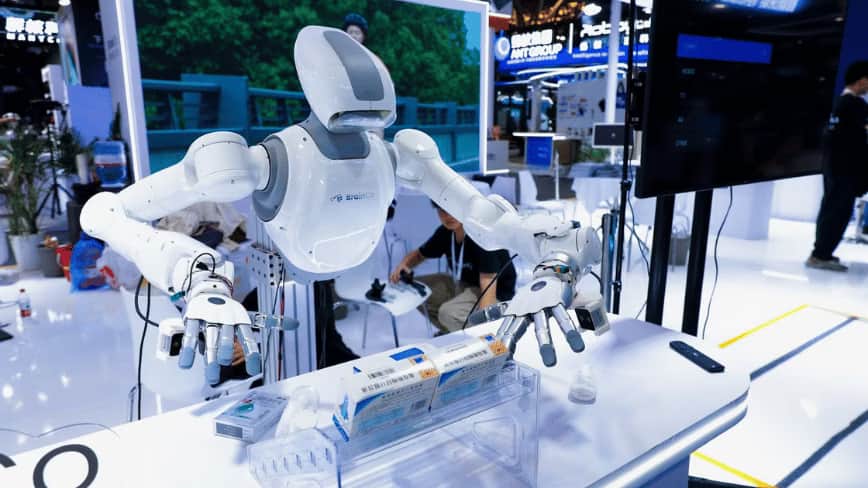
Image: TNW
A lightweight headset, a thought about picking up a cup, and a robot arm that reaches out to do it—BrainCo drew crowds with that demonstration at the World AI Conference (WAIC) in Shanghai, the South China Morning Post reported.
BrainCo calls its system the Brain-Controlled Robot AI Platform, describing it as the world’s first integrated brain-to-robot system. That “world’s first” designation is the company’s own claim.
How BrainCo’s brain-controlled robot platform works
The platform processes a user’s intent in three stages:
- An EEG headset reads the wearer’s brain signals.
- AI decodes those signals into an intention, such as “grab that.”
- The system converts the intention into commands for a robot.
BrainCo said the full loop takes under 200 milliseconds. During the demonstration, a mind-controlled robotic arm grasped a cup and picked up an apple.
The platform is designed to work with off-the-shelf robots, including humanoids, robotic arms, and four-legged “dogs.” That could allow robotics labs to use the system without developing specialized hardware.

Recommended reading
A Humanoid Robot Lost Its Head—and Kept Fighting
BrainCo’s embodied AI data system
BrainCo also presented a tool targeting a major challenge in embodied AI: the shortage of high-quality training data. Tasks such as folding laundry or handling fragile objects require large volumes of demonstrations.
Its Embodied AI Data Collection Solution combines a wheeled, dual-arm rig with a precision glove to capture human demonstrations. The system also records the operator’s EEG, documenting both the movements performed by the hands and the brain signals associated with them. BrainCo says the approach is intended to create a more consistent supply of real-world training data.
Founded in 2015, BrainCo built its business around brain-computer interfaces for medical rehabilitation. Its prosthetic hands and legs read nerve and muscle signals. The robot platform marks the company’s move further into robotics.
“A decade of BCI research has given us the ability to decode what a person intends to do and translate that into machine action,”
The launch comes as companies race to develop brain-computer interfaces and embodied AI, while China is pushing strongly in both areas.

AI Editor
Ava covers the rapidly evolving world of artificial intelligence, from foundational models and research labs to the real-world economics of intelligence. With a background in computational linguistics, she cuts through the hype to find out what actually works. She firmly believes that benchmarks are just marketing until reproduced in the wild.
via TNW