• 5 min read
Project Orion’s Nuclear Rocket Could Reach Saturn
Project Orion promised reusable missions to Mars and the outer planets using thousands of nuclear blasts—but its fallout and weapons risks were immense.
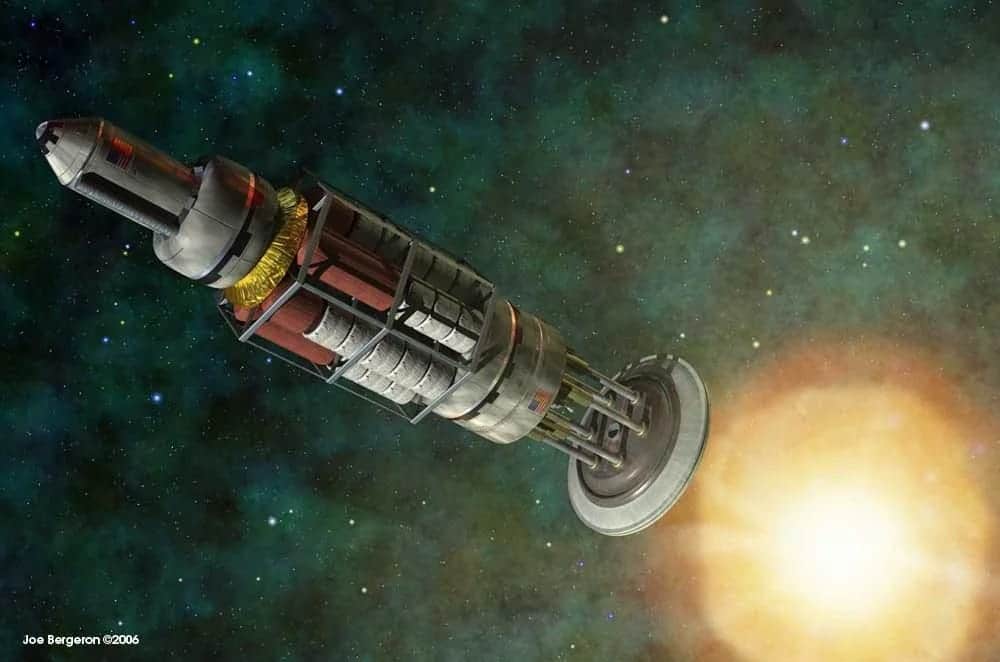
Image: Hacker News
“My purpose, and my belief, is that the bombs that killed and maimed at Hiroshima and Nagasaki shall one day open the skies to man.”
A nuclear pulse rocket sounds like a child’s answer to the problem of reaching Jupiter: eject a continuous stream of nuclear bombs—about one per second—from the rear of the spacecraft, then ride the resulting blast waves on a giant shock absorber. To slow down, turn the vehicle around and detonate bombs in the forward direction.
The concept’s performance is extraordinary. Chemical rockets such as Saturn V and Starship provide enough thrust to leave Earth but are highly inefficient. Ion engines are efficient but produce only a few ounces of thrust. Nuclear pulse propulsion occupies the missing middle: nuclear fuel provides enormous energy density, while thrust is limited mainly by how much acceleration the spacecraft can withstand.
Apollo’s mass ratio was about 540:1. A nuclear pulse rocket could approach 1.5, according to the designs discussed here. That would make it possible to launch from Earth, deliver 4,000 tons of scientists and equipment to Mars, return intact, and refuel for another mission.
Orion’s proposed missions
The mass budget would dwarf today’s orbital infrastructure. The International Space Station weighs about 400 tons, while nuclear pulse propulsion could theoretically support missions such as:
- Soft-landing 5,700 tons on the Moon, compared with 17 tons for Apollo.
- Landing a 1,300-ton payload on Enceladus and returning it to Earth on a three-year round trip.
- Sending a crew of 20 to Callisto or Europa and back in two years, with enough shielding to make Europa survivable.
- Sending 50 people on a 200-day round trip to Mars, including a 30-day surface stay.
- Sending 10,000 tons to medium Earth orbit.
An early 1958 design envisioned carrying 20 people to Enceladus and back within three years—roughly the duration of a conventional Mars mission—and doing so in a fully reusable vehicle launched once from Earth. A practical vehicle would weigh around 4,000 tons, roughly the size of an apartment building. Larger versions could reach cruise-ship or city scale.
Recommended reading
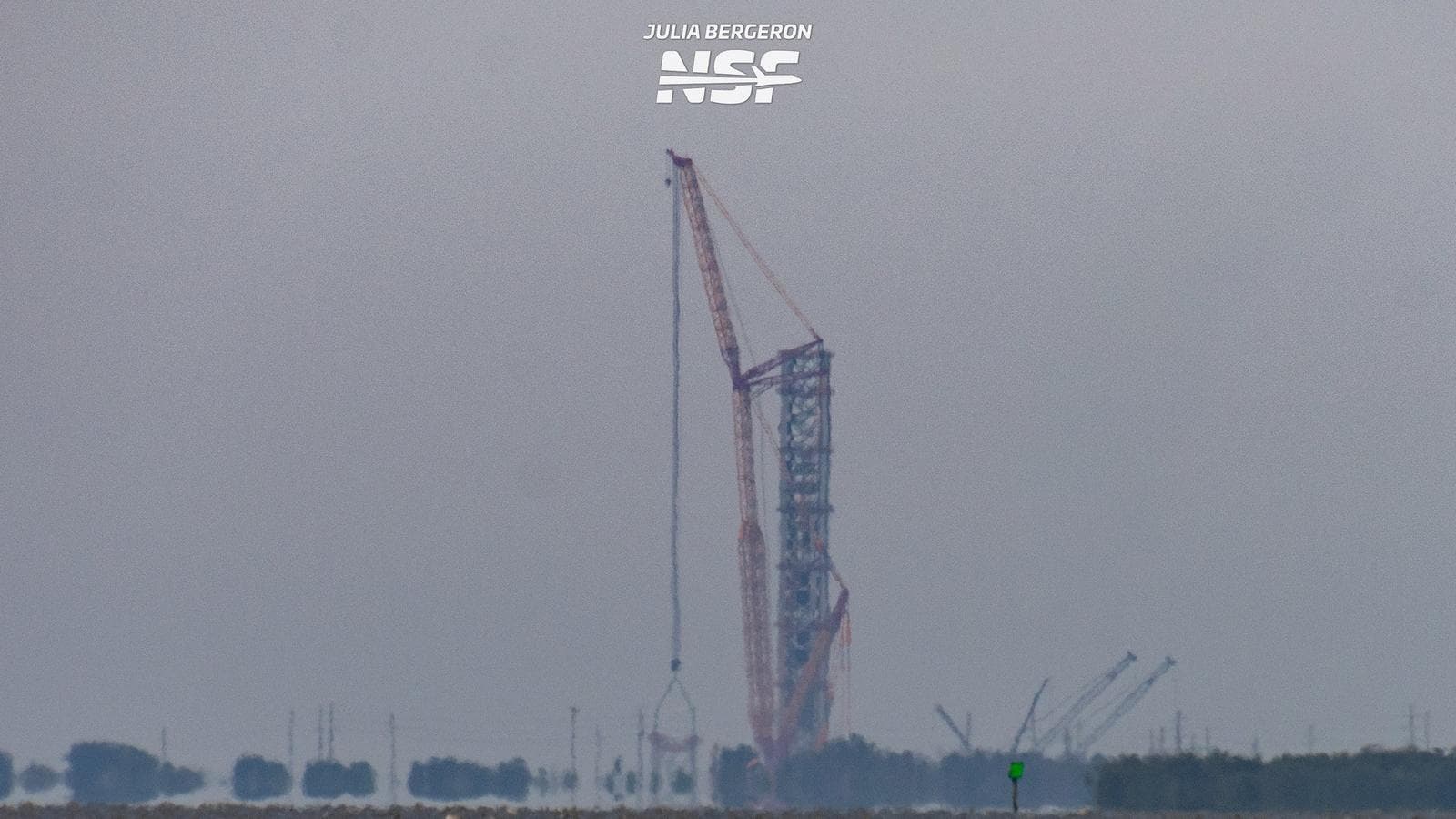
SpaceX installs seventh Mechazilla tower section
How the nuclear pulse engine works
The idea began with mathematician Stanisław Ulam, who sketched a spacecraft propelled by small nuclear explosions while working at Los Alamos in the 1940s. Freeman Dyson and Ted Taylor later developed the concept at General Atomic, securing modest funding after the 1957 Sputnik panic.
Project Orion built and flew a small proof-of-concept vehicle using conventional explosives in 1959. The program came close to a genuine atomic test before funding ended in 1964.
The proposed spacecraft used a broad, flat metal pusher plate connected to the main body by large shock absorbers. Each propulsion cycle would work as follows:
- A 0.1–3 kiloton nuclear bomb detonates about 100 meters behind the plate.
- The blast vaporizes a disk of propellant—potentially ice, metal, or stored waste—and drives the plasma toward the plate.
- The plasma strikes the plate, producing a cannon-like impulse.
- A thin oil layer ablates from the plate, protecting it from the heat.
- Shock absorbers stretch the impact into a human-tolerable acceleration of 2–4 g.
- The plate is recoated with oil and returns to position before the next bomb arrives.
Bombs would detonate once or twice per second, adding about 20 mph to the spacecraft’s speed each time. Roughly 200 bombs would be needed to escape the atmosphere, followed by another 600 to reach a 300-mile circular Earth orbit. A Mars round trip could require about 2,000 detonations, while the plate would spend less than one second in contact with superheated plasma.
The failure modes and fallout problem
Orion’s engineering challenges extended well beyond the explosions. A dud could leave the rebounding pusher plate moving away from the spacecraft, requiring a system to arrest its momentum and a special half-charge to return it to a neutral position. A fizzle, in which the chemical explosives fire without detonating the nuclear core, could be worse: the plate is designed for a uniform plasma wave, not high-speed shrapnel.
Bomb delivery was another major problem. Each device could weigh several hundred pounds and had to reach a point a few hundred meters behind the spacecraft with precise timing. Proposed solutions included angled launch tubes and rockets that curved around the pusher plate before detonating between crossed radar beams. Orion even consulted Coca-Cola about dispensing mechanisms, since vending machines had already solved the problem of reliably delivering identical containers from a rack.
Computing and navigation were also limiting factors. Early designs called for crews of 20–40 partly because astronauts would need to steer with graph paper and sextants. Engineers also had to sequence bombs with the correct yields during launch. Plasma turbulence around the pusher plate was another question that atomic testing would have been needed to answer in 1959, although computers could simulate it today.
Launching Orion would require dozens of conventional rockets unless it were launched from the ground using nuclear explosions. Even in orbit, fission products could become trapped in Earth’s magnetic field and eventually return. The roughly 200 explosions required to reach orbit would produce fallout equivalent to a 10-megaton air burst.
The vehicle would also place one of the largest nuclear arsenals on Earth under the pilot’s control. A guidance failure, a redirected bomb, a launch accident, or a misfire could spread plutonium and leave an almost-functional nuclear weapon somewhere along the flight path. Remote Pacific launch sites could reduce some risks, but not the fallout problem—or the proliferation danger of building thousands of compact, low-yield nuclear charges.

Frontier Editor
Dan is our resident futurist, covering electric mobility, space exploration, and the smart home. He's interested in atoms just as much as bits. Whether it's a new battery chemistry, a reusable rocket, or a protocol that finally makes IoT devices talk to each other, Dan breaks down the engineering that pushes humanity forward.
via Hacker News