• 2 min read
Battery design gets a boost from atomic-scale ML
LLNL researchers used physics-informed machine learning to model sodium-ion anodes and lithium-ion electrolytes at atomic scale.
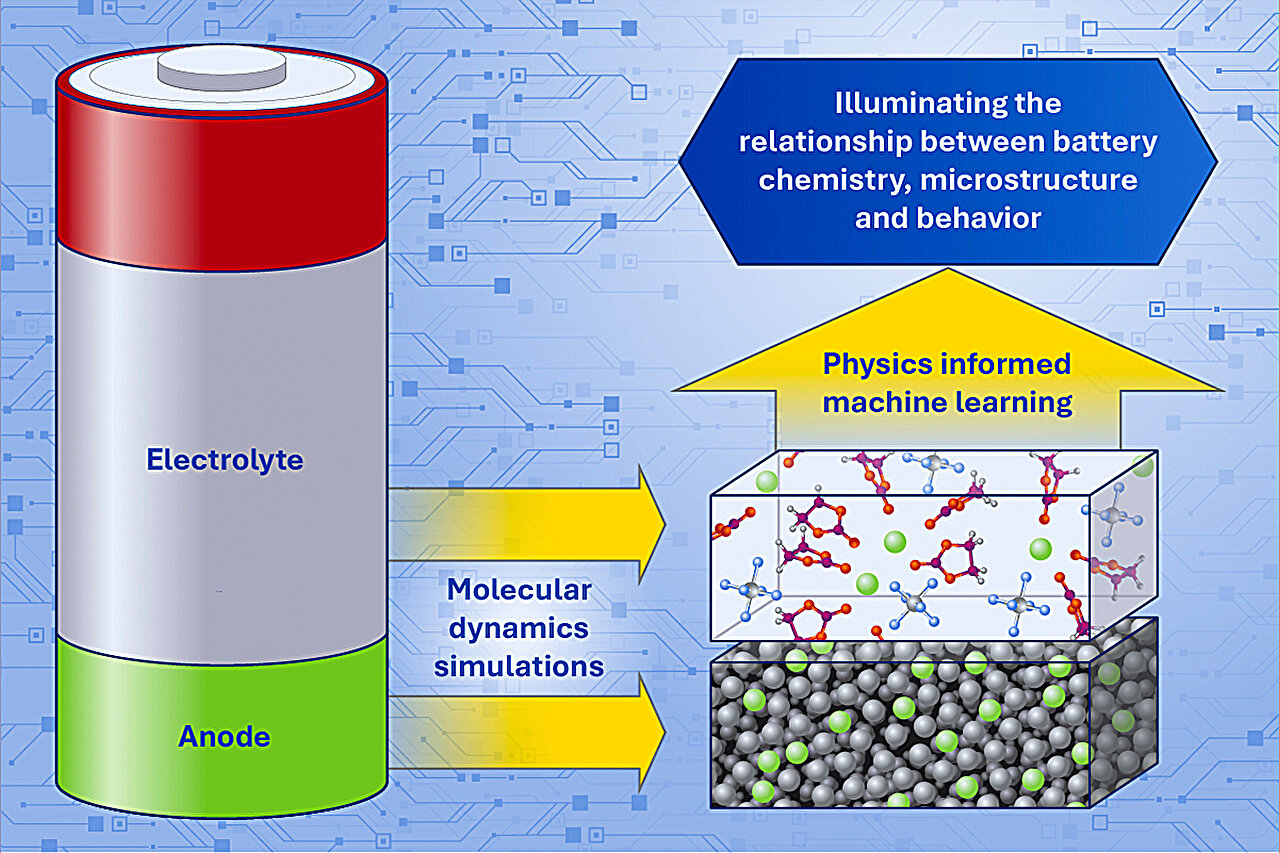
Image: TechXplore
Lawrence Livermore National Laboratory researchers say physics-informed machine learning can turn one of battery science’s biggest problems—atomic-scale disorder—into a design tool.
In two 2026 papers, the team combined molecular dynamics simulations with machine learning to study hard carbon anodes for sodium-ion batteries and liquid electrolytes for lithium-ion batteries. According to LLNL scientist Liwen (Sabrina) Wan, the work shows that structural complexity is not just a barrier to understanding but potentially an advantage for designing next-generation energy-storage materials.
Hard carbon in sodium-ion batteries
The first study, published in Energy Storage Materials, focused on hard carbon, the most commercially mature anode material for sodium-ion batteries. Sodium’s abundance and domestic availability make the chemistry attractive for U.S. supply-chain resilience, but hard carbon is difficult to engineer because it consists of disordered, graphene-like sheets filled with pores and voids.
LLNL used its high-performance computing systems to simulate how atoms in the material move over time. That produced what author Nikhil Rampal described as an atom-by-atom movie of sodium ions diffusing, clustering, or getting trapped inside the carbon. The team then trained a machine learning model on those simulations, enabling larger, longer, and more accurate runs at lower cost.

Recommended reading
Luch-5 satellites kept Soyuz MS-29 linked to the ISS
The model classified sodium-ion motion into eight different regimes tied to the ions' interactions with hard carbon. The researchers found that as carbon density and sodium loading rise, ions can cluster or become trapped in nanopores, affecting rate capability and thermal safety. LLNL says the result is a quantitative map linking microstructure to ion transport, with practical guidance for improving hard carbon performance.
Electrolyte screening for lithium-ion batteries
The second paper, published in EES Batteries, applied the same approach to lithium-ion battery electrolytes. Electrolyte design is notoriously difficult because the combinations of solvents, salts, additives, and concentrations are too numerous to test exhaustively.
Instead of relying on text-based molecular representations, the LLNL team generated realistic 3D molecular configurations with molecular dynamics and fed them into a machine learning model that predicted the statistical stability of each configuration. The researchers argue that electrochemical stability depends on the full molecular ensemble, not just a list of ingredients.
Rampal said changing a lithium salt produced a 57% wider stability window, driven by how the anion arranged itself around the lithium ion—an effect conventional text-based encoders would miss.
Wan said the broader workflow could become a high-throughput screening platform for battery materials across lithium, sodium, and multivalent chemistries.
The two papers are:
- Nikhil Rampal et al, Physics-informed machine learning exploration of Na storage mechanisms in disordered carbon, Energy Storage Materials (2026), DOI: 10.1016/j.ensm.2026.104967
- Srikant Sagireddy et al, Integrated machine learning-molecular dynamics framework for electrolyte property prediction, EES Batteries (2026), DOI: 10.1039/d6eb00024j

Frontier Editor
Dan is our resident futurist, covering electric mobility, space exploration, and the smart home. He's interested in atoms just as much as bits. Whether it's a new battery chemistry, a reusable rocket, or a protocol that finally makes IoT devices talk to each other, Dan breaks down the engineering that pushes humanity forward.
via TechXplore