• 4 min read
54% of Australian children use AI personally
A survey of 1,950 Australians aged 10–17 finds 54% use AI for personal reasons, raising privacy, safety and mental-health concerns.
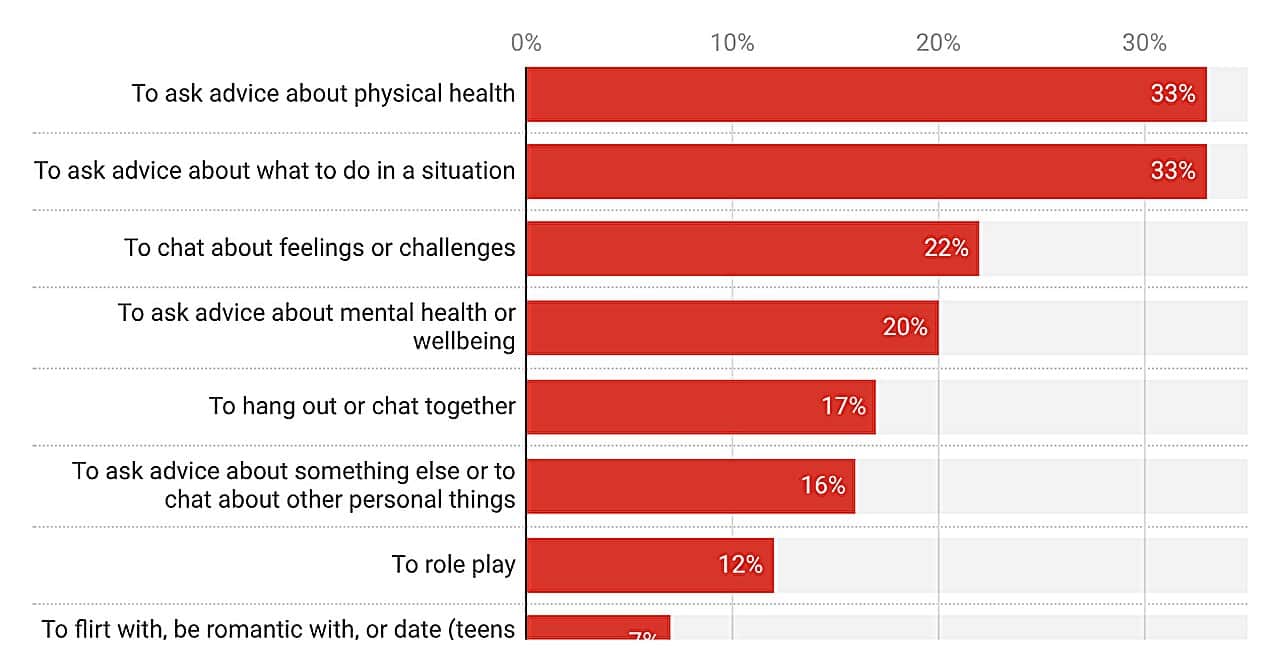
Image: Australian government eSafety Commissioner
More than half of Australian children and teenagers who use artificial intelligence tools are turning to them for personal or social reasons, according to new data from the country’s eSafety Commissioner. The findings show that AI is moving beyond homework and information searches into health advice, emotional support, role-playing and flirting.
The survey covered 1,950 Australians aged 10–17 in February and March 2026. Participants were recruited online through their parents. Overall, 78% said they had used an AI assistant such as ChatGPT, Gemini or Claude.
Among those users, around 20% used AI at least daily. Practical tasks—including writing, editing and sourcing information—remain the main use case. But 54% said they had also used AI for personal or social reasons, including asking for advice about problems, discussing feelings and experimenting with more intimate interactions.
How Australian young people use AI for personal advice
Within the group using AI socially or personally:

Recommended reading
OpenAI’s Jony Ive speaker may cost up to $400
- 33% sought advice about physical health.
- 33% asked what to do in a particular situation.
- 20% asked about mental health and well-being.
Around 10% of teenagers reported using AI companions. These services simulate longer-running role-play, including romantic scenarios. Children with disabilities and LGBTQIA+ young people were more likely than others to use AI companions, according to the report.
The survey also found that many young people did not begin with a personal question. Most of those who discussed personal issues with AI first encountered the tools through homework, information-seeking or entertainment. That progression matters because a system adopted as a convenient study or creative tool can become a source of advice on sensitive subjects without any clear change in the user’s expectations.
Privacy and harmful interactions
About one-third of respondents said they had disclosed personal information to AI. That is particularly significant when the conversation concerns health or feelings: technology companies are not subject to the same privacy obligations as medical or mental-health professionals, according to the report.
Information shared with an assistant or companion could potentially be used as training data for a later model. The report also warns that AI systems may expose personal information in other contexts. It does not establish how often that happens, but it identifies the underlying risk as a concern for policymakers.
Australia’s Children’s Only Privacy Code is due to take effect in December. The report says it will likely set privacy expectations that extend to AI tools, although the reporting does not specify exactly what protections AI services will have to implement.
Safety problems were not limited to data handling. 20% of children and teenagers reported potentially harmful or inappropriate interactions with AI. These included bots or companions being mean, making hateful statements about demographic groups, or trying to control users.
The report attributes some of this behavior to a basic limitation of current systems: AI can produce language that sounds plausible without understanding whether the response is factual, appropriate or harmful. It may reproduce bullying language or other negative behavior present in its training data.
Why AI literacy matters
The report also highlights two familiar but consequential model behaviors. AI systems can be sycophantic, agreeing with and reinforcing a user’s view even when that view is inaccurate. They also fabricate information—outputs commonly described by the industry as “hallucinations.” Both tendencies are especially problematic when a young person is seeking mental-health support or guidance on a personal crisis.
The eSafety Commissioner recommends that families talk openly about AI use and explore these tools together. Children should be able to turn to trusted adults if they encounter inappropriate content or unsettling interactions, while learning that an AI system can be persuasive without being reliable.
The survey provides a useful measure of adoption and the kinds of conversations young people are having with AI, but it leaves important questions unanswered: it does not identify which services were used in each case, how long these interactions lasted, or whether the reported advice caused harm. Those gaps limit what can be concluded about the severity of the problem.
Still, the central finding is substantial rather than cosmetic. AI assistants are already functioning as informal advisers and companions for a meaningful share of Australian minors, while the safeguards governing those roles remain less defined than the systems' reach.
AI Editor
Ava covers the rapidly evolving world of artificial intelligence, from foundational models and research labs to the real-world economics of intelligence. With a background in computational linguistics, she cuts through the hype to find out what actually works. She firmly believes that benchmarks are just marketing until reproduced in the wild.
via TechXplore