• 2 min read
Acrab’s mini PC targets Nvidia’s $5,000 AI system
Acrab’s Agent Box targets 100-billion-parameter models locally, claiming near-DGX Spark performance at roughly one-fifth the cost.
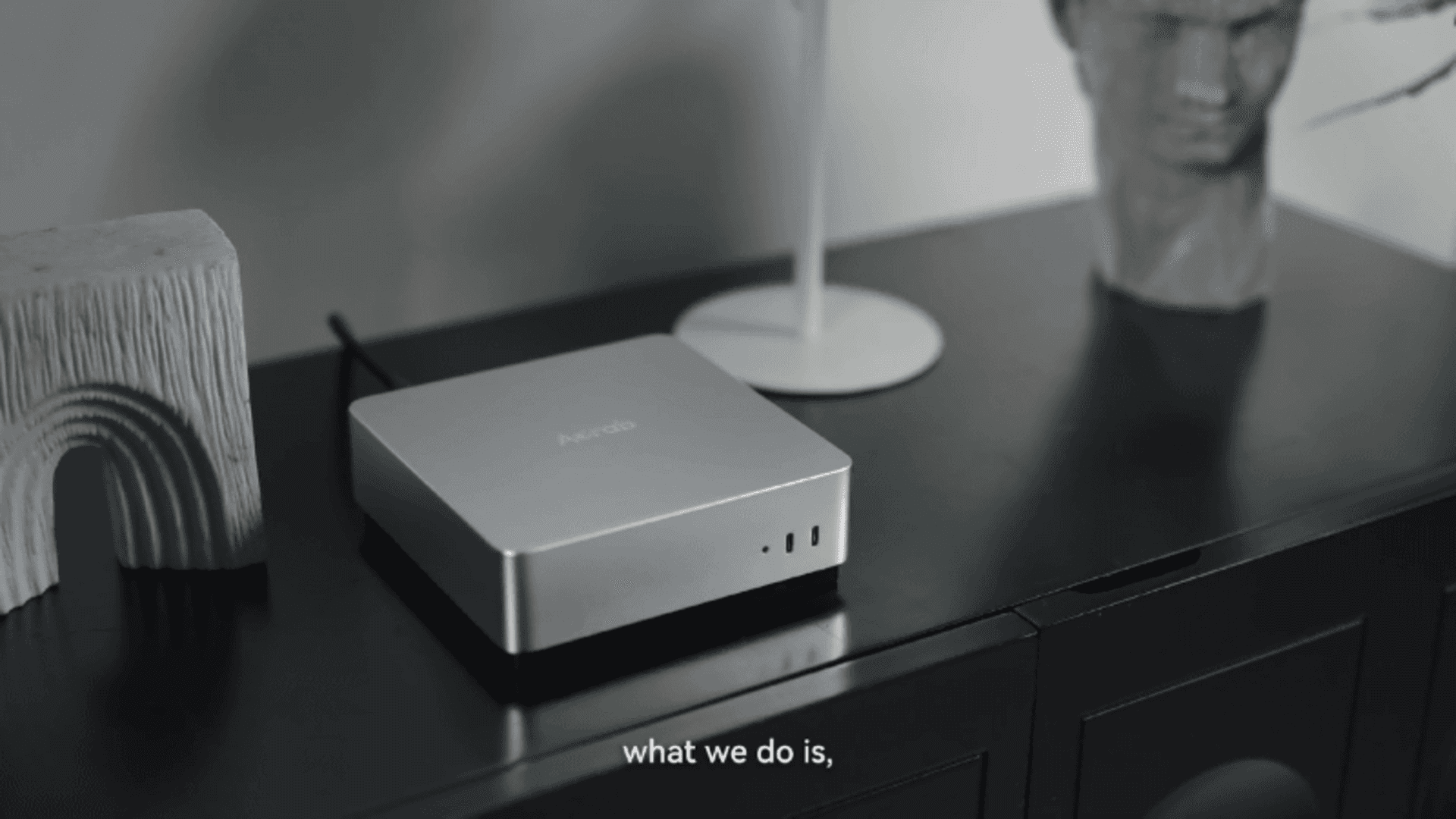
Image: TechRadar
Singapore-based startup Acrab has introduced the Agent Box, a mini PC designed to run language models with up to 100 billion parameters entirely on local hardware. The company says it delivers performance close to Nvidia’s $5,000 DGX Spark, while cutting costs to roughly one-fifth and halving power consumption.
Acrab has not disclosed an exact retail price or release date.
G≡LIX 1 hardware for local inference
The system’s proprietary G≡LIX 1 chip is manufactured on a 5nm process and combines:
- A 20-core Arm CPU
- A GPU rated at 3 TFLOPS
- A multicore neural processing unit tuned for large language model inference
- 273GB/s of high-bandwidth unified memory
- An 8MB L1 cache and 768GB/s L2 cache
Acrab claims the processor reaches 700 TOPS while remaining compact enough for desktop use. Its neural processing unit is balanced with a general-purpose compute unit, while VAE vector acceleration reportedly improves attention processing by up to three times.
The system-on-chip also integrates a video DSP cluster, camera-input subsystems, and a high-resolution display engine. In internal testing, Agent Box reached a prefill rate of 1,416.8 tokens per second using a Gemma 26B A4B configuration with a 40K KV cache and 10K-token input. Acrab compared that with 188.9 tokens per second on an Apple Mac Mini M4 Pro, claiming a 7.5x improvement over conventional consumer hardware.

Recommended reading
Minnesota’s nudification ban survives xAI challenge
“Generative AI helped people find answers. Agentic AI will help them get things done.”
Software platform and expansion plans
Agent Box is intended to ship as more than a hardware platform. Acrab says its software stack includes AI runtimes, developer toolchains, operating-system capabilities, reference designs, and orchestration software for autonomous agents.
Company demonstrations showed voice commands creating and printing 3D models, operating robotic vacuum cleaners, and controlling connected devices such as smart lights, smart air conditioners, and smart locks.
Acrab says local inference can reduce token costs, keep sensitive information on the device, maintain functionality during limited internet connectivity, and provide persistent memory for personalized assistants. It plans to extend the platform into AI NAS products, industrial and service robots, and smart vehicles through hardware-manufacturer partnerships.
Acrab has disclosed limited corporate information. Copyright notices accompanying the announcement reference CATL, described as the world’s largest electric vehicle battery manufacturer, but the source does not independently confirm the nature of that relationship.
“Our goal is to give device makers and developers the foundation to bring agentic intelligence into many different products and environments,” Dr. Phua said. “Agent Box demonstrates what the technology can do today, while GΞLIX 1 and our full-stack platform are designed to support a much broader ecosystem of devices and applications.”
AI Editor
Ava covers the rapidly evolving world of artificial intelligence, from foundational models and research labs to the real-world economics of intelligence. With a background in computational linguistics, she cuts through the hype to find out what actually works. She firmly believes that benchmarks are just marketing until reproduced in the wild.
via TechRadar