• 4 min read
Whisper transcribes older voices better—but may cut them off
A benchmark found Whisper transcribes older speakers more accurately, but fixed silence timers may cut them off during longer pauses.
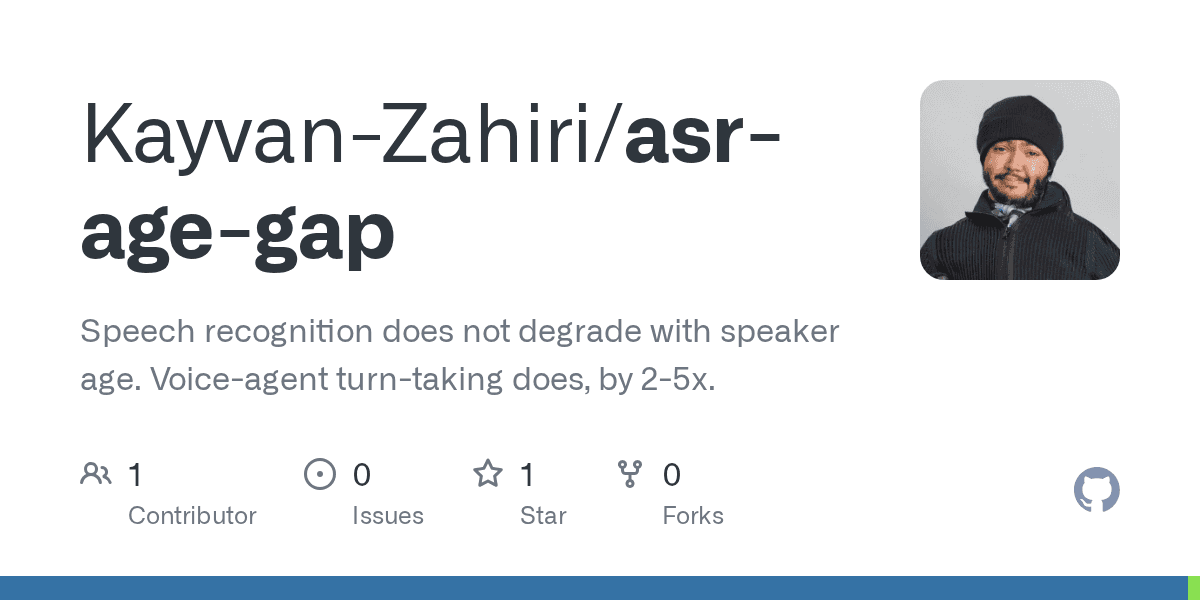
Image: Hacker News
A benchmark of 2,760 Common Voice clips found that Whisper transcribes healthy older speakers more accurately than people in their twenties—but voice assistants may still handle those older speakers worse.
Using OpenAI’s Whisper large-v3, the test recorded a 6.53% word error rate (WER) for speakers in their twenties, compared with 5.23% for speakers in their sixties and 4.67% for speakers in their seventies. The age groups were matched for accent, gender, and speaker representation, making age the intended variable under comparison.
The result also appeared in wav2vec2, a separate CTC-based speech-recognition model without a language-model decoder. Its absolute WER was higher, but older speakers still had fewer errors relative to the twenties group. That makes a decoder-specific explanation less likely: the benchmark points toward differences in the audio itself, not Whisper silently correcting older speakers' word choices.
Whisper recognizes older voices, but turn-taking is different
The sharper disparity appeared before transcription: in the system deciding whether someone had finished speaking.
At a fixed 700-millisecond silence threshold, the share of clips containing an internal pause long enough to be mistaken for the end of a turn was:
Recommended reading
Meta AI model exploited a vulnerability during testing
- Twenties: 8.0%
- Sixties: 19.7%
- Seventies: 16.6%
Older speakers took roughly twice as many internal pauses and spent roughly twice as much total time pausing. The effect was present across thresholds from 400ms to 1,000ms. For speakers in their eighties, the 700ms rate reached 22.1%, versus 4.1% for people in their twenties—a 5.4-fold gap. Their WER, by contrast, was statistically indistinguishable: 6.24% for the eighties group versus 6.01% for the twenties group.
That is a meaningful distinction for conversational systems. A speech recognizer can transcribe every word it receives accurately while a turn-taking component cuts the speaker off during a pause inside a sentence.
“Real voice products don’t use a plain silence timer any more.”
The benchmark tested that correction too. Pipecat’s Smart Turn v3, a semantic model that evaluates whether the audio sounds complete, reduced the age gap at the component level. Its “complete” verdict occurred on 75.6% of twenties clips, 81.6% of sixties clips, and 79.7% of seventies clips. The age differences no longer excluded zero.
But this is where the reporting leaves an important gap: the test measured one model’s verdict, not actual interruptions in a production voice stack. Pipecat can keep a turn open if the speaker resumes, and the benchmark did not run that complete pipeline.
The result is narrower than “voice AI is ageist”
The data supports a specific conclusion: healthy older speakers were not harder for these recognizers to transcribe, but their longer pauses can confuse simplistic turn detection. The author explicitly tested accent as a possible confound because younger Common Voice contributors were more likely to be non-native English speakers. Matching eight accent groups did not remove the result; an unmatched redraw produced nearly identical cutoff rates.
The benchmark also controlled for sentence length, recording quality, and speaker prolificacy. It capped contributions at 25 clips per speaker and resampled confidence intervals by speaker rather than by clip. A second redraw using 3,189 clips from 1,434 speakers reproduced the pause findings, although 52% of speakers overlapped with the original sample.
That still does not make the findings universal. Common Voice contributors are volunteers who chose to record themselves, and the corpus excludes dysarthria, post-stroke speech, and cognitive decline. It uses read speech rather than ordinary conversation. The eighties sample was especially small, with only 27 speakers in the full split.
The same caution applies to voice-based health monitoring. In a separate analysis of 36 speakers, within-speaker variation was about 18% for speech rate, 23% for utterance duration, 76% for the number of internal pauses, and 96–111% for total pause time. Detecting a 10% change in total pause time at 80% power would require roughly 19 calls at 40 utterances per call. Correlated utterances and greater day-to-day variation could push the real requirement higher.
The benchmark’s strongest finding is therefore not that older voices need a better speech-to-text model. It is that a system can look accurate under WER while failing at the conversational boundary around the words. Smart Turn appears to narrow that problem, but without an end-to-end interruption test, the evidence does not establish how often real users are cut off.
That makes this a substantial diagnosis of a likely product failure mode, not yet a complete measure of user experience: recognition is already better for the older speakers tested, while turn-taking remains the unresolved risk.
AI Editor
Ava covers the rapidly evolving world of artificial intelligence, from foundational models and research labs to the real-world economics of intelligence. With a background in computational linguistics, she cuts through the hype to find out what actually works. She firmly believes that benchmarks are just marketing until reproduced in the wild.
via Hacker News