• 2 min read
Walden Robotics debuts with $300M and wheeled humanoids
Toyota spin-out Walden Robotics launched with $300 million at a $1.1 billion valuation, betting factory humanoids should roll on wheels, not legs.
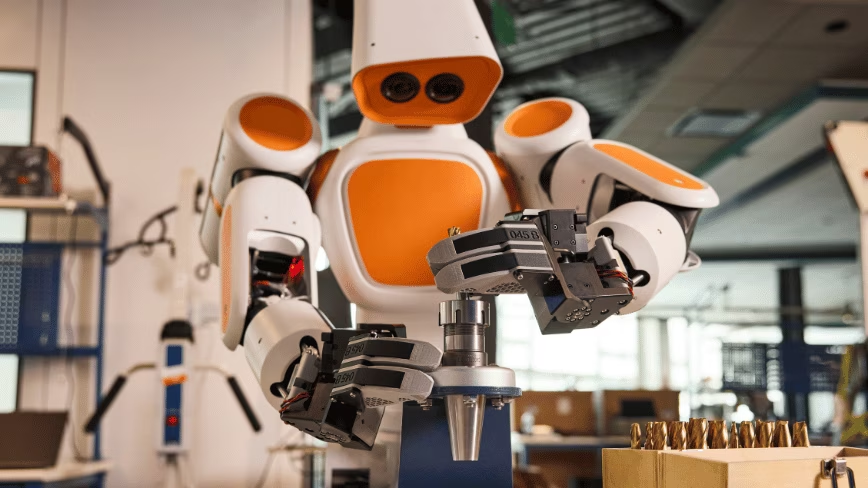
Image: TNW
Walden Robotics has emerged from stealth with $300 million in funding and a $1.1 billion valuation, backing a factory robot design that deliberately skips legs. The Toyota spin-out is building humanoids for industrial work, but CEO Russ Tedrake says the choice to use wheels is driven by what factory operators actually want.
“If you listen to the people on the factory floor, they aren’t ready, and they don’t want them yet.”
Toyota and Deviation Capital co-led the seed round, with Nvidia, Boeing, Samsung Ventures, and CoreWeave Ventures also investing. That is a notable lineup for a startup that is only six months old.
Why Walden chose wheels over legs
Most humanoid robotics companies are trying to build machines that walk. Walden has gone in the opposite direction, pairing a humanoid upper body with a wheeled base for what Tedrake describes as a safer, more practical fit for factories.
According to the company, wheeled robots can slow and stop around people more easily, making it simpler to meet existing factory safety rules. The design also leaves room for larger batteries and more computing power, both important for robots expected to work full shifts.
Toyota factory deployment and Large Behavior Models
Walden is not pitching a future concept. Since February, its robots have been operating in production at a Toyota plant in North America, with one robot working eight-hour shifts alongside human teams. The machines handle repetitive jobs including:

Recommended reading
Mira Murati’s lab unveils Inkling, a 975B open model
- loading and unloading car parts
- cleaning machinery
- kitting parts for assembly
The company spun out of the Toyota Research Institute in January and develops its own hardware, software, and AI. Its robots use Large Behavior Models, which Walden says allow them to learn new tasks and improve through practice. The startup says its customers now span automotive, aerospace, semiconductors, electronics, logistics, and life sciences.
Tedrake said that delivering value in manufacturing depends on understanding how factories already operate. Hiroki Nakajima, Toyota’s chief technology officer, tied the effort to the company’s principles of kaizen and jidoka, with people kept at the center.
Walden is entering a crowded field as 1X, LimX, and Booster push humanoids forward and Hyundai scales up Boston Dynamics' Atlas. Morgan Stanley estimates the market could exceed $5 trillion by 2050. Tedrake, though, struck a more cautious note, saying the opportunity is large and the technology feels ready, but “success is not assured” without a credible business case and solid unit economics.

AI Editor
Ava covers the rapidly evolving world of artificial intelligence, from foundational models and research labs to the real-world economics of intelligence. With a background in computational linguistics, she cuts through the hype to find out what actually works. She firmly believes that benchmarks are just marketing until reproduced in the wild.
via TNW