• 3 min read
Mira Murati’s lab unveils Inkling, a 975B open model
Thinking Machines Lab has launched Inkling, a 975 billion-parameter open-weight model it says is flexible, not best-in-class.
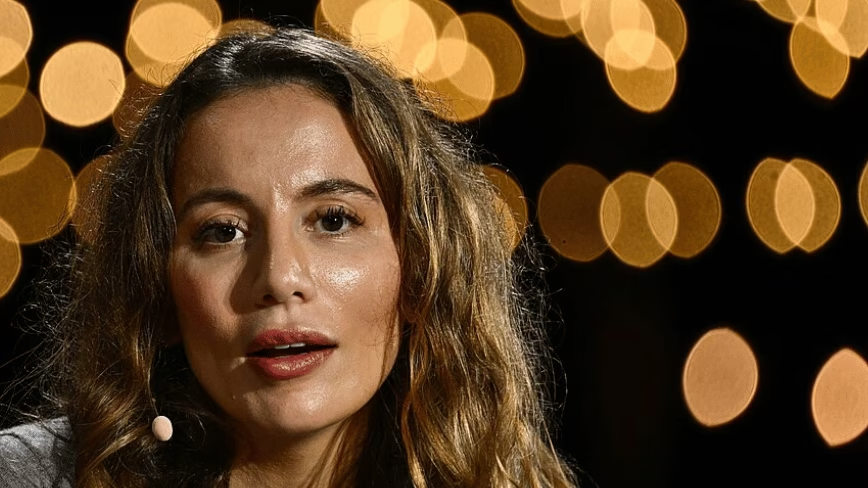
Image: TNW
Mira Murati’s Thinking Machines Lab has released Inkling, its first model, and the company is making an unusual pitch: this is not the top-performing model on the market, but it may be more useful to companies that want to shape a system around their own data and workflows.
Inkling is an open-weight model, meaning developers and businesses can download and modify it themselves. That puts it in contrast with the flagship systems sold by OpenAI, Anthropic, and Google. Technically, it is a mixture-of-experts model with 975 billion total parameters, though it activates only about 41 billion for a given task. It supports a 1 million-token context window and was trained on 45 trillion tokens spanning text, images, audio, and video.
For now, Inkling can reason across text, images, and audio, but it only outputs text, including code and structured data. Thinking Machines says plainly in its own materials that Inkling is “not the strongest model available today, closed or open.”

Recommended reading
OpenAI’s GPT-Red hacked a real vending machine
The company’s bet is that breadth and adaptability matter more than topping benchmark charts. Inkling is designed as a general-purpose base model that customers fine-tune for specific work through Tinker, Thinking Machines' customization platform. Users can also adjust its “thinking effort” to trade off speed against accuracy.
On one coding benchmark, the lab says Inkling matched Nvidia’s Nemotron 3 Ultra while using one-third as many tokens. It also previewed Inkling-Small, a lighter version with 12 billion active parameters aimed at lower-cost, faster deployments.
Tinker, Bridgewater, and the open-model pitch
Thinking Machines argues that centrally trained and frozen systems will lose out to models tuned by each organization. Through Tinker, customers can fine-tune Inkling and own the resulting model themselves, though they also assume the safety risks of what they build.
As evidence, the lab pointed to a project with hedge fund Bridgewater. The companies trained an open model on Bridgewater’s financial expertise, and Thinking Machines says it reached 84.7% on financial reasoning tests, beating leading proprietary models at a fraction of the cost. That result comes from the companies' own evaluation, not an independent test.
The argument echoes comments from Microsoft CEO Satya Nadella, who recently warned that companies using closed models pay twice: once in fees, and again by giving away knowledge embedded in their prompts. The rise of low-cost open-weight models, especially from China, is pushing in the same direction.
Built in nine months with borrowed help
Thinking Machines says it brought Inkling to market in about nine months. For comparison, OpenAI took about five years to ship and monetize, while Anthropic took roughly three, according to TechCrunch.
The lab did not build everything from scratch. To kick off training, it used distillation from other open models, including Moonshot’s Kimi K2.5. Thinking Machines says its next model will be trained fully in-house. Inkling itself ran on Nvidia GB300 systems, part of a March agreement for a gigawatt of Nvidia compute.
The company’s business has had a less smooth run. It raised $2bn at a $12bn valuation last year, while a reported $50bn funding round later stalled. Two co-founders left earlier this year, though headcount has recovered to around 200.
Thinking Machines is not charging for Inkling itself. For now, the business model depends on Tinker.

AI Editor
Ava covers the rapidly evolving world of artificial intelligence, from foundational models and research labs to the real-world economics of intelligence. With a background in computational linguistics, she cuts through the hype to find out what actually works. She firmly believes that benchmarks are just marketing until reproduced in the wild.
via TNW