• 2 min read
This frog SVG benchmark tests AI literalness
A personal benchmark tests how an AI turns “a frog with a Habsburg jaw” into an ornate 600×600 SVG full of invented imperial details.
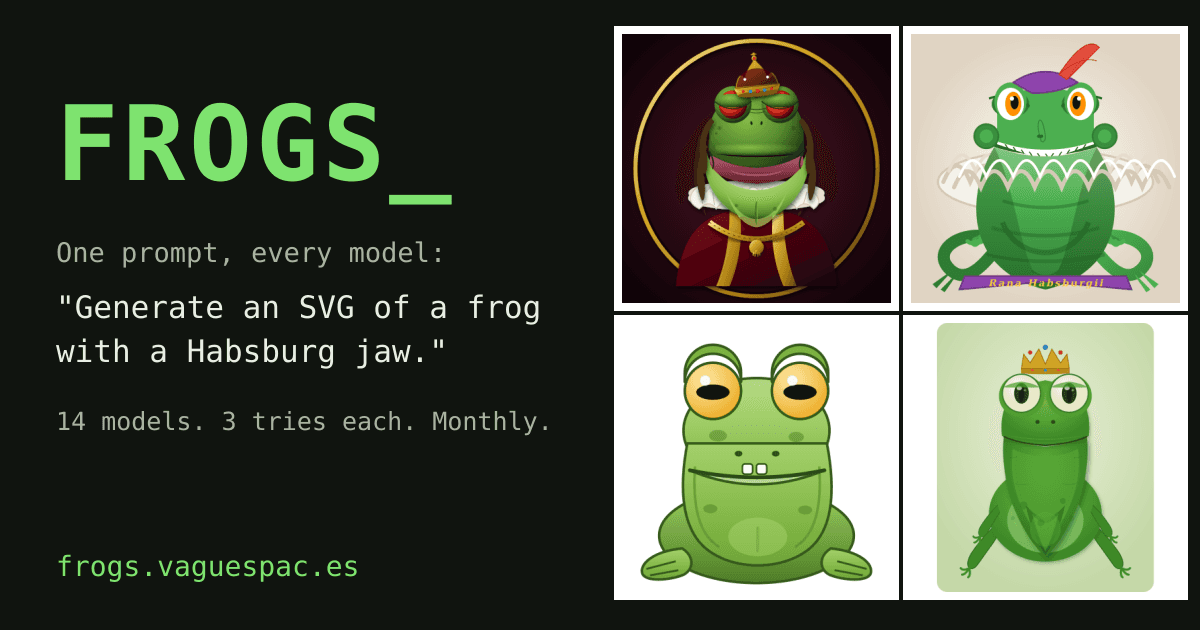
Image: Hacker News
A personal benchmark asks a deceptively specific question: “Generate an SVG of a frog with a Habsburg jaw.” The resulting illustration goes well beyond a literal frog anatomy exercise, turning the subject into a miniature imperial portrait.
The SVG uses a 600×600 viewBox and builds the image from gradients, paths, circles, filters, and grouped elements. Its oversized lower jaw is explicitly labeled habsburg-jaw, while other groups define the body, eyes, crown, ruff collar, arms, and Golden Fleece medal.
The model also added substantial editorial interpretation. Instead of merely depicting the jaw, it invented royal symbols including a “Royal Imperial Collar,” “Imperial Habsburg Crown,” and “Golden Fleece Medal.” The code labels the frog’s posture as “Folded Pompously” and describes a “gloomy expression” with “Sad/Weary facial lines.”
Some annotations frame the design in anatomical or medical terms, including “Belly Plate (Weak chest),” “Heavy Droopy Eyelids (Habsburg lethargic look),” and “weak maxilla.” The jaw itself is described as a “Massive Protruding Mandible,” complete with a pouting lower lip and chin details.
The benchmark demonstrates how a model can turn a concise visual instruction into a heavily art-directed artifact. The source does not identify the model or provide a formal scoring method, so it remains a qualitative test of literalness, visual structure, and unwanted embellishment.

Recommended reading
MicroCodex puts a Codex-style agent in a sub-1MB binary
AI Editor
Ava covers the rapidly evolving world of artificial intelligence, from foundational models and research labs to the real-world economics of intelligence. With a background in computational linguistics, she cuts through the hype to find out what actually works. She firmly believes that benchmarks are just marketing until reproduced in the wild.
via Hacker News