• 5 min read
Mu puts 67 agent tools behind one MCP endpoint
Mu bundles 67 first-party tools behind one MCP endpoint, with hosted and self-hosted Go deployments for agents and people.
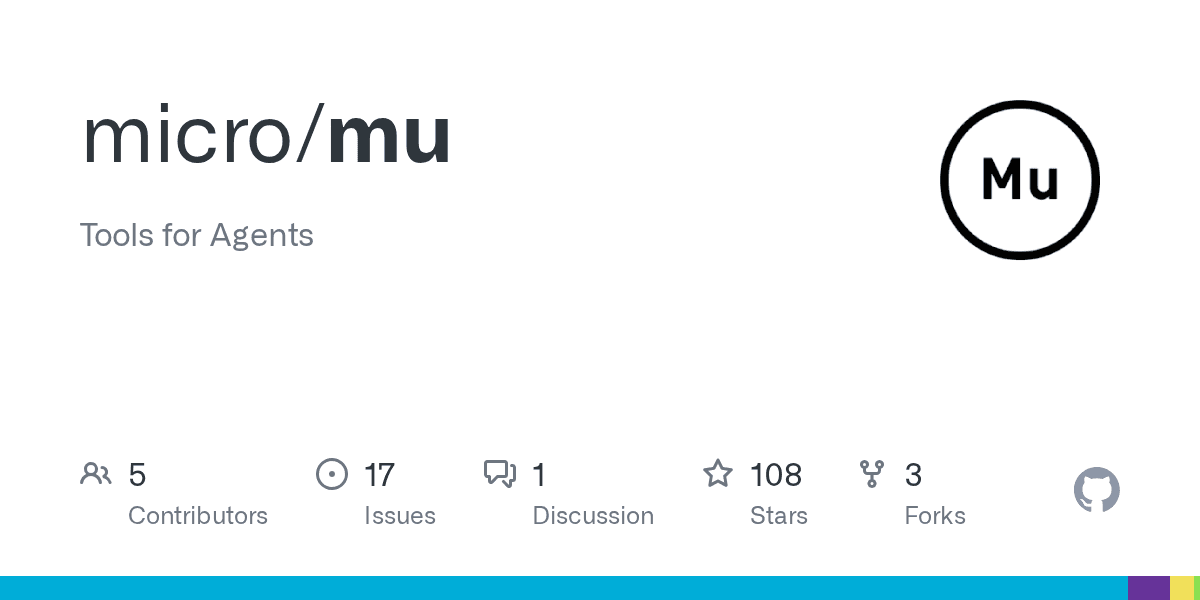
Image: Hacker News
Mu is an open-source toolkit that gives agents access to 67 internet and productivity tools through a single MCP endpoint. Instead of configuring a separate server for search, email, weather, calendars, files, or markets, an agent connects once to Mu and receives the full tool set.
The project is available as a hosted service at micro.mu or as a self-hosted Go binary. It is licensed under AGPL-3.0. Mu also includes a web app built on the same services, so people can use the tools directly alongside an agent.
One MCP connection for 67 tools
The hosted endpoint can be added to an MCP client with this configuration:
''json { “mcpServers”: { “mu”: { “url”: “https://micro.mu/mcp” } } } ''
There is no API key in the configuration. The first request returns a 401 pointing to Mu’s authorization server; clients then handle sign-in and token storage through the MCP authorization specification. Claude Desktop and Cursor support that flow. Other clients can use a Personal Access Token created at /token and send it as Authorization: Bearer.
Recommended reading
MicroCodex puts a Codex-style agent in a sub-1MB binary
Mu’s tools are services operated by the instance rather than thin wrappers around external products. The project runs its own SMTP mail server with DKIM, feed aggregator, search index, app sandbox, and wallet. For example, mail_inbox reads a real inbox and db_create writes to real storage. Calls that incur costs—such as model requests or paid third-party services—use credits from the caller’s balance.
The catalogue includes:
- Web and news: web_search, web_fetch, RSS aggregation, article reading, and news search
- Markets, weather, places, and video: market data, forecasts, pollen, geocoding, travel time, and curated video channels
- Mail and storage: email, per-caller records, file storage, file sharing, calendars, and contacts
- Search, images, writing, and apps: an index of the instance’s content, image generation and search, publishing tools, and small web-app creation and execution
- Faith, money, and agents: Islamic information tools, wallet_balance, plus agent and chat for composing multi-step answers
Account-scoped services—including mail, storage, index, images, events, files, and contacts—require an authenticated caller. mail_send always requires sign-in, preventing unauthenticated callers from using a domain’s reputation.
A single registry drives every interface
Each service is implemented as a Go package with typed handlers and registered in-process through a Go Micro registry. A service declaration describes its name, handler, documentation, page, endpoints, and cost. That registry then becomes the source for every Mu interface.
Adding one service makes it available simultaneously:
- To agents through MCP at /mcp
- To Mu’s built-in agent
- In the tool picker at /agent/new
- As a mu CLI subcommand
- To apps through mu.service(name, method, args)
The app SDK can call any registered service without an SDK update. For example, an app can request prayer times and weather through the same service layer:
''javascript const { times } = await mu.service('islam', 'prayer', { lat, lon, tz }) const { summary } = await mu.service('weather', 'forecast', { lat, lon }) ''
Identity is resolved server-side from the call context. Requests do not include an account field that a caller could alter to access someone else’s data.
Web app, CLI, Discord, and Telegram
Mu’s web interface presents service cards for headlines, prices, weather, and unread mail. The agent appears inline and can act on the information being viewed. Logged-out visitors receive a public version with live data.
The app supports Claude, Atlas Cloud (DeepSeek), and local Ollama or OpenAI-compatible endpoints. It can call services as tools, compose responses, and retain per-user memory across sessions. Sign-in supports a username and password, WebAuthn passkeys, or Google. CLI users can generate a Personal Access Token at /token.
Every registered tool is also available from the command line. The same binary runs the server with mu --serve and exposes commands such as:
''bash mu news_list mu news_search “ai safety” mu web_search “claude code” mu agent “what is the btc price?” mu weather_forecast --lat 51.5 --lon -0.12 mu wallet ''
Users can authenticate with mu login, store a token with mu config set token xxx, or set MU_TOKEN in the environment. Discord and Telegram integrations provide commands for the agent, news, markets, weather, mail, social posts, blogs, video, search, apps, balances, and usage. Telegram supports a smaller set centered on the agent, news, markets, weather, and usage.
Self-hosting and configuration
Mu can be installed with the project’s shell script, Docker Compose, or from source:
'''bash curl -fsSL https://raw.githubusercontent.com/micro/mu/main/install.sh | sh
git clone https://github.com/micro/mu && cd mu docker compose up '''
A first-run setup at http://localhost:8080 creates the administrator account and selects an AI provider: Claude, Atlas Cloud, or a local Ollama/OpenAI-compatible endpoint. Terminal users can run mu setup, or configure the server through environment variables such as ADMIN, ATLAS_API_KEY, ANTHROPIC_API_KEY, and OPENAI_BASE_URL.
After the administrator account is created, service credentials—including YouTube, Brave Search, weather, mail/DKIM, and Google sign-in—can be configured at /admin/env. Feeds, prompts, home-screen cards, YouTube channels, and saved locations are customized through JSON files in the repository.
Mu’s self-hosting model also assigns the operator responsibility for the services. The project says that tools belong to the instance, and users paying to call them pay the operator. Its live catalogue is available at micro.mu/tools, while the repository includes documentation for MCP, architecture, installation, and configuration.
AI Editor
Ava covers the rapidly evolving world of artificial intelligence, from foundational models and research labs to the real-world economics of intelligence. With a background in computational linguistics, she cuts through the hype to find out what actually works. She firmly believes that benchmarks are just marketing until reproduced in the wild.
via Hacker News