• 2 min read
Strained ultrathin RuO2 shows signs of altermagnetism
Ultrathin strained ruthenium dioxide shows spin textures consistent with altermagnetism, a finding that could inform future spintronic RAM designs.
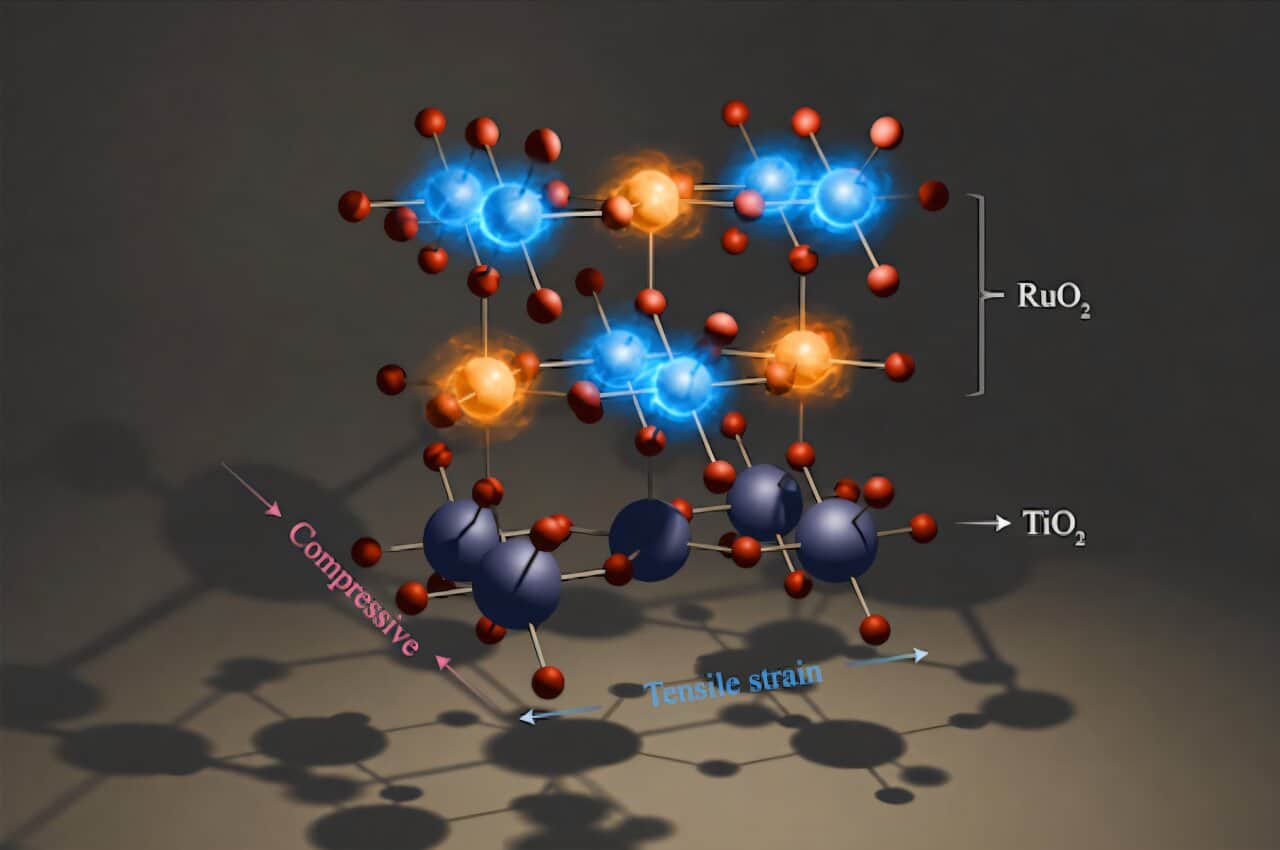
Image: TechXplore
Illustration of strain-induced emergent magnetism in ultrathin RuO2/TiO2. Theoretical altermagnetic spin density is shown in orange and blue in the upper RuO2 layers. Credit: Rice University/Yichen Zhang, using OpenAI ChatGPT.
Ruthenium dioxide (RuO2) may display altermagnetism when prepared as an ultrathin film only a few atomic layers thick, according to research from Rice University, the University of Minnesota and the Paul Scherrer Institute. The findings, published in Science Advances, suggest that the material’s magnetic behavior can differ sharply between its bulk and ultrathin forms.
Altermagnetism is a recently proposed class of magnetism that could support smaller and more capable RAM architectures. RuO2 was one of the first proposed candidates, but previous studies of its bulk form found no evidence of magnetism.
Recommended reading
China turns coal into graphene and carbon materials
“Ruthenium dioxide was one of the first materials to be proposed as an altermagnetic candidate, but studies on its bulk form didn’t return evidence of magnetism. Our research shows that its ultrathin form, on the other hand, may be the key to making it magnetic.”
How strain changes RuO2
The team examined the material’s spin texture—the spatial arrangement of electron spins—to determine its magnetic state. Researchers used spin-resolved angle-resolved photoemission spectroscopy, or spin-resolved ARPES, and compared the measurements with theoretical calculations.
Under the team’s experimental conditions, the ultrathin RuO2 films showed spin textures consistent with unconventional magnetism. The effect depended on lattice strain, a form of pressure placed on the material’s electronic structure. Without that strain, as in naturally occurring bulk RuO2, the electron spins did not show signs of altermagnetism.
“The strain-dependent nature suggests that we may be able to use lattice strain as a tuning knob to induce or control altermagnetism. This could be extremely useful when thinking about next-generation spintronics and RAM architectures.”
What the measurements showed
The researchers reported mirror-odd and mirror-even spin textures in epitaxially strained ultrathin RuO2 films. Zhang said the results indicate that bulk and ultrathin RuO2 may have distinctly different magnetic properties under the right conditions.
The study does not establish that unstrained bulk RuO2 is magnetic. Instead, it identifies strain as a possible way to induce or control altermagnetic behavior in ultrathin films. The researchers also stressed that high-quality material preparation, careful measurement protocols and detailed analysis were essential to distinguishing the relevant electron-spin properties.
The paper, “Observation of mirror-odd and mirror-even spin texture in ultrathin epitaxially strained RuO2 films,” lists Yichen Zhang and colleagues as authors. It was published in Science Advances in 2026 with DOI 10.1126/sciadv.aec2917.
Lisa Lock, BA in art history and MA in material culture. Former museum editor, paramedic and transplant coordinator; editing for Science X since 2021.
Andrew Zinin, who holds a master’s degree in physics and has research experience.
Frontier Editor
Dan is our resident futurist, covering electric mobility, space exploration, and the smart home. He's interested in atoms just as much as bits. Whether it's a new battery chemistry, a reusable rocket, or a protocol that finally makes IoT devices talk to each other, Dan breaks down the engineering that pushes humanity forward.
via TechXplore