• 7 min read
SpaceX’s trillion-dollar bet on orbital data centers, by the numbers
SpaceX’s AI1 megaconstellation hinges on extreme launch rates, trillion‑dollar capex, and hard thermal and radiation problems in orbit.

Image: Ars Technica
SpaceX wants a million data center sats in orbit
SpaceX has shifted its long-term story away from rockets and toward orbital data centers. The company envisions a constellation of 1 million satellites generating 120 GW to power tens of millions—and potentially up to 100 million—frontier-class GPUs in space.
Founder Elon Musk outlined the concept months ago. In June, a promotional video with Musk and Ian Dahl, SpaceX’s director of satellite engineering, finally put concrete specs on the first-generation AI1 satellite.
“There’s not some magic that’s necessary that doesn’t exist,” Musk said. “A lot of this is technology we’ve already made for Starlink V3 satellites. Basically, we don’t think this is a super hard problem.”
The physics may be “non-magical,” as Ars noted in part 1 of this series, but the economics—and the engineering at scale—are anything but easy.
What an AI1 needs to carry to orbit
Based on SpaceX’s schematic, each AI1 satellite would fly with Solar power and cooling hardware sized for serious compute:
Recommended reading
Luch-5 satellites kept Soyuz MS-29 linked to the ISS
- ~600 m² of solar arrays (about 1.5× a basketball court)
- 150 kW peak power, 120 kW average power for computing
Those arrays likely weigh 1–2 metric tons if built from standard silicon cells. Satellite industry consultant Stuart Taylor told Ars that SpaceX might consider perovskite solar cells, which rumor says the company is eyeing, but their long-term stability is still unproven, so the analysis assumes silicon.
The compute load then demands a large radiator, estimated from various sources at another 1–2 metric tons. Add the bus, GPUs, and other components and you get a total spacecraft mass of roughly 3.5 to 7.5 metric tons.
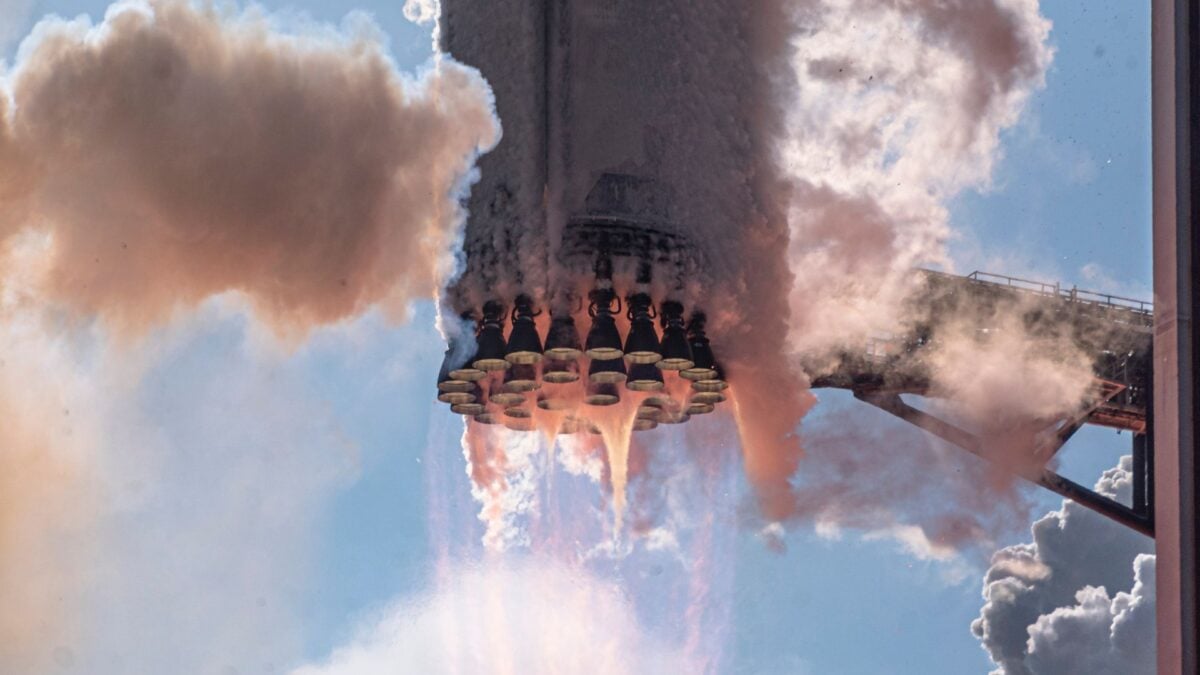
That pushes this project into super heavy-lift territory. Starship V3 is estimated at 100 metric tons to low-Earth orbit. SpaceX is already planning a V4 with a projected 200 metric ton capacity.
Launch economics: optimistic to brutal
For a fully reusable Starship—both stages returning, re-stacked in hours—the theoretical floor is mainly propellant and ops. Ars assumes an idealized launch cost of $20 million, about $100/kg to LEO at 200 metric tons capacity.
To stress-test the idea, Ars models three scenarios:
- Optimistic: 200 t payload, 3.5 t AI1 mass, $20M/launch
- Neutral: 150 t payload, 5.5 t AI1 mass, $50M/launch
- Pessimistic: 100 t payload, 7.5 t AI1 mass, $100M/launch
Assuming each satellite lasts five years before disposal or reentry, deploying and replenishing 1 million satellites requires massive launch cadence:
- Optimistic: 57 AI1 per launch → 17,500 launches total, 3,500/year
- Neutral: 27 AI1 per launch → 37,000 launches total, 7,400/year
- Pessimistic: 13 AI1 per launch → 77,000 launches total, 15,300/year
Even the best case implies 10 launches a day. Worst case is 42 launches a day.
By comparison, the entire world attempted 329 orbital launches last year, with 321 reaching at least marginal orbit, per astrophysicist Jonathan McDowell. SpaceX did 170 of those. The AI1 vision would require at least a 20× increase in SpaceX’s own launch rate.
SpaceX today has one Starship pad at Starbase, Texas, and expects four launch towers across Texas and Florida within a couple of years, optimized for equatorial orbits. Sun-synchronous missions may require new sites; the company is considering locations in Louisiana and elsewhere for due-south launches.
The trillion-dollar capex stack
Quilty Space estimates Starlink V3 satellites at around $1 million apiece. AI1s will be larger, with significantly more solar and high-end compute. Even with economies of scale, Ars uses $1 million per satellite as a best case.
Ars also pegs global ground infrastructure at ~$100 billion across all scenarios.
That yields rough all-in costs for a 1 million–satellite AI1 constellation:
- Optimistic: $350 billion in launch, $1M per sat → $1.45 trillion total
- Neutral: $1.85 trillion in launch, $1.5M per sat → $3.45 trillion
- Pessimistic: $7.7 trillion in launch, $2.0M per sat → $9.8 trillion
Iridium Communications CEO Matt Desch called orbital data centers a “hot, hot area” largely because of Starlink’s announcement but warned of “massive technical challenges.”
“It’s a really, really long-term opportunity at best, and I wonder if all the discussion isn’t for other reasons than maybe just solving an immediate problem,” he said, adding that jumping on the trend could help valuation but that Iridium prefers to “focus on really delivering results in cash and growth.”
SpaceX just pulled off the most lucrative IPO in stock market history, but even that is a down payment. Without a dramatic cut in launch costs via Starship, Ars concludes, the AI1 megaconstellation “doesn’t seem remotely feasible.”
Radiation: GPUs vs. space
Radiation is the other major constraint. From Starlink, SpaceX has found many processors and memory components are already fairly radiation-tolerant. Sam Waldman, a physicist who worked on avionics at SpaceX from 2012 to 2018, said power supplies and some components are more vulnerable, but techniques to harden them are well understood.
High-end chips are less proven. Musk said SpaceX plans to start with Nvidia Rubin chips, then eventually build its own. There’s early evidence that conventional data center silicon can be adapted for orbit.
Starcloud, a small startup, is one of the first serious space-data-center players. Last year it did extensive ground testing on an Nvidia H100 GPU, then bolted it to a small satellite bus and launched it as the Starcloud-1 mission on a Transporter rideshare.
So far, the H100 has performed well in orbit, according to co-founder and CEO Philip Johnston.
“The lifetime will be the same as on the ground, and there’s an argument to be made that it could be even longer,” Johnston said, arguing that chips like the H100 can work in space with modest shielding.
Other experiments are more cautious. Hewlett-Packard has flown high-performance computers on the ISS via its Spaceborne program. Google tested its V6e Trillium TPU compute tray and found ionizing radiation can cause device failures over time, but that devices should operate reliably in space for about five years.
That ~5-year reliability window lines up with the expected service life and with the timeframe in which data center chips go from cutting-edge to old.
In-space repairs aren’t realistic for the foreseeable future, so the system has to tolerate that limited lifetime—and the enormous resupply rate it implies.
Cooling: the hardest engineering problem
If radiation is manageable, heat might be the real showstopper.
On Earth, data centers lean on convection: fans move air, air carries heat away. In vacuum, there’s no air, so satellites must use thermal radiation—infrared energy emitted into space. The process is weak, forcing the use of very large radiator panels with coolant loops carrying heat from hot zones to the radiating surface.
NASA has already done this at a comparable scale. The International Space Station uses six ammonia-cooled radiators with a combined mass of just over 6 metric tons, enough to dissipate about 70 kW of heat—roughly the class of cooling SpaceX will need per AI1.
Waldman noted that Starlink has already pushed SpaceX to optimize thermal design.
“Starlinks look the way they do because they’re maximizing the surface area to radiate heat,” he said. “They [SpaceX] have very good data for this problem.”
Starcloud is targeting the same bottleneck. Johnston said two-thirds of his engineering team is working on a low-cost, low-mass deployable radiator, conceptually similar to the ISS system. The company is now assembling the Starcloud-2 mission, a 45

Frontier Editor
Dan is our resident futurist, covering electric mobility, space exploration, and the smart home. He's interested in atoms just as much as bits. Whether it's a new battery chemistry, a reusable rocket, or a protocol that finally makes IoT devices talk to each other, Dan breaks down the engineering that pushes humanity forward.
via Ars Technica