

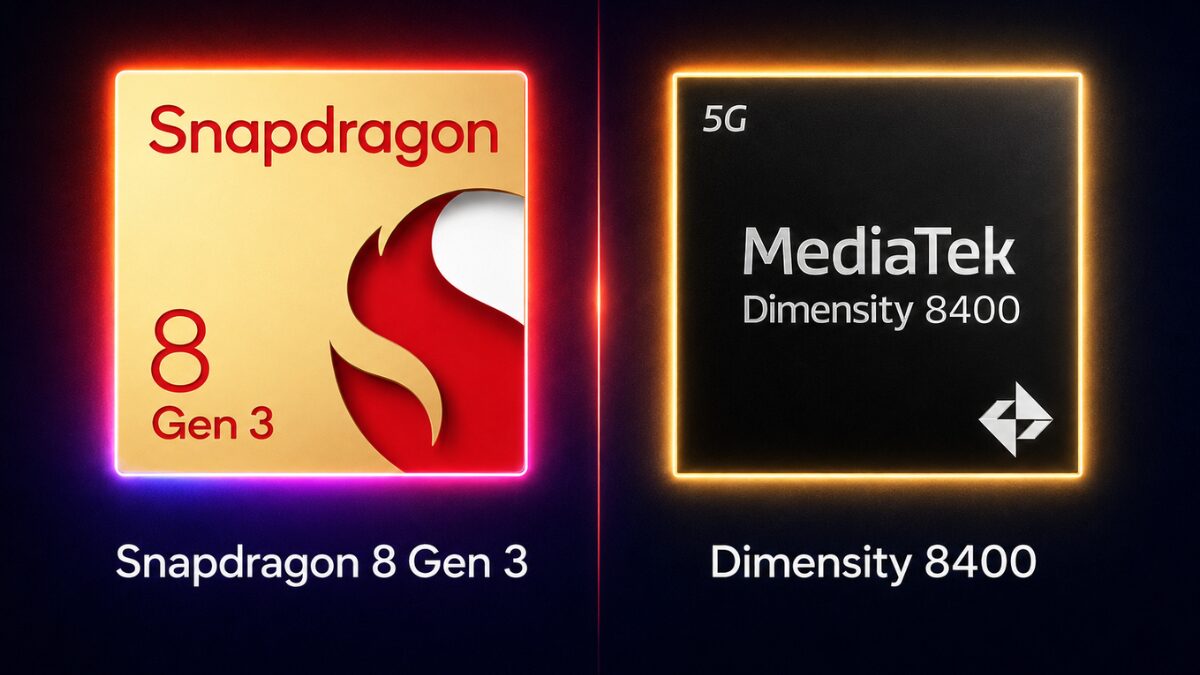
The Snapdragon 8 Gen 3 still looks like the safer bet for buyers chasing top-end phone performance, and the Snapdragon 8 Gen 3 vs Dimensity 8400 benchmark numbers make that pretty plain. MediaTek’s Dimensity 8400 is cheaper to position and good enough for plenty of mainstream flagship phones, but Qualcomm’s older chip keeps a clear edge in CPU, GPU, and connectivity – which is exactly why it keeps showing up in more premium devices.
That tug-of-war says more about the smartphone market than about either chip alone. Rising memory and RAM costs, plus tight chip supply, have pushed brands to stretch older high-end silicon further, while MediaTek has been trying to turn efficient upper-midrange parts into credible alternatives.
Snapdragon 8 Gen 3 vs Dimensity 8400 benchmarks
The test results came from an iQOO 12 with Snapdragon 8 Gen 3 and an iQOO Z10 Turbo with Dimensity 8400. In Geekbench 6, Qualcomm’s chip scored 2216 in single-core and 6781 in multi-core, while MediaTek’s scored 1629 and 6492.
- Geekbench 6 single-core: 2216 vs 1629
- Geekbench 6 multi-core: 6781 vs 6492
- AnTuTu v11 total: 2,332,791 vs 2,031,886
- AnTuTu GPU: 818,651 vs 645,958
The GPU gap is the ugly one for MediaTek. On AnTuTu v11, Snapdragon 8 Gen 3 led by 14% overall and by 26% in graphics, which is the sort of difference you notice in games long before you notice it in email or social apps. The CPU lead was narrower, but still on Qualcomm’s side.
Core design and graphics tell the story
The two chips take different routes to similar everyday speed. Snapdragon 8 Gen 3 uses a 1 x Cortex-X4, 3 x Cortex-A720, 2 x Cortex-A520 layout, while Dimensity 8400 goes with a 1 x Cortex-A725, 3 x Cortex-A725, 4 x Cortex-A725 setup. MediaTek’s all-big-core design is neat on paper, but Qualcomm’s prime core and higher clocks do more of the heavy lifting.
Graphics is where the separation becomes harder to ignore. Adreno 750 simply has the stronger hand here, and the benchmark results back that up with higher, steadier performance under load. If your phone is going to spend its life gaming, editing, or pushing high-refresh visuals, the Snapdragon chip is the one to beat.
Camera and connectivity still favor Qualcomm
Both chips bring modern AI and imaging hardware, but Qualcomm’s extras are more ambitious. Snapdragon 8 Gen 3 supports up to 8K/30fps or 4K/120fps video recording, while Dimensity 8400 tops out at 4K/60fps. The Snapdragon platform also adds Wi-Fi 7, mmWave support, and a Snapdragon X75 5G modem with up to 10 Gbps download speed.
MediaTek’s part is no slouch: it supports up to 320MP single-camera hardware, has zero shutter lag across multi-camera setups, and leans into agentic AI support. But it still trails on wireless speed, with a peak 5G rate of 5.17 Gbps and Wi-Fi 6E instead of Wi-Fi 7.
So the real choice is less ”fast chip or slow chip” and more ”do you need the best gaming and connectivity headroom, or just excellent everyday speed?” For most users, Dimensity 8400 is probably enough. For buyers who want the strongest all-round flagship silicon, Snapdragon 8 Gen 3 still owns the crown.