

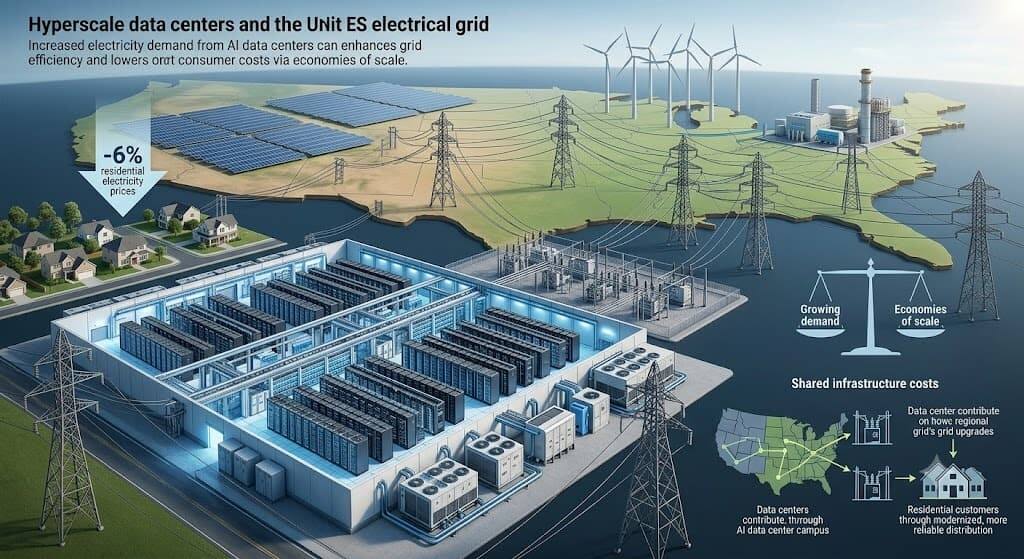
The U.S. data-center boom did not push household electricity bills higher between 2015 and 2024, according to new research from the Electric Power Research Institute and Watershed. In places where server farms expanded fastest, retail power prices were actually about 6% lower than they would have been without that growth, a result that cuts against the familiar AI-doomsday storyline.
The reason is less magical than it sounds. Utilities spend huge sums on plants, transmission lines, and local grids, so adding a big, steady customer can spread those fixed costs over more kilowatt-hours. That is textbook scale economics, and it helps explain why a hungry new industry can sometimes make an energy system more efficient instead of more expensive.
What the data center study shows
Researchers say data centers now account for about 4.5% of U.S. electricity use, and EPRI expects that share to rise to 9-17% by 2030. Even so, the study found that every additional 10% of data-center capacity was associated with roughly a 0.4% drop in retail tariffs for households.
- Data-center capacity up 160% on average in some U.S. regions from 2019 to 2024
- Household tariffs down about 6% versus a no-growth scenario
- Estimated price effect: about 0.4% lower retail tariffs for each extra 10% of capacity
How EPRI tested the data-center effect
The team used a two-stage least squares model with an instrumental variable to get around the obvious objection: maybe data centers simply go where electricity was already cheap. Their workaround was unexpected but clever – the planned U.S. interstate highway network drawn up in 1947, which helped shape the fiber routes that later made some locations attractive for data centers, while having no direct say in today’s power prices.
That matters because the AI buildout has become a political punching bag, with forecasts of exploding demand often treated as proof that consumers will pay the bill. The broader reality is messier: new load can justify new generation, including solar and wind, and can improve the economics of the grid if it arrives before bottlenecks start biting.
The catch for utilities and households
Still, this is not a blank check for hyperscalers. The study’s authors warn that the benefit could fade if grid expansion costs keep rising, and there are already warning signs: transformer shortages, long waits for gas turbines, and more expensive renewable equipment. If those pressures keep building, today’s tariff relief could turn into tomorrow’s bill shock.
For now, though, the counterintuitive takeaway is clear: in the current U.S. system, large data centers look less like an energy parasite and more like a bulk buyer that can help lower average costs. The next question is whether utilities can keep up long enough for that to stay true.