

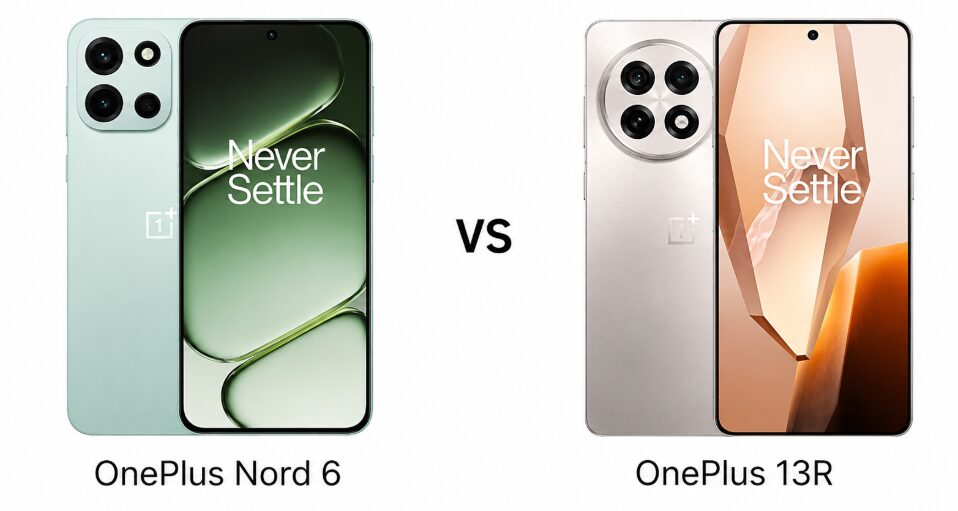
OnePlus has managed something mildly annoying for shoppers: two phones that look like they belong in the same cart, but pull in very different directions. The new OnePlus Nord 6 is the tougher, newer, longer-running machine, while the OnePlus 13R still makes a strong case by pairing flagship-grade performance and a more versatile camera system with a lower price.
If you want the shortest answer, it is this: the Nord 6 is the safer bet for battery life and longevity, but the 13R is still the cleaner value play for most buyers. That split is exactly how OnePlus keeps both devices relevant instead of letting the newer model simply wipe out the older one.
OnePlus Nord 6 vs OnePlus 13R design and display
The Nord 6 goes practical, not flashy. Its plastic frame and back are less premium in hand, but the payoff is serious protection: IP68/IP69 and MIL-STD-810H certification. The 13R counters with an aluminum frame and glass back, plus IP65 water resistance, so it feels nicer even if it is easier to fuss over.
Both phones use 6.78-inch AMOLED panels with HDR support, but the Nord 6 leans into speed with a 165Hz refresh rate, 3840Hz PWM dimming, and 3600 nits peak brightness. The 13R answers with LTPO AMOLED tech, Dolby Vision, HDR Vivid, and a higher 4500-nit peak, which should make it the better pick for films, streaming, and everyday viewing.
- Nord 6: 165Hz refresh rate, 3840Hz PWM dimming, 3600 nits peak brightness
- 13R: LTPO AMOLED, Dolby Vision, HDR Vivid, 4500 nits peak brightness
- Result: Nord 6 for gaming smoothness, 13R for richer media playback
Snapdragon 8s Gen 4 versus Snapdragon 8 Gen 3
Under the hood, the Nord 6 brings Qualcomm’s Snapdragon 8s Gen 4, UFS 4.1 storage, Android 16, and OxygenOS 16. The 13R uses the Snapdragon 8 Gen 3, which still has the edge in GPU muscle and heavy sustained loads, especially if you care about demanding games or video work.
There is a catch, though: software age matters more than launch badges. The Nord 6 arrives with Android 16, so it starts life one step ahead and should stay feeling fresher for longer, while the 13R begins on Android 15. That is the sort of unglamorous detail that becomes annoying two years later, right when your ”perfectly good” phone starts feeling old.
Battery is where the Nord 6 stops being polite. Its global model carries 7500mAh, while the India variant jumps to 9000mAh. The 13R’s 6000mAh cell is already solid, but it is simply not in the same weight class, and both phones support 80W wired charging.
- Nord 6: Snapdragon 8s Gen 4, UFS 4.1, Android 16, 7500mAh or 9000mAh battery
- 13R: Snapdragon 8 Gen 3, Android 15, 6000mAh battery
- Shared feature: 80W wired charging
OnePlus Nord 6 camera vs OnePlus 13R camera
The rear-camera win goes to the 13R, and it is not subtle. It has a 50MP main camera, a 50MP telephoto lens with 2x optical zoom, and an 8MP ultrawide camera. The Nord 6 keeps things simpler with a 50MP main camera and an 8MP ultrawide, which means fewer shooting options and no dedicated zoom lens.
The selfie side flips the script. The Nord 6 offers a 32MP front camera with autofocus and 4K video recording, while the 13R uses a 16MP selfie camera limited to 1080p. For anyone living on video calls or short-form content, that is a very real advantage, not spec-sheet decoration.
- 13R rear cameras: 50MP main, 50MP telephoto with 2x optical zoom, 8MP ultrawide
- Nord 6 rear cameras: 50MP main, 8MP ultrawide
- Nord 6 front camera: 32MP with autofocus and 4K recording
- 13R front camera: 16MP with 1080p video
OnePlus Nord 6 vs OnePlus 13R price and value
Price keeps the 13R annoyingly persuasive. It is listed at around $450 (₹40,000), while the Nord 6 sits around $500 (₹43,000). That gap is enough to make the older phone look like the obvious bargain, especially since it still brings flagship Snapdragon 8 Gen 3 performance, a premium build, LTPO display tech, and a telephoto camera.
The Nord 6 is the better pick if your priorities are battery endurance, durability, and newer software. The 13R is the better value if you want a more polished design, stronger rear cameras, and performance that is still comfortably near the top of the pile. In other words: OnePlus made the newer phone tougher, but the older one easier to recommend.
That balance is probably not an accident. It keeps the 13R attractive in a market where last-generation flagships often become the sweet spot, while the Nord 6 tries to win the people who would rather carry a phone that lasts longer than it dazzles.