• 3 min read
SiC betavoltaic cell targets 50 years of power
KERI demonstrated a SiC betavoltaic cell designed to run for over 50 years, with projected unit-cell output 4,200 times Korea’s prior target.
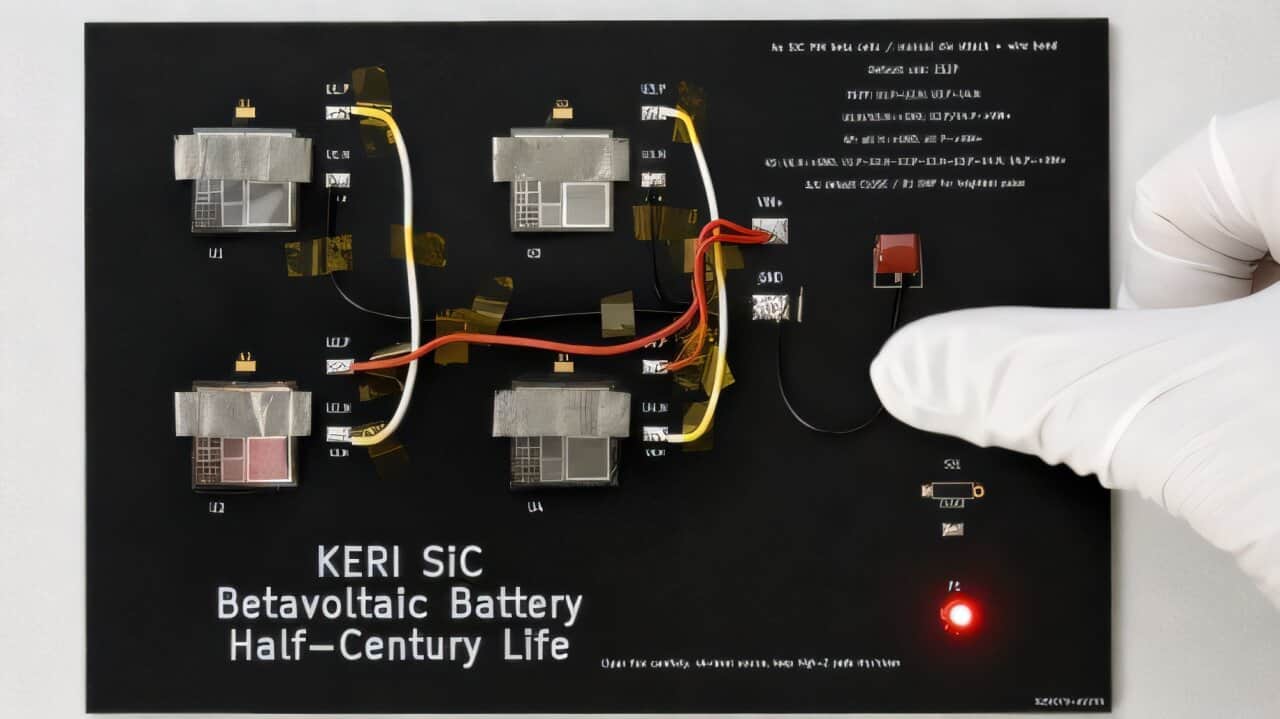
Image: TechXplore
A team in South Korea has demonstrated a silicon carbide (SiC) betavoltaic cell designed to produce electricity for more than 50 years without recharging or replacement. The Korea Electrotechnology Research Institute (KERI) says the device could operate in environments such as space, the deep sea, underground sites and polar regions, where conventional batteries and solar panels face serious limits.
The work was led by Dr. Seo Jae-hwa at KERI’s Advanced Semiconductor Research Center, in collaboration with Professor Yoon Young-jun’s team at Kyungpook National University. The findings were published in the International Journal of Energy Research.
SiC cell reaches 160 µW/cm²
Betavoltaic cells generate electricity by converting electrons released by radioactive material into electrical current. Their operating principle resembles that of a solar cell, but they use beta particles instead of sunlight, enabling continuous low-power generation regardless of weather or temperature.
Recommended reading
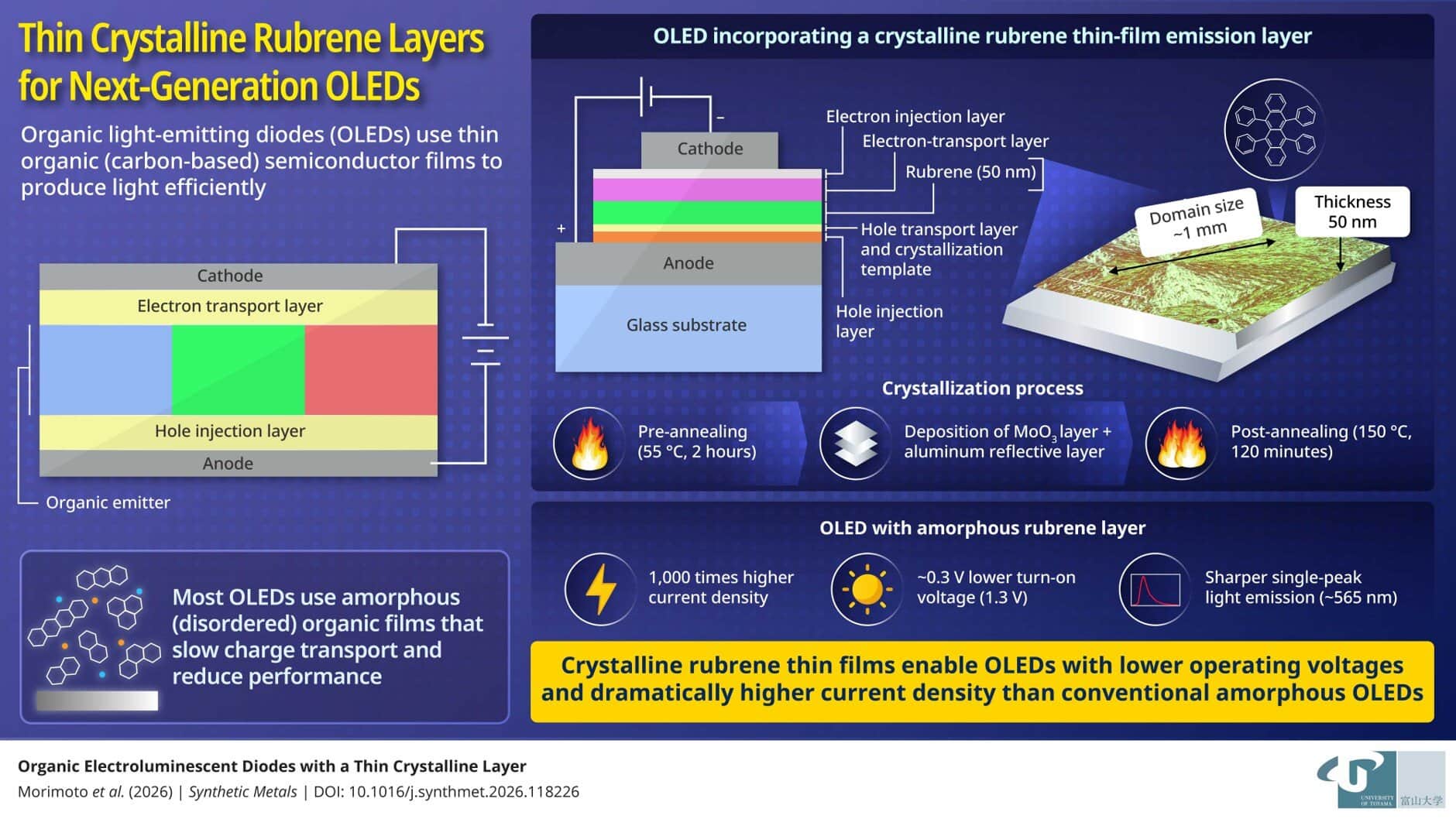
Crystalline rubrene pushes OLED current density 1,000× higher
KERI used SiC because it offers greater resistance to heat and radiation than conventional silicon. The researchers optimized a p-i-n diode structure and combined it with nickel-63 (Ni-63), a beta-emitting isotope. After establishing Korea’s first specialized measurement system for the technology and completing safety procedures, they measured a power density of 160 µW/cm² and built a prototype that powered a low-power LED.
Based on Ni-63's decay characteristics, KERI estimates the device can run for more than 50 years in ultra-low-power applications that would typically use coin-type lithium batteries. The result is a 60,000-fold improvement over previously reported experimental results in Korea.
4,200-fold unit-cell improvement
Electron-beam tests simulating an ideal configuration, where Ni-63 forms a thin, uniform layer on the semiconductor, indicated a potential power density of 0.85 mW/cm² and output exceeding 20 µW per unit cell. That is more than 4,200 times Korea’s previous unit-cell performance target.
Ni-63's long half-life gives the platform potential for century-scale power generation. KERI says expanding the cell and stacking multiple units could support integration into products competing with commercial systems from leading global competitors.
The researchers also developed an AI predictive model that forecasts output power and voltage with 98%–99% accuracy, reducing design-optimization time. In a separate test, they directly irradiated the cell with high-energy 15-MeV protons to simulate one component of the radiation environment encountered by spacecraft. The resulting degradation data will help assess the cell’s reliability for space missions.
“A betavoltaic cell is not designed for high-power applications like those in electric vehicles. Instead, it serves as an ultra-long-life power source that steadily delivers small amounts of electricity for decades without maintenance, making it well suited for remote environments that are difficult for humans to access.”
Seo said potential applications include unmanned defense-surveillance sensors, space and deep-sea emergency beacons, and other systems that store energy before periodically transmitting signals.
Yoon said the achievement covered fabrication, measurement and prototype demonstration rather than relying only on simulations or basic research. KERI has filed related patent applications and plans to work with companies in aerospace, defense, nuclear power, radiation safety and remote sensing on technology transfer and joint product development.
Computing Editor
Tomas lives in the terminal. He covers chips, laptops, and operating systems with a focus on performance and efficiency. He reads kernel changelogs the way other people read fiction, and he's always on the hunt for the perfect mechanical keyboard switch. If it processes data, Tomas has an opinion on it.
via TechXplore