• 2 min read
Crystalline rubrene pushes OLED current density 1,000× higher
University of Toyama researchers built OLEDs with crystalline rubrene, achieving 1,000× higher current density and a 1.33V turn-on voltage.
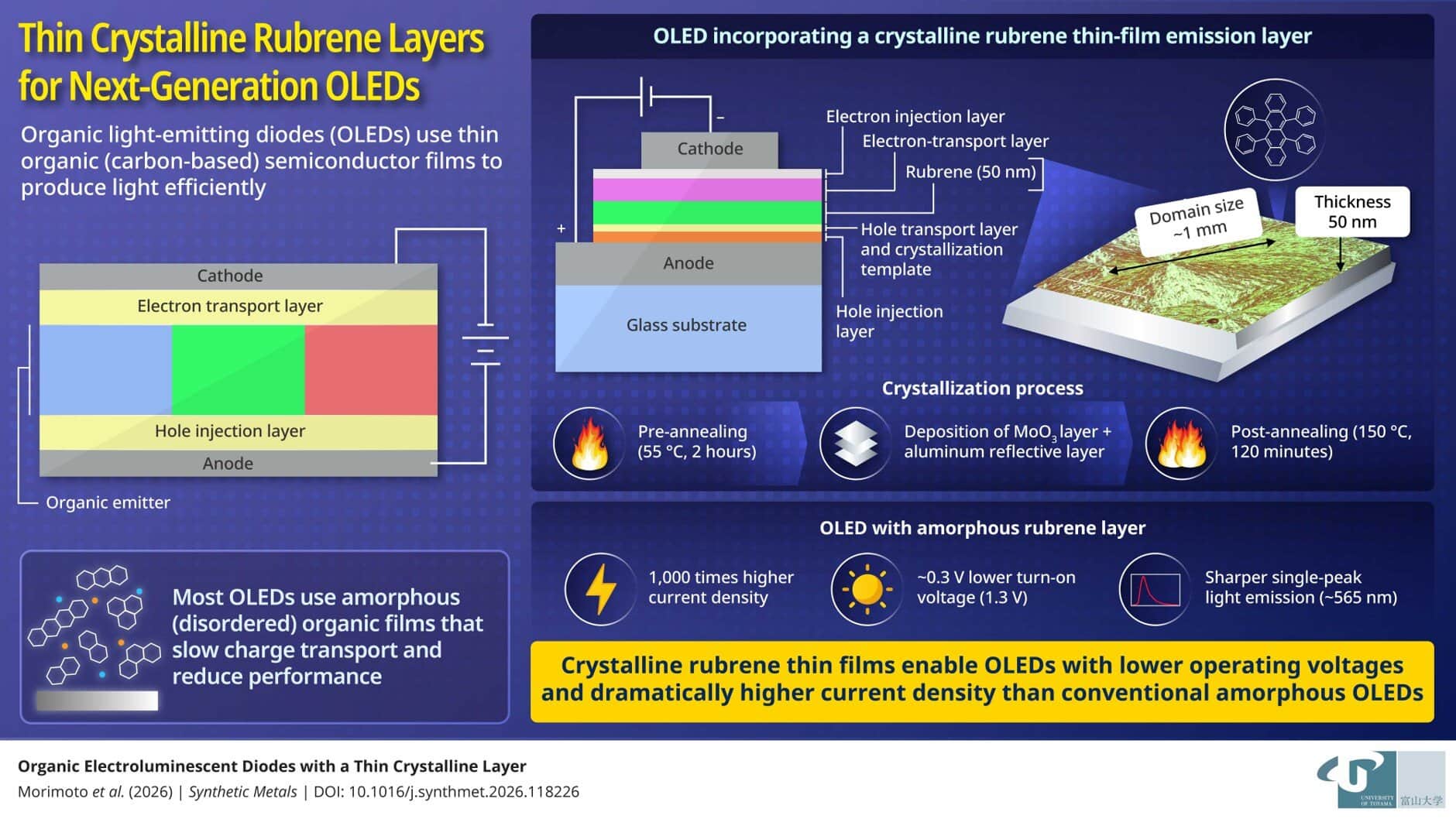
Image: TechXplore
A new OLED design from researchers at the University of Toyama, Japan, uses a crystalline rubrene thin film to deliver up to 1,000 times higher current density than devices made with amorphous rubrene. The device also has a lower turn-on voltage and produces a sharp, single emission peak.
OLEDs have evolved significantly since 1987, when Ching W. Tang and Steven A. VanSlyke at Eastman Kodak Company developed the first practical device. Modern OLEDs are used in smartphone and television displays, as well as lighting, but the organic layers used in commercial devices typically have an amorphous, disordered structure.
Rubrene can transport electrical charges far more efficiently when it forms crystals. However, conventional vacuum evaporation—the standard process for depositing OLED layers—normally leaves rubrene in an amorphous state.
How the crystalline rubrene OLED works
The Toyama team, led by Professor Masahiro Morimoto with Yuya Honda and Shigeki Naka, deposited several ultrathin layers onto an indium tin oxide substrate, including a 50-nanometer rubrene layer. They then used a two-step annealing process to crystallize it.
During the first heating step, small crystal seeds formed in the rubrene. After the remaining layers were deposited, a second heating step allowed those seeds to grow into large domains.
Recommended reading
SiC betavoltaic cell targets 50 years of power
Polarized optical microscopy showed crystal regions measuring about 1 millimeter across throughout the film. The structures were distributed uniformly across the substrate, while X-ray diffraction confirmed an orthorhombic crystal structure.
“We have extended the concept of Tang’s organic electroluminescent diodes to rubrene crystalline thin films and fabricated OLEDs with superior characteristics. This represents the first application of non-epitaxial crystalline thin films to OLEDs.”
OLED performance gains
Compared with amorphous-rubrene OLEDs, the crystalline devices achieved:
- Current densities up to 1,000 times higher
- A luminance turn-on voltage reduced by 0.30 volts, to 1.33 volts
- A sharp single emission peak near 565 nanometers, replacing the broad, two-peak spectrum of amorphous rubrene
The study was made available online on July 1, 2026, and is scheduled for publication in volume 320 of Synthetic Metals on August 1, 2026. The researchers say the result demonstrates that high-performance organic crystals can be integrated into thin-film OLEDs using standard vacuum-deposition techniques.
“Just as the semiconductor industry has driven historical breakthroughs by precisely controlling the structural order of materials, we believe the OLED field is now at a similar turning point. While current commercial OLEDs remain amorphous, our findings clearly show that transitioning to 'crystalline' structures will define the next generation of OLED technology.”
The paper, “Organic electroluminescent diodes with a thin crystalline layer,” was published by Masahiro Morimoto and colleagues in Synthetic Metals (2026), DOI: 10.1016/j.synthmet.2026.118226.
The story credits Swati Mestri and Andrew Zinin.
Computing Editor
Tomas lives in the terminal. He covers chips, laptops, and operating systems with a focus on performance and efficiency. He reads kernel changelogs the way other people read fiction, and he's always on the hunt for the perfect mechanical keyboard switch. If it processes data, Tomas has an opinion on it.
via TechXplore