• 3 min read
KAIST grows aligned semiconductor films at 150°C
KAIST researchers grew aligned tellurium films at 150°C on van der Waals materials, enabling low-temperature semiconductor device fabrication.
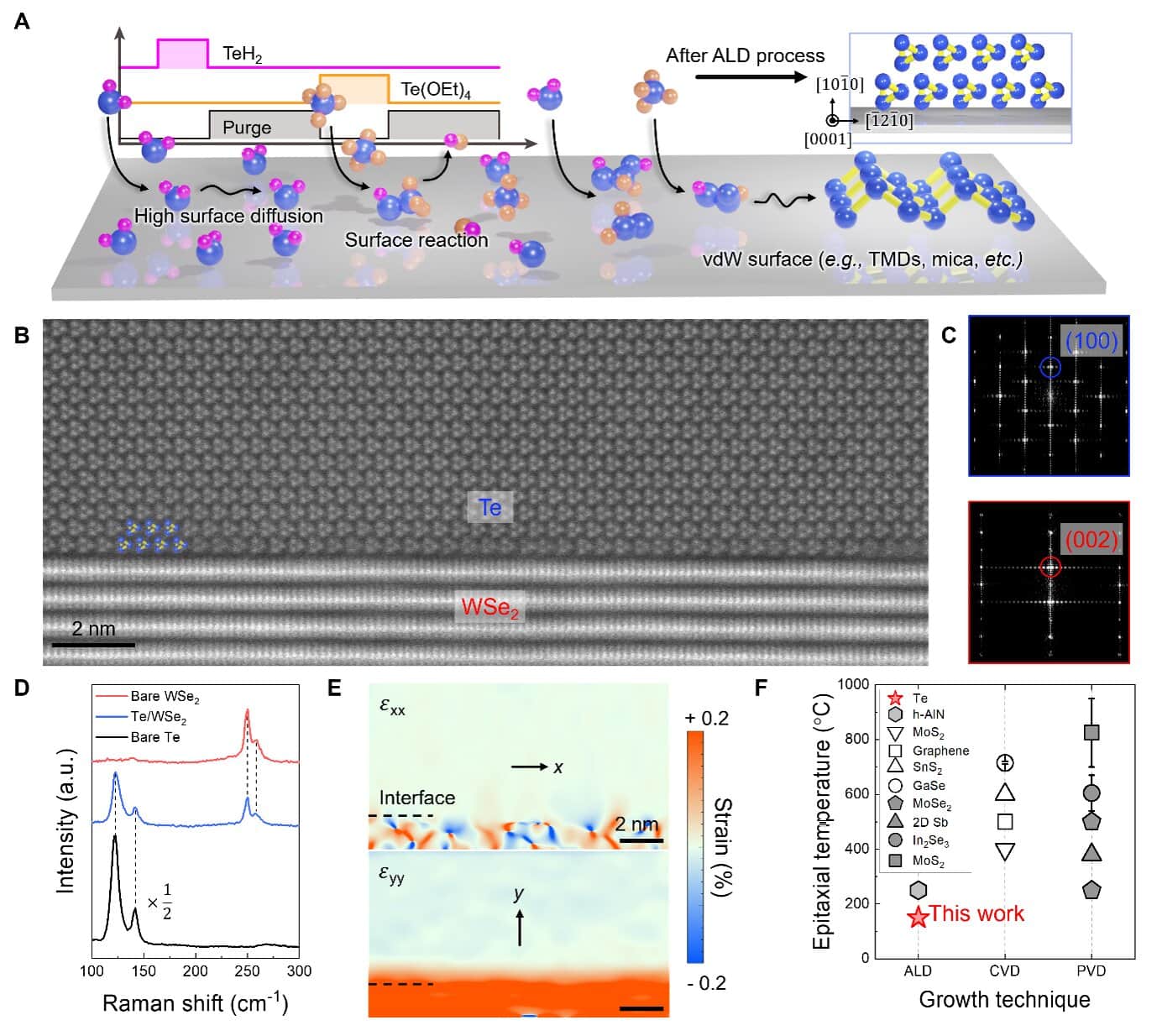
Image: TechXplore
Diffusion-steered epitaxial atomic layer deposition of tellurium and the structural characteristics of tellurium grown on WSe₂. Credit: The Korea Advanced Institute of Science and Technology (KAIST)
A KAIST-led research team has developed an atomic layer deposition (ALD) technique that grows crystal-aligned tellurium semiconductor films at just 150°C (302°F). The method could help manufacturers stack different semiconductor materials without damaging their properties or the interfaces between them.
The work, published in Science Advances, was led by Joonki Suh of KAIST’s Department of Chemical and Biomolecular Engineering, in collaboration with Bonggeun Shong of Hanyang University and Yimo Han of Rice University in the United States.
Van der Waals materials, including transition metal dichalcogenides (TMDs), are made of atomic layers held together by weak interlayer forces. That structure allows different materials to be stacked while preserving atomically clean interfaces, making them candidates for next-generation AI chips and ultra-low-power devices.
Recommended reading
Crystalline rubrene pushes OLED current density 1,000× higher
Their chemically stable surfaces, however, make it difficult to grow additional semiconductor layers in a uniform orientation. The problem is particularly pronounced at low temperatures, where atoms tend to nucleate and grow in random directions rather than following the structure of the underlying crystal.
Conceptual illustration of tellurium thin-film growth using diffusion-steered epitaxial atomic layer deposition. Credit: The Korea Advanced Institute of Science and Technology (KAIST); AI-generated image
Precursors move toward stable growth sites
The new approach allows tellurium-containing precursors—the molecular building blocks used to fabricate semiconductors—to move across the surface before settling at energetically stable positions. They then form an aligned thin film instead of nucleating randomly.
ALD supplies semiconductor precursors sequentially, enabling uniform films with atomic-level control over thickness. In the team’s process, this controlled deposition produced tellurium epitaxially in a single direction on several van der Waals materials.
Tellurium is being studied for semiconductor and optoelectronic applications, including photodetectors and light-emitting diodes, because it combines strongly direction-dependent electrical conductivity with light-controlling properties.
The researchers confirmed that the method works with multiple underlying materials:
- Tungsten diselenide (WSe₂)
- Molybdenum disulfide (MoS₂)
- Rhenium diselenide (ReSe₂)
- Mica
Epitaxial growth follows the atomic arrangement of the substrate, producing an ordered film that can improve electrical transport and semiconductor performance. The team also used the resulting films to fabricate transistors and optoelectronic devices that detect or emit light, demonstrating that the process extends beyond material growth to functional devices.
“This study is the first to demonstrate that high-quality semiconductor films can be grown on van der Waals materials at low temperature without damaging the underlying materials.”
Suh said the technology could become a manufacturing platform for integrating a range of next-generation semiconductors on a single chip.
The study, “Van der Waals template–encoded soft epitaxy of tellurium enabled by atomic layer deposition,” was published in Science Advances in 2026. DOI: 10.1126/sciadv.aef1430.
Lisa Lock: BA in art history and MA in material culture. Former museum editor, paramedic, and transplant coordinator; editing for Science X since 2021.
Robert Egan: Bachelor’s in mathematical biology and master’s in creative writing.
Computing Editor
Tomas lives in the terminal. He covers chips, laptops, and operating systems with a focus on performance and efficiency. He reads kernel changelogs the way other people read fiction, and he's always on the hunt for the perfect mechanical keyboard switch. If it processes data, Tomas has an opinion on it.
via TechXplore