• 3 min read
Solar windows harvest indoor light and sunlight
UCL researchers built semi-transparent perovskite solar windows that convert indoor light and sunlight into electricity.
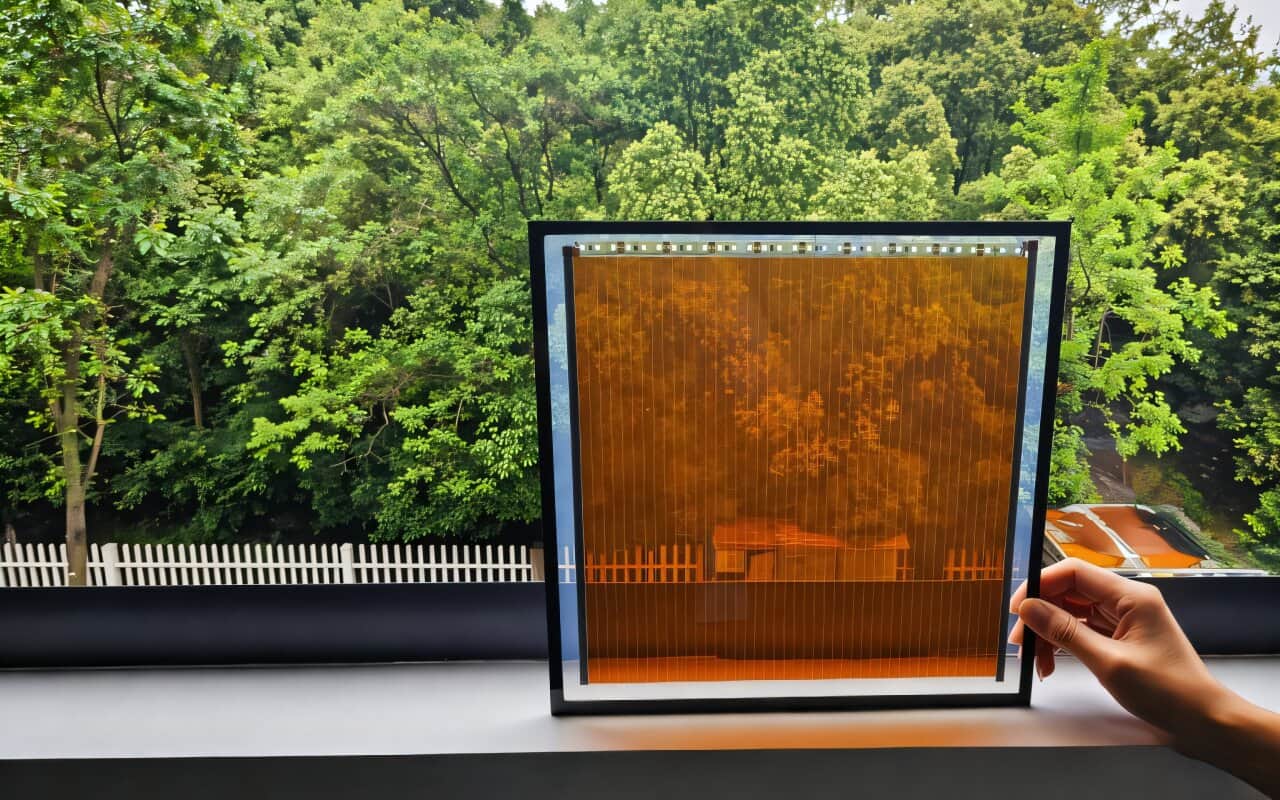
Image: TechXplore
The prototype. Credit: University College London
A new type of semi-transparent solar cell could turn windows into power sources that work under both sunlight and indoor lighting. An international team led by researchers at University College London (UCL) describes the technology in a paper published in Advanced Energy Materials.
The approach could allow buildings to generate electricity at night and on cloudy days, as well as in direct sunshine. The researchers designed solar windows that transmit 30% of sunlight—compared with roughly 80% or 90% for ordinary glass—while retaining strong energy-generation performance.
“Rooftops are commonly fitted with solar panels but the vast window areas of many modern buildings remain largely untapped as an energy resource. ”In our study, we showed it is possible to keep the window transparent so it can let light through while maintaining the solar cells' efficiency. “The next step is to engineer flexible solar cells that can be applied to curved structures like windows on the Shard or on cars as well as non-rigid surfaces such as clothes or backpacks. We would also like to build solar cells over larger scales than we achieved in this study. ”The longer-term vision is to make semi-transparent photovoltaics as easy to integrate as a window film. As the technology matures, these devices could potentially be developed into flexible films that can be applied directly onto vehicle glass, sunroofs and other transparent surfaces to generate clean electricity without major structural changes."
Lead author Siming Huang, a Ph.D. student at UCL’s Institute for Materials Discovery, said the partial shading could also reduce cooling demand. By blocking some sunlight, the technology acts similarly to tinted glass, potentially lowering the energy needed for air conditioning in hotter regions.
Recommended reading
Rosatom advances 10 MW mini reactor for Chukotka
Perovskite layers tuned for indoor light
The team used perovskite, a material increasingly used in outdoor solar panels. Unlike conventional silicon-based cells, perovskite’s composition can be adjusted to absorb the specific wavelengths found in indoor lighting.
Computer modeling helped the researchers balance transparency with efficiency. They built a light-absorbing perovskite layer just 185 nanometers thick—about 500 times thinner than a human hair and three or four times thinner than the layer used in typical solar cells.
The researchers also added 3-trifluoromethyl-1H-1,2,4-triazole, a molecule that reduces defects known as “traps.” These defects can hold electrons in place before their energy is collected. The molecule also helped stabilize the perovskite crystal structure and limit degradation over time.
Transparent electrode boosts performance
Gold electrodes commonly used in perovskite solar cells conduct electricity effectively but block light. To improve transparency, the team placed a thin gold layer between two transparent layers of molybdenum oxide, reducing reflection and allowing more light to pass through.
In a 30cm by 30cm panel, the solar cells converted 22% of bright indoor light at 1,000 lux into electricity and 14% of sunlight. During a standard accelerated durability test, the bare device retained 80% of its efficiency after 300 hours of continuous exposure to light.
The researchers say the next stages include scaling up the cells and developing flexible versions for curved windows, vehicle glass, sunroofs, clothing and backpacks.
Sadie Harley, BSc Life Sciences & Ecology
Robert Egan, bachelor’s in mathematical biology and master’s in creative writing
Publication: Siming Huang et al., “Multimodal Strategy for Efficient Semi‐Transparent Perovskite Solar Cells and Modules with Record Indoor Performance,” Advanced Energy Materials (2026). DOI: 10.1002/aenm.70883

Frontier Editor
Dan is our resident futurist, covering electric mobility, space exploration, and the smart home. He's interested in atoms just as much as bits. Whether it's a new battery chemistry, a reusable rocket, or a protocol that finally makes IoT devices talk to each other, Dan breaks down the engineering that pushes humanity forward.
via TechXplore