• 3 min read
Candy-serving robot exposes a gap in human comfort
A study of Biscee, an autonomous candy-serving robot, found visitors watched it more, took more sweets and felt uneasy when it came too close.
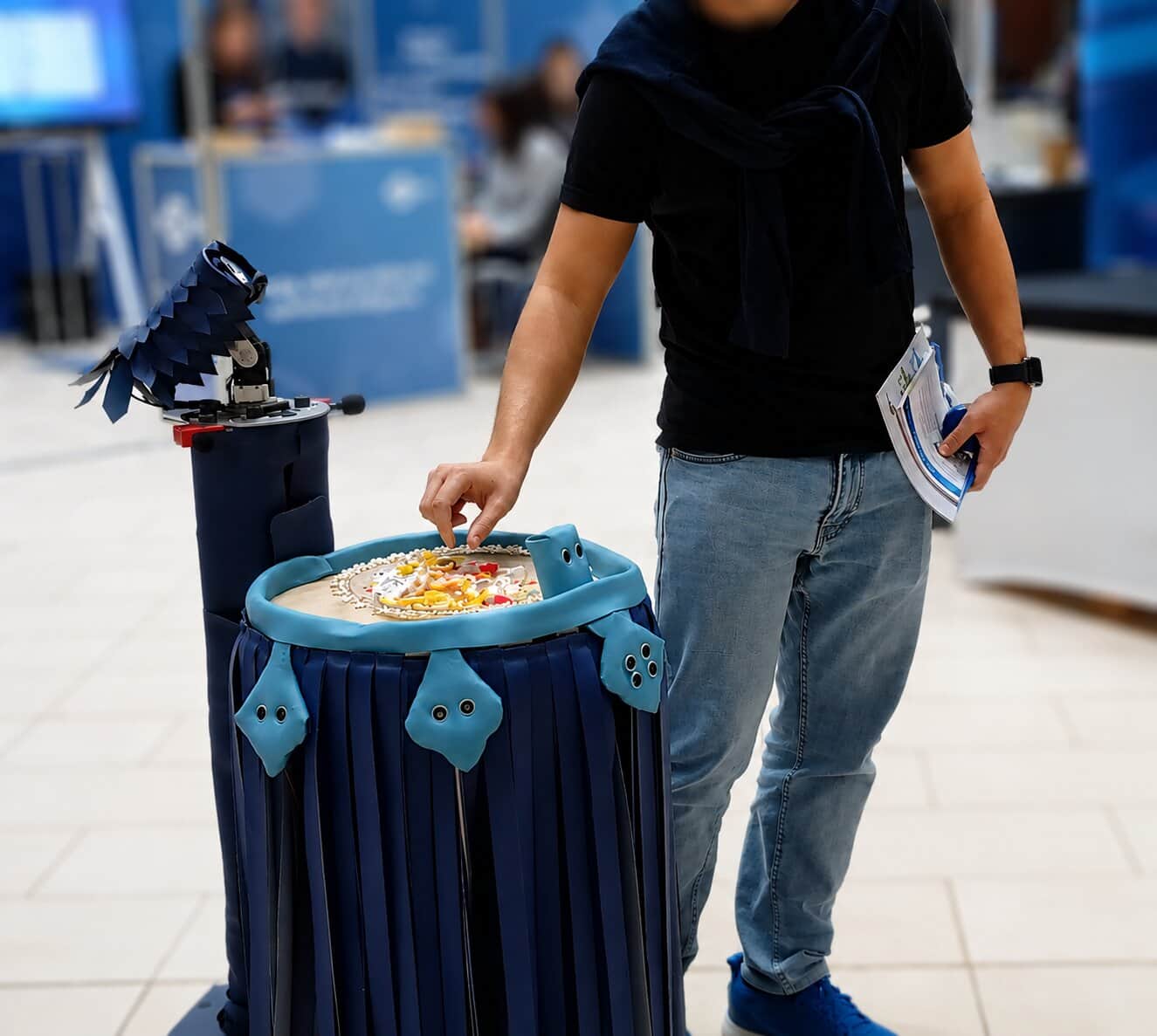
Image: TechXplore
An autonomous service robot offering candy attracted more attention than a human server at public events—and emptied its tray faster. Credit: Márta Gácsi / ELTE Eötvös Loránd University
Visitors were more curious than cautious around Biscee, a mobile, nonhumanoid robot developed by ethologists at ELTE Eötvös Loránd University and the HUN-REN–ELTE Comparative Ethology Research Group. The findings, published in Computers in Human Behavior Reports, also suggest that people may follow different social rules when interacting with a robot.
Researchers compared Biscee with a young woman performing the same candy-serving task at real-life public events. The robot moved autonomously through crowds, carrying sweets on a tray, while the human server worked in the same environment.
Recommended reading
Yandex Music blends recommendations for two users
The robot drew attention—and candy
Visitors were more likely to watch Biscee than the human server, but they were no more likely to move away from it. The researchers also observed people pointing at, waving to and touching the robot, even when its tray was empty. That suggests the robot itself, rather than only the candy, drove much of the interest.
“Visitors were more likely to observe the robot than the human server. Yet despite attracting extra attention, the robot did not make people more likely to move away or avoid it.”
Biscee’s tray emptied faster in every trial. The difference was not simply that more people stopped at the robot: visitors often took two or more candies at once, something they never did from the human server. The researchers suggest that people may have felt less pressure to follow the social norm of taking “just one” when the server was a robot.
The results indicate that even relatively simple social robots can handle routine service tasks in busy public spaces.
Credit: Márta Gácsi / ELTE Eötvös Loránd University
Reported comfort did not match observed behavior
The team also asked visitors how they felt. While people stepped away from Biscee just as rarely as they did from the human server, some said they felt slightly uncomfortable when the robot approached closely, describing it as somewhat pushy or intrusive.
“This discrepancy highlights the importance of combining different methods to assess the intended users' attitudes toward a social robot in more depth during the early development of the agent.”
Gácsi said this step is often missing, creating a gap between users' preferences and the robotic agent presented to them.
The study offers a real-world view of human-robot interaction, but the researchers caution against assuming that coexistence will be seamless. They argue that rigorous research will be needed as robots become more common in shared public spaces.
The paper, “Taking candy from a robot: Attitudes toward an autonomous non-humanoid service robot at real-life events,” was published in Computers in Human Behavior Reports in 2026. DOI: 10.1016/j.chbr.2026.101204.
Lisa Lock: BA art history, MA material culture. Former museum editor, paramedic, and transplant coordinator. Editing for Science X since 2021.
Robert Egan: Bachelor’s in mathematical biology, Master’s in creative writing. Well-traveled with unique perspectives on science and language.

Computing Editor
Tomas lives in the terminal. He covers chips, laptops, and operating systems with a focus on performance and efficiency. He reads kernel changelogs the way other people read fiction, and he's always on the hunt for the perfect mechanical keyboard switch. If it processes data, Tomas has an opinion on it.
via TechXplore