• 2 min read
Reshetnev develops folding 12-meter satellite reflector
Reshetnev has tested a folding 12-meter satellite reflector designed to fit under a rocket fairing and deploy with a single actuator.
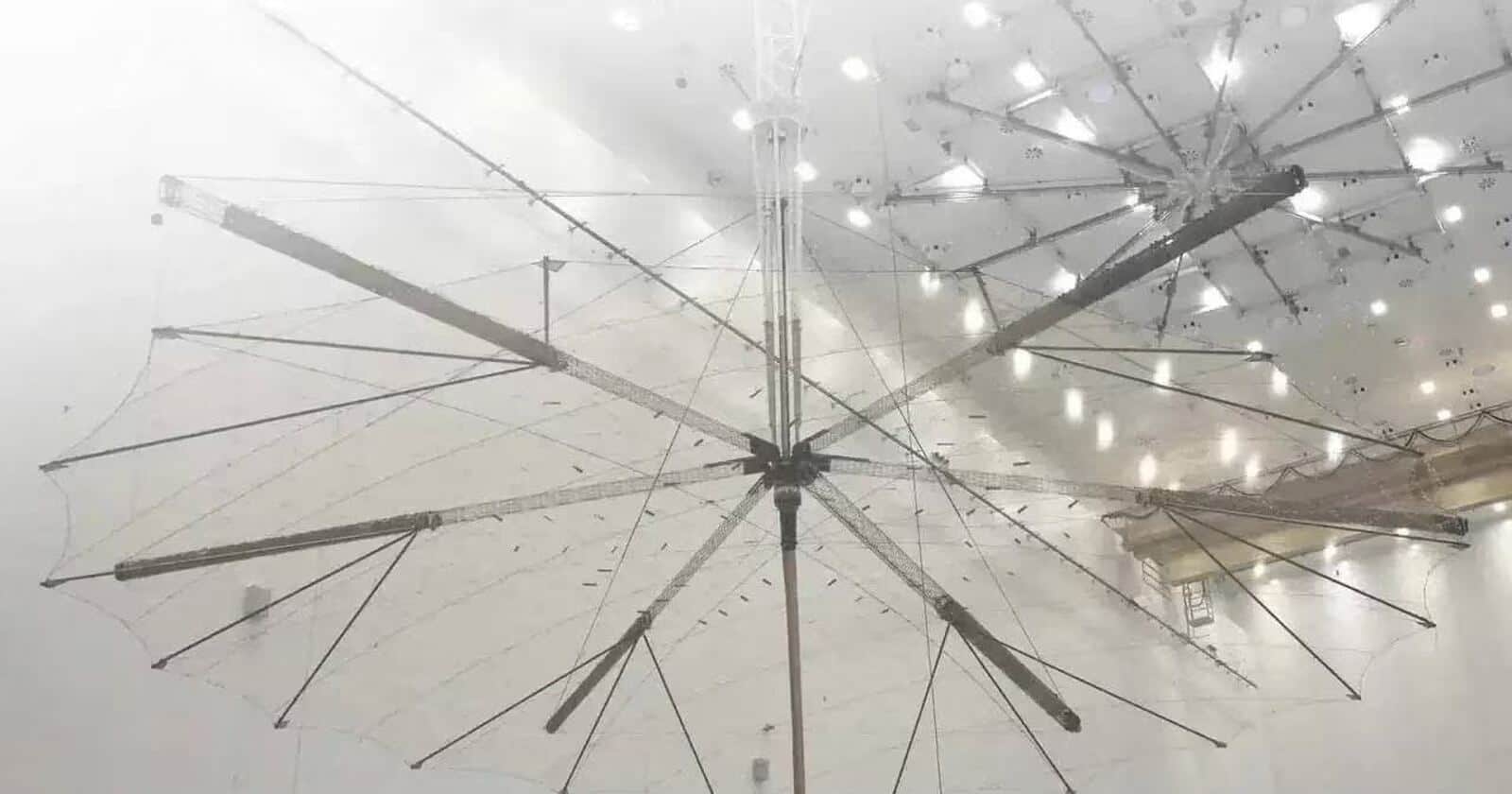
Image: ITzine
Image credit: Roscosmos
Reshetnev, the Russian satellite manufacturer officially known as Information Satellite Systems named after academician M. F. Reshetnev, has developed a folding 12-meter umbrella-type reflector for space communications. A prototype has already undergone testing, and the company plans to use the design on future satellites.
The antenna has a diameter of 12 meters. When folded, it forms a compact package that can fit beneath a launch vehicle’s fairing. A single actuator deploys the reflector once the spacecraft is in orbit.

Recommended reading
Starlink Mini 2 reportedly adds a built-in battery
That arrangement addresses a central spacecraft-design constraint: a large aperture can provide greater signal gain, but the antenna must still fit within the launcher’s strict mass and volume limits.
How the folding reflector is built
The reflector is designed to fold and deploy without bulky mechanical systems. For a space antenna, that can reduce mass and simplify testing while limiting the number of components that could fail after launch.
A 12-meter antenna is intended for applications requiring high sensitivity and the ability to receive weak signals. Potential uses include satellites serving remote areas and relay spacecraft operating across long distances.
The reflector’s mesh is also part of Reshetnev’s development work. In 2022, the company presented a replacement for conventional 15–30-micrometer tungsten and molybdenum wire. That material was a metal composite designed to combine high electrical conductivity with resistance to physical stress—an effort to balance strength, low weight, and stable radio-frequency performance in large space reflectors.
Image credit: Roscosmos
Why large deployable antennas matter
Satellite communications must balance two competing requirements: large antennas and sufficient link power on one side, and strict limits on spacecraft mass, volume, and launch cost on the other. Large deployable reflectors remain valuable, but they are difficult to manufacture and qualify.
Companies including Boeing and Airbus Defence and Space, along with specialist suppliers in the United States and Europe, are developing lightweight deployable antennas and mesh reflectors for telecommunications satellites. Reshetnev has a long history in this segment. Its umbrella-type antennas have been installed on relay satellites since the 1980s, when signal power was a primary concern.
The new reflector retains that basic approach while aiming to make it more suitable for current spacecraft. Reliable deployment can also simplify satellite designs intended for series production and reduce dependence on complex post-launch operations.
The prototype is now undergoing ground verification of its characteristics. If testing confirms the results, the next step will be integrating the reflector into new satellite platforms. That phase will show whether the new materials and folding mechanism can support serial production—or whether the antenna remains a prototype.

Frontier Editor
Dan is our resident futurist, covering electric mobility, space exploration, and the smart home. He's interested in atoms just as much as bits. Whether it's a new battery chemistry, a reusable rocket, or a protocol that finally makes IoT devices talk to each other, Dan breaks down the engineering that pushes humanity forward.
via ITzine