• 3 min read
Porous 3D-printed feet cut robot power use
Porous TPMS feet and learned gait control cut a quadruped robot’s battery power use by up to 6.2% at 0.4–1.0 m/s.
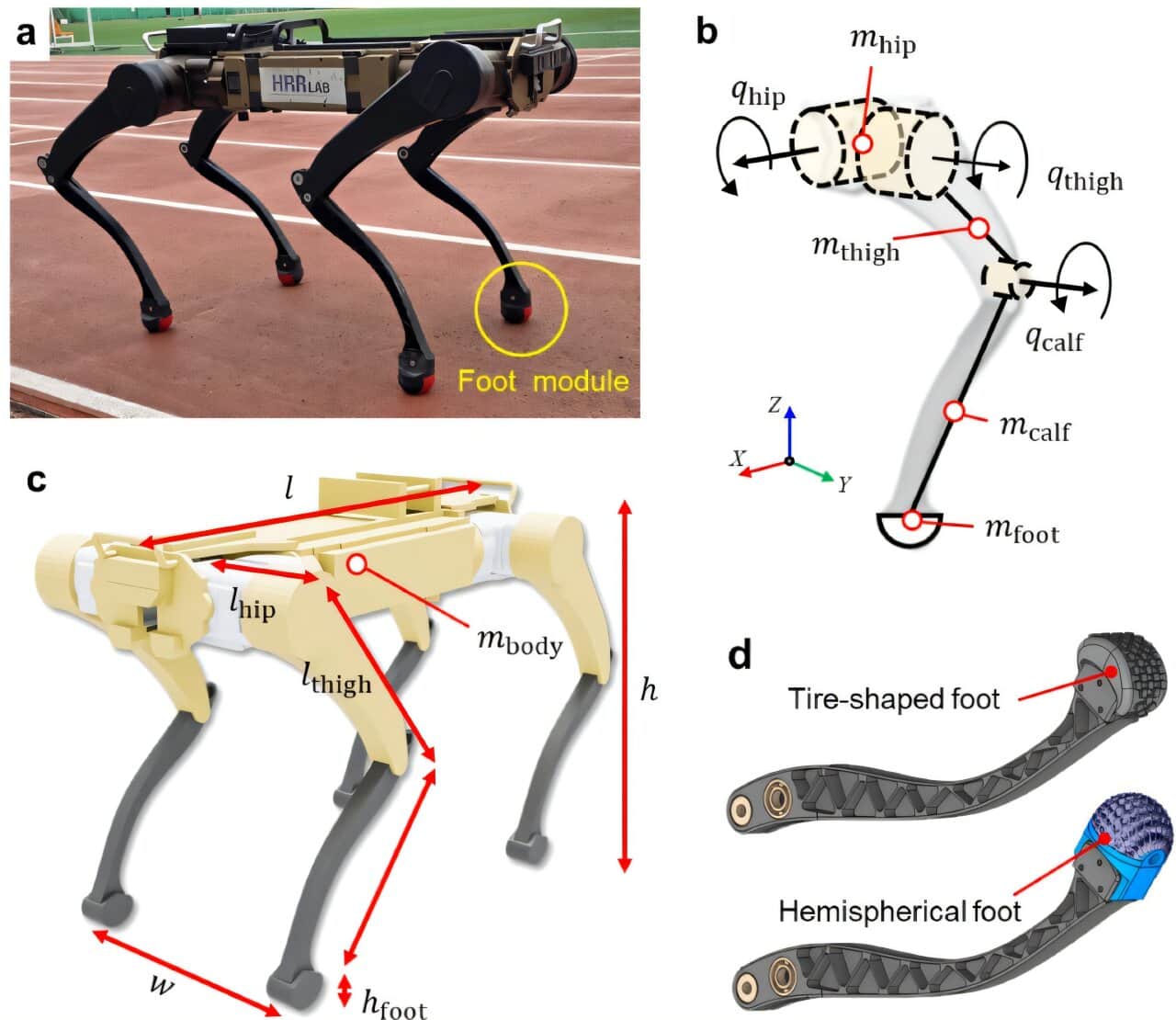
Image: TechXplore
A new foot design for quadruped robots reduced battery power consumption by as much as 6.2%, according to researchers at Seoul National University of Science and Technology in the Republic of Korea. The system combines porous, 3D-printed feet with a deep reinforcement learning controller that coordinates the robot’s gait with the feet’s elastic behavior.
The results, published in the International Journal of Precision Engineering and Manufacturing-Green Technology in 2026, were measured at walking speeds from 0.4 to 1.0 meters per second (0.9 to 2.2 mph). Compared with conventional solid feet, the new feet cut battery power consumption by 1.4% to 6.2% while maintaining stable locomotion.
Why compliant feet can save energy
Quadruped robots use repeated leg movements for inspection, transportation and search-and-rescue tasks. Unlike wheeled robots, they cannot rely primarily on rolling motion, so improving the efficiency of each step is a persistent engineering challenge.
Recommended reading
China powers megawatt turbine with pure helium
One common approach is to add springs or other elastic components to the legs. These parts absorb impact energy when a foot lands and release it during push-off. At low walking speeds, however, much of that stored energy can be dissipated instead of helping the robot move forward. The resulting inefficiency can also make the robot less stable.
The researchers addressed the problem by integrating the elastic element into the foot itself. Their triply periodic minimal surface (TPMS) structures use repeating three-dimensional porous networks. The structures are lightweight, stiff and capable of absorbing energy, with potential applications that include airless tires and soft-robotic grippers and joints.
“By modulating foot stiffness and leveraging passive energy absorption and release, the proposed approach offers a practical alternative to conventional leg-mounted spring mechanisms.”
Three TPMS foot designs tested
The team designed and 3D-printed three hemispherical foot structures:
- Primitive
- Gyroid
- Diamond
Compression tests measured how effectively each design stored and released energy. The researchers selected the diamond structure with a relative density of 60% because it offered the best combination of flexibility and energy absorption, while minimizing energy loss.
The optimized foot was fitted to the commercially available RBQ-10 quadruped robot. The first study image shows the platform, its three-degree-of-freedom leg structure, component dimensions, and a comparison between its conventional tire-shaped foot and the hemispherical TPMS module. The second shows the porous footpads used in testing. Credit: International Journal of Precision Engineering and Manufacturing-Green Technology (2026); Dr. Jung-Yup Kim and Dr. Keun Park, Seoul National University of Science and Technology.
Reinforcement learning adapts the gait
The feet alone do not automatically produce the reported savings. The researchers trained a deep reinforcement learning controller to evaluate walking strategies according to their energy consumption while accounting for how the TPMS structures compressed and rebounded.
This allowed the robot to synchronize its gait with the feet’s passive energy storage and release. By reducing the mechanical work required from the motors—and avoiding unnecessary corrective movements—the controller helped the robot exploit the compliant feet without sacrificing stability.
“These results demonstrate that TPMS metastructures, when properly modeled and exploited through learning-based control, can serve as effective energy-shaping components for energy-efficient quadruped locomotion.”
The study did not report a price or availability timeline for the TPMS foot modules. It identified indoor service, inspection, logistics and other real-world uses as potential applications for quieter, more energy-efficient quadruped robots.
The research paper, “Energy-efficient Quadruped Robot Locomotion Via TPMS-Based Foot Design and Deep Reinforcement Learning,” was authored by Kang-Hui Lee and colleagues. Its DOI is 10.1007/s40684-026-00895-5.
Who reported the study
Swati Mestri holds a bachelor’s degree in Electronics Engineering and has worked as a content editor since 2019.
Robert Egan holds a bachelor’s degree in mathematical biology and a master’s degree in creative writing.
Frontier Editor
Dan is our resident futurist, covering electric mobility, space exploration, and the smart home. He's interested in atoms just as much as bits. Whether it's a new battery chemistry, a reusable rocket, or a protocol that finally makes IoT devices talk to each other, Dan breaks down the engineering that pushes humanity forward.
via TechXplore