• 2 min read
Perovskite solar cells top 26% with interface chemistry fix
A new bidentate ligand strategy pushed n-i-p perovskite solar cells to 26.19% efficiency and kept over 80% performance after 1,000 hours at 75°C.
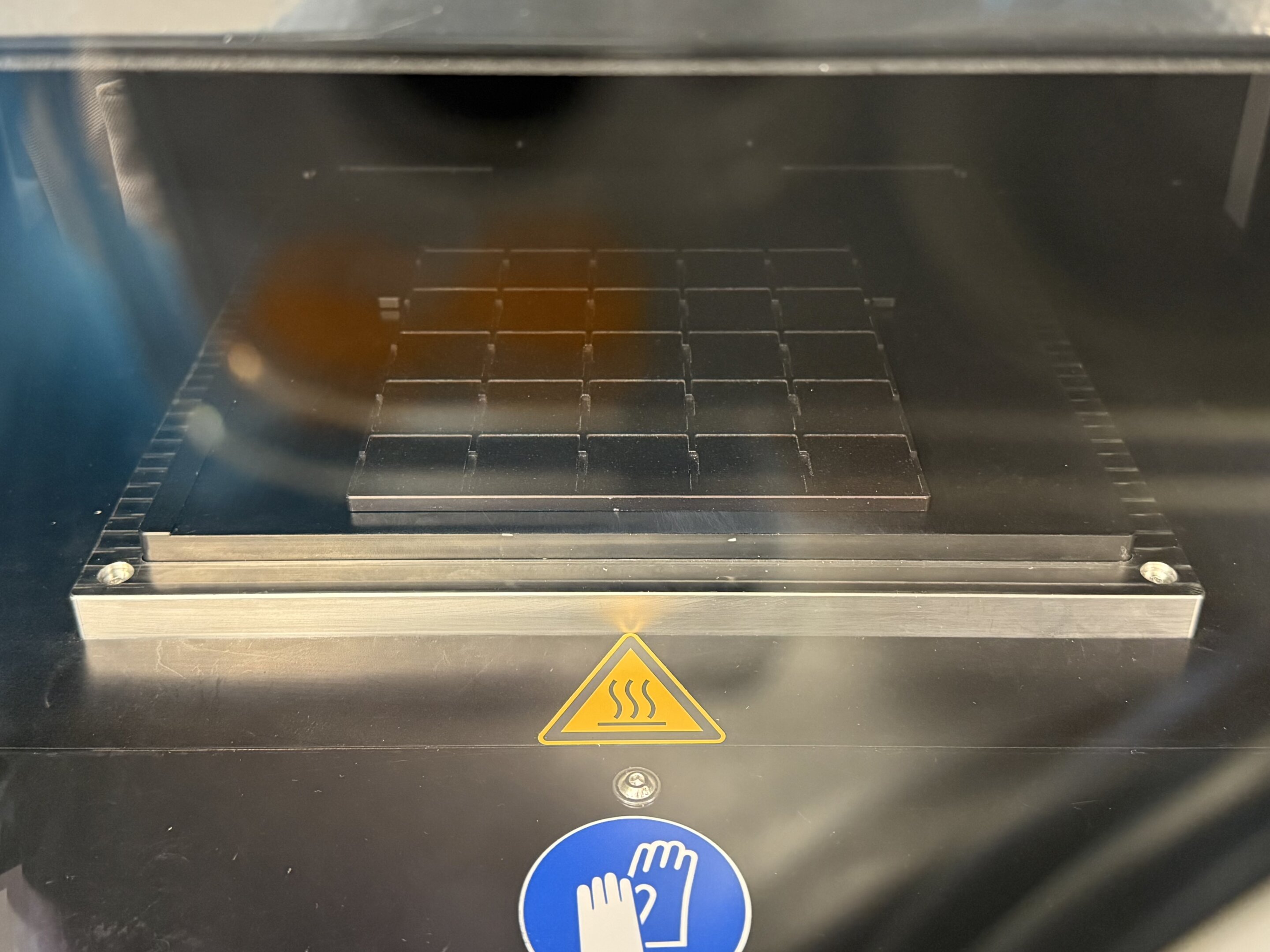
Image: TechXplore
Perovskite solar cells have cleared 26% efficiency in a new study by an international collaboration led by teams at Helmholtz Zentrum Berlin, Purdue University, and Emory University. The researchers report 26.19% power conversion efficiency in an n-i-p architecture, alongside a stabilized efficiency of 25.65% and improved durability under heat and light stress.
The work, published in the Journal of the American Chemical Society, targets a stubborn problem in perovskite photovoltaics: leftover lead iodide (PbI₂) at the surface after film formation. While some PbI₂ can help during crystallization, uneven residual patches at the final interface can create local surface-potential variations, trap charge carriers, and increase nonradiative recombination.
The team’s solution was a new class of bidentate molecular ligands designed to bind selectively to residual PbI₂ through two anchoring sites. According to the researchers, that lets the molecules reconstruct residual PbI₂ into more stable and electronically favorable PbI₆ coordination structures without disturbing the underlying three-dimensional perovskite absorber. The top-performing molecule, MeXT, produced a much more uniform electronic surface, reducing interfacial disorder and voltage losses while improving charge transport toward the hole transport layer.
The best device delivered:

Recommended reading
Luch-5 satellites kept Soyuz MS-29 linked to the ISS
- 26.19% efficiency
- 1.198 V open-circuit voltage
- 83.2% fill factor
- 26.28 mA cm⁻² short-circuit current density
Under combined light and thermal stress at 75°C (167°F), treated devices retained more than 80% of their initial efficiency after 1,000 hours.
A key part of the study came from the HZB team’s use of transient and spatially resolved surface photovoltage measurements, which showed how the molecular treatment changed charge separation and extraction at the interface. Rather than simply passivating defects, the optimized treatment altered charge selectivity itself: poorly treated surfaces showed electron accumulation and trapping, while the bidentate approach suppressed those pathways and promoted hole accumulation and extraction.
The group says this points to a broader design rule for building electronically homogeneous interfaces through selective chemical coordination. It also feeds into HZB’s next step: a fully robotized line for solar cell preparation, characterization, and optimization at HySPRINT, due to be installed over the coming three months. The platform is intended to speed experimental optimization by roughly a factor of 10, with the first photos and videos from the new robotic lab planned for September and October 2026.

Frontier Editor
Dan is our resident futurist, covering electric mobility, space exploration, and the smart home. He's interested in atoms just as much as bits. Whether it's a new battery chemistry, a reusable rocket, or a protocol that finally makes IoT devices talk to each other, Dan breaks down the engineering that pushes humanity forward.
via TechXplore