• 2 min read
Perovskite emitter pushes vapor-deposited LEDs forward
An X-type perovskite emitter delivers 21.9% EQE and 16.8 nm emission linewidth in vapor-deposited LEDs, improving prospects for high-resolution displays.
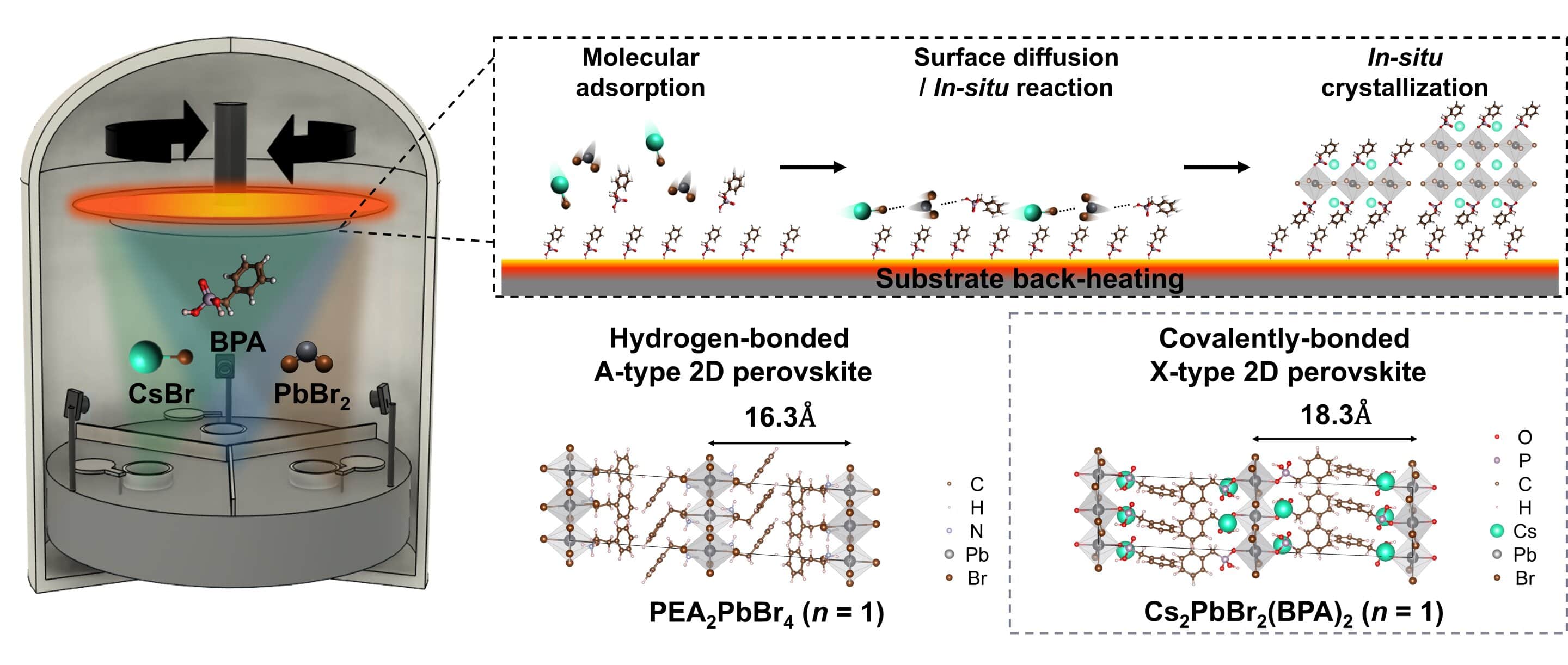
Image: TechXplore
A new perovskite emitter has enabled vapor-deposited LEDs with a reported 21.9% external quantum efficiency (EQE) and a narrow 16.8-nanometer emission linewidth. The device was developed by a joint team led by Tae-Woo Lee of Seoul National University and Samuel D. Stranks of the University of Cambridge.
The researchers designed an X-type quasi-two-dimensional perovskite emitter that stabilizes the crystal phase most favorable for light emission during vacuum deposition. Their findings were published July 1 in Nature Nanotechnology.
Left: Photoluminescence efficiency of perovskite films; center: external quantum efficiency of LED devices; right: device-efficiency trend. Credit: Nature Nanotechnology, originally published in Nature Nanotechnology.
Why vacuum-deposited perovskites have lagged
Perovskites are being studied for displays because they combine high efficiency, vivid and color-pure emission, low material costs and compatibility with fabrication methods used for OLEDs. Vacuum deposition is particularly attractive because it is already widely used in OLED manufacturing.
Recommended reading
Russia’s Falcon 9 rival is still only a demonstrator
The process has been difficult for perovskites, however. Multiple precursors react simultaneously on the substrate, and rapid, uncontrolled crystallization can produce mixed phases, uneven films and reduced efficiency and color purity. Commercial production also requires uniform large-area films, precise thickness control and reliable pixel patterning.
The team addressed the problem by introducing X-type spacer organic molecules that coordinate strongly with lead ions during crystallization. This suppresses disordered growth and selectively promotes the most energetically stable crystal phase, giving researchers thermodynamic control over the film’s formation pathway.
X-type molecules guide crystal growth
The researchers also created a nanoscale hetero-scaffold by chemically bonding the X-type spacer molecules with lithium fluoride (LiF). The scaffold limits random crystal growth and encourages uniform crystallization across the film.
Photographs of large-area devices. Credit: Nature Nanotechnology (2026). DOI: 10.1038/s41565-026-02208-y
The resulting perovskite films achieved a photoluminescence quantum yield above 85%. The team also fabricated devices on large-area substrates, flexible platforms and patterned structures. The researchers say the approach could support ultra-high-resolution displays, AR/VR microdisplays, color-conversion layers and other emissive devices, including at ultra-small pixel sizes.
“This study is significant because it provides a fundamental understanding of how perovskite precursors react and crystallize on a substrate during vacuum deposition and, based on this understanding, establishes a new X-type quasi-2D perovskite emitter design.”
The study’s authors describe the material as a new design strategy for controlling crystallization itself, rather than simply adding a processing additive. The team plans to expand the scalability and patterning capabilities of vapor-deposited PeLEDs.
The research was published as “Halide-site-substituting spacer creates quasi-two-dimensional perovskites for vapour-deposited light-emitting diodes” by Chan-Yul Park et al. in Nature Nanotechnology (2026), DOI: 10.1038/s41565-026-02208-y.

Frontier Editor
Dan is our resident futurist, covering electric mobility, space exploration, and the smart home. He's interested in atoms just as much as bits. Whether it's a new battery chemistry, a reusable rocket, or a protocol that finally makes IoT devices talk to each other, Dan breaks down the engineering that pushes humanity forward.
via TechXplore