• 4 min read
Moonshot’s Kimi K3 packs 2.8T parameters
Moonshot AI says Kimi K3 is the world’s largest open language model, with 2.8 trillion parameters and a 1 million-token context window.
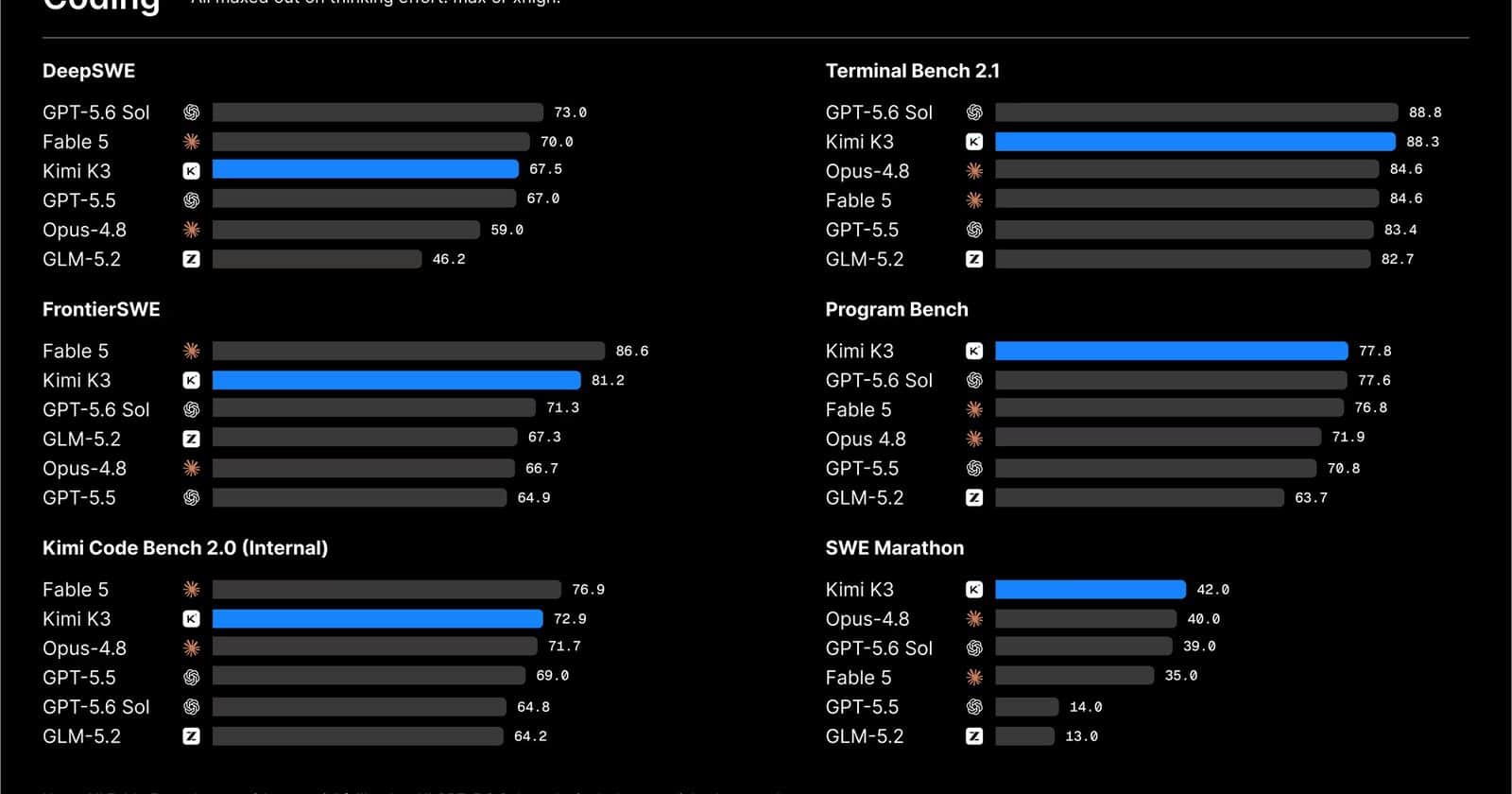
Image: kod
Moonshot AI has unveiled Kimi K3, putting one number front and center: 2.8 trillion parameters. The company is positioning it as the largest open language model in the world, aimed less at flashy demos than at practical workloads such as coding, long-document analysis, and tasks that require holding a huge amount of context at once.
The model is already running across Moonshot’s own services, while full weights are set to be released on July 27. According to the company, Kimi K3 supports a context window of up to 1 million tokens and offers native multimodality, meaning it can handle both text and images.
That makes it nearly three times larger than Kimi K2. Among open Chinese models, the gap is also notable: DeepSeek previously announced 1.6 trillion parameters, while Xiaomi was at roughly 1.02 trillion.
Recommended reading
$100 AI music videos show sharp gaps between Claude and GPT
K3 is available in:
- Kimi chatbot
- Kimi Code
- Kimi Work
- API access
Pricing is set at $3 per million input tokens and $15 per million output tokens. For an open model, that is well above the near-budget pricing Chinese labs trained the market to expect in 2024 and 2025.
Benchmark claims and trade-offs
Moonshot describes K3 as a system built for long tasks: processing batches of documents, maintaining coherent reasoning across large contexts, or writing code from specifications that run to dozens of pages. That is where competition has tightened in 2026, with OpenAI and Anthropic pushing closed models forward while open-model developers try to catch up on more than just price.
Moonshot says Kimi K3 still trails Anthropic’s Claude Fable 5 and OpenAI’s GPT-5.6 Sol in overall performance. But the company claims stronger results against many rivals in coding and reasoning. Some of those gains, the source says, are also reflected by outside platforms: in Arena blind tests, developers reportedly preferred Kimi over leading US models for front-end development tasks, and in the general text ranking K3 surpassed the standard version of Claude Opus 4.8 and reached the level of GPT-5.6 Sol.
That matters because Moonshot is no longer selling just scale. It is selling the idea that an open model no longer looks like a fallback option.
Pricing pressure and the open-model race
The launch fits a broader shift in open models. Not long ago, Meta’s Llama 3.1 405B was a benchmark for the segment, and a release measured in the hundreds of billions of parameters felt like the upper limit. Chinese companies then pushed quickly on both size and engineering performance. Moonshot is now trying to claim the next step.
There is a downside. According to Artificial Analysis, K3 shows a higher tendency to hallucinate than the previous version. That is a familiar trade-off: as companies scale up model size and reasoning behavior, maintaining accuracy across long answers gets harder. In enterprise use cases centered on documents and code, that can quickly turn into extra hours of verification.
The pricing tells its own story too. Kimi K3 is notably more expensive than its predecessor and is now priced closer to midrange Western models. That is a meaningful shift for the wider market. Chinese labs spent years promoting the idea that open models could be both strong and almost free, but as model sizes and infrastructure demands rise, that argument is getting harder to sustain.
Moonshot announced K3 at WAIC in Shanghai, a venue that has increasingly become a stage for Chinese companies making global ambitions clear rather than showing off lab demos. The startup was founded in 2023, and Alibaba is named among its investors and partners. In May, the company raised about $2 billion at a $20 billion valuation, while Chinese media reported a new round at a valuation above $30 billion.
After the weights go public on July 27, the next test will come fast: how Kimi K3 performs on independent clusters, against DeepSeek, and in localized workloads for code, documents, and enterprise agents.

AI Editor
Ava covers the rapidly evolving world of artificial intelligence, from foundational models and research labs to the real-world economics of intelligence. With a background in computational linguistics, she cuts through the hype to find out what actually works. She firmly believes that benchmarks are just marketing until reproduced in the wild.
via ITzine