

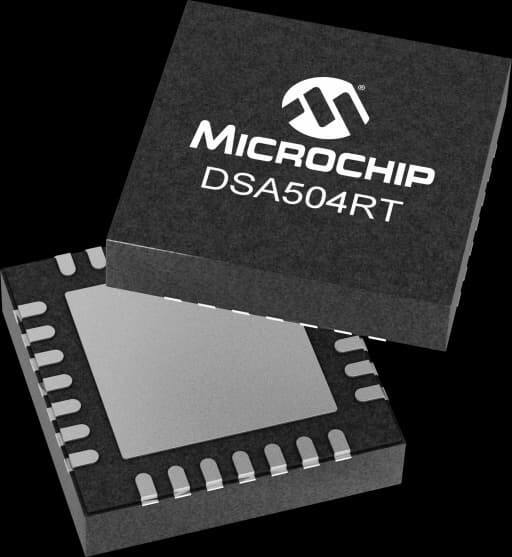
Microchip has launched the DSA504RT, a radiation-tolerant programmable clock generator that squeezes up to six output frequencies out of one reference source for aerospace and defense systems. The DSA504RT clock generator aims to reduce board space, lower power draw, and simplify timing design in space hardware.
That matters because timing hardware is one of those boring parts that becomes very exciting the moment it stops behaving. By folding several oscillators, buffers, and synthesizers into a single device, Microchip is aiming at the kind of design consolidation space platforms and defense gear love: less complexity, more predictability, and a cleaner reliability story.
DSA504RT clock generator specifications
The DSA504RT is built around an analog phase-locked loop and includes 2 fractional and 2 integer frequency dividers, plus 6 programmable output buffers. Each output can be configured for LVPECL, LVDS, HCSL, or CMOS, which gives designers room to reuse the same chip across different parts of a system instead of redesigning the clock tree every time.
- Up to 6 independent output frequencies
- About 200 femtoseconds of jitter in the 12 kHz-20 MHz range
- Supports PCIe Gen 1-7 requirements
- Input reference range: 10-250 MHz differential, up to 200 MHz CMOS
Built for harsh orbital and defense environments
Microchip says the chip operates from −55 to +125 °C and runs on 1.71 to 3.63 volts, which is the kind of spec sheet you want when repair crews are not an option. It is also rated for radiation exposure, with single-event latch-up above 78 MeV·cm2/mg at 125 °C and a total ionizing dose of 50 krad(Si).
The part comes in two packages: a hermetic CQFP32 for long-duration space use and a VQFN28 for higher-reliability commercial aerospace designs. That split is smart, because the space market still values metal-and-ceramic toughness, while many non-space customers want the same resilience without paying for overkill.
Why fewer timing chips can be better
This is not just a component launch; it is Microchip pushing a familiar systems-engineering argument. Consolidating timing functions can improve FIT, reduce power, cut mass, and shrink the bill of materials – all while making synchronization easier across satellites, avionics, and defense computing platforms. Competitors in this space have spent years selling specialized clock parts; the broader trend is toward highly integrated timing devices that do more with less silicon.
The obvious question is whether customers will trade modularity for integration. In high-stakes systems, the answer is often yes, especially when the integrated part is tuned for low jitter and wide standards support. Microchip’s bet is that one well-behaved clock generator is worth more than a pile of discrete parts that each bring their own failure mode to the party.