• 3 min read
Battery researchers find lithium metal sweet spot
Tohoku University researchers found that **1–2 M LiTFSI** electrolytes can improve lithium metal battery safety, lifespan, and deposition uniformity.
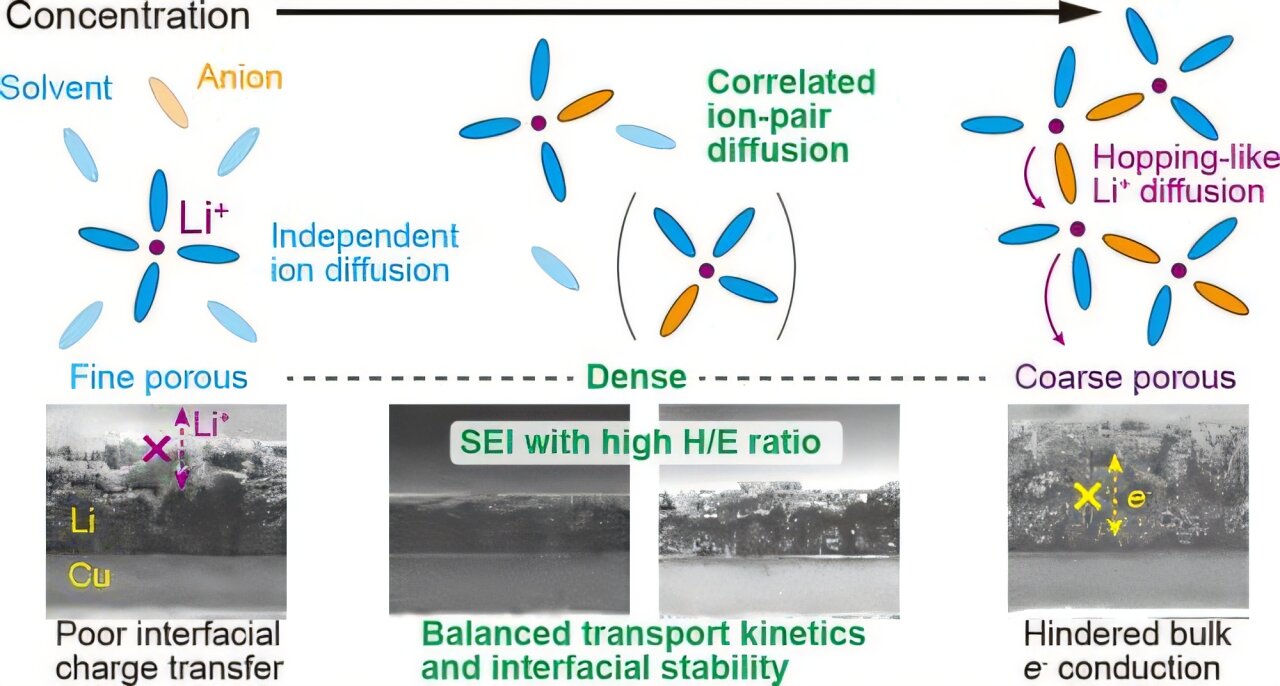
Image: TechXplore
Why this matters
Lithium metal has long been seen as a promising anode material for next-generation rechargeable batteries because it can store far more energy than the graphite anodes used today. The problem is durability and safety: during charging, lithium can grow into needle-like dendrites, which shorten battery life and can create hazards.
Researchers at Tohoku University’s Institute for Materials Research (IMR) now say the answer is not simply adding more salt to the electrolyte. In a study published in ACS Electrochemistry, they identified an optimal electrolyte concentration that helped lithium deposit more evenly while strengthening the battery’s protective surface layer.
The concentration range that worked best
The team tested electrolytes with different concentrations of lithium bis(trifluoromethanesulfonyl)imide (LiTFSI) in a mixture of ethylene carbonate and propylene carbonate. Their best results came at 1–2 molar (M) LiTFSI.
At that range, lithium ions and negatively charged TFSI ions moved through the electrolyte at nearly the same rate. According to the researchers, that balanced transport produced a more uniform flow of ions to the electrode surface, helping lithium form smooth, dense layers instead of irregular dendritic growth.

Recommended reading
Luch-5 satellites kept Soyuz MS-29 linked to the ISS
What the researchers measured
To connect electrolyte behavior with what happens at the battery surface, the researchers combined several techniques:
- pulsed-field gradient nuclear magnetic resonance (PFG-NMR)
- electrochemical measurements
- electron microscopy
- impedance spectroscopy
- nanoindentation
That let them link ion transport in the electrolyte with the mechanical properties of the solid electrolyte interphase (SEI), the protective layer that forms on the lithium metal surface.
Why too little or too much salt caused problems
The study found that balanced ion motion also produced a harder, more mechanically stable SEI layer. That matters because the SEI helps determine whether lithium grows smoothly or turns porous and unstable.
The trade-offs were clear:
- Dilute electrolytes formed weaker protective layers and allowed porous lithium deposits to develop.
- Highly concentrated electrolytes reduced ion mobility and hindered electron transport, leading to nonuniform lithium growth.
“Our results show that achieving stable lithium metal deposition is not simply a matter of increasing the salt concentration,” said Hongyi Li, an assistant professor at Tohoku University’s Institute for Materials Research.
“Instead, the key is creating a balance where lithium ions and anions move cooperatively while maintaining a mechanically robust interfacial layer. This provides a new design principle for developing practical lithium metal batteries.”
A design rule for future batteries
The work points to a different way of designing electrolytes for lithium metal batteries: optimize both ion transport and interfacial stability, rather than relying only on highly concentrated formulations.
According to the researchers, that intermediate concentration regime could help improve performance, safety, and lifespan in batteries aimed at electric vehicles, portable electronics, and large-scale renewable energy storage.
The paper is “Correlated Ion-Pair Diffusion Enables Balanced Transport Kinetics and Interfacial Stability for Lithium Metal Anodes” by Rongkang Jin et al, published in ACS Electrochemistry (2026) with DOI 10.1021/acselectrochem.6c00140.

Frontier Editor
Dan is our resident futurist, covering electric mobility, space exploration, and the smart home. He's interested in atoms just as much as bits. Whether it's a new battery chemistry, a reusable rocket, or a protocol that finally makes IoT devices talk to each other, Dan breaks down the engineering that pushes humanity forward.
via TechXplore