• 2 min read
Layered crystal boosts waste-heat conversion
Science Tokyo researchers developed TlFe1.6Se2, a bulk crystal combining high thermoelectric power with thermal conductivity near 0.2 W m-1 K-1.
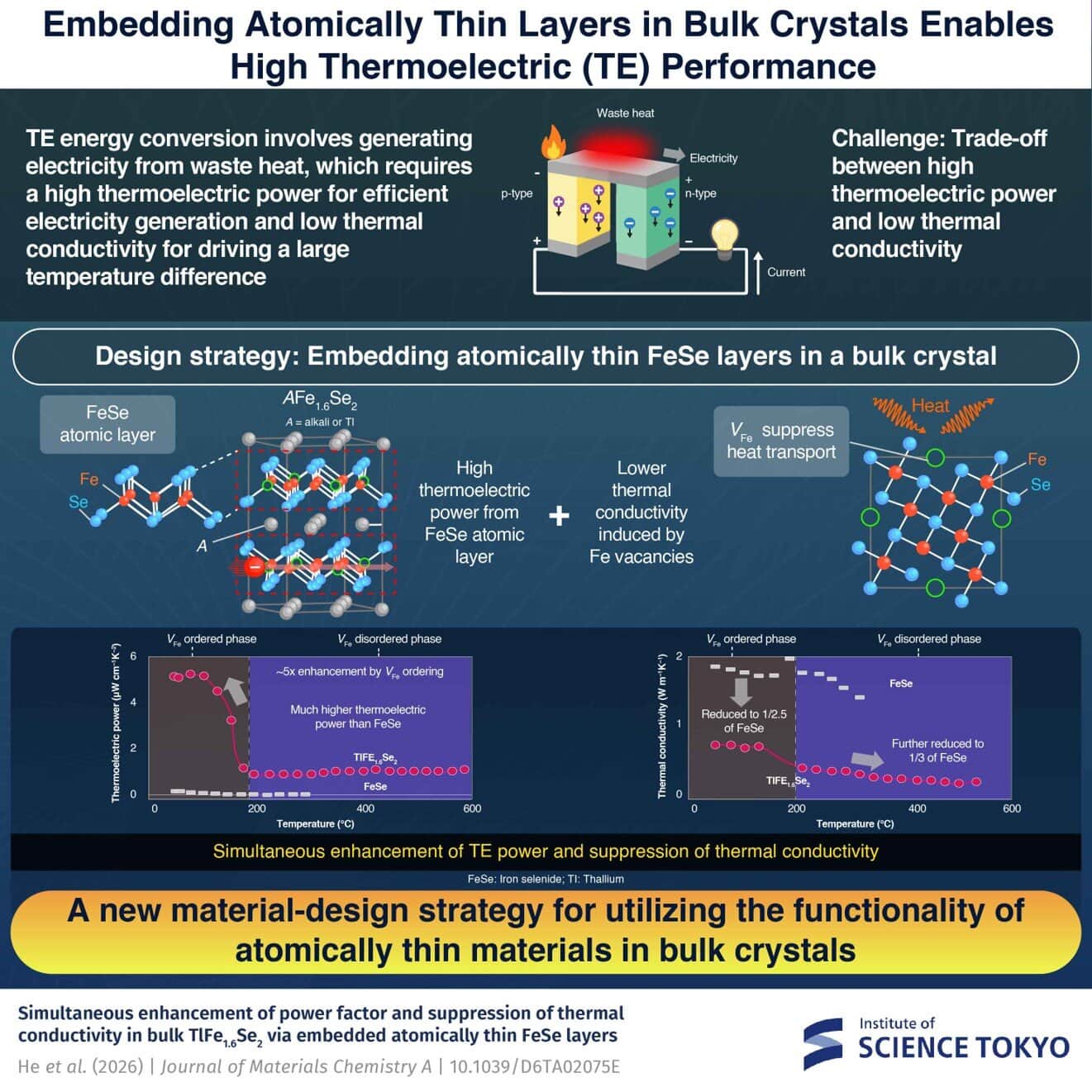
Image: TechXplore
A layered crystal developed at Science Tokyo combines the electrical behavior of atomically thin iron selenide with unusually poor heat conduction—a combination that could improve the conversion of industrial and automotive waste heat into electricity.
The material, TlFe1.6Se2, embeds periodic layers of atomically thin iron selenide (FeSe) inside a bulk crystal containing ordered iron vacancies. Researchers led by Professor Takayoshi Katase designed it to address a longstanding thermoelectric trade-off: materials must conduct electricity effectively while blocking heat well enough to preserve the temperature difference that generates power.
Thermoelectric systems could recover energy from factories, automobiles and power plants. But the high thermoelectric power factor seen in ultrathin FeSe films has been difficult to reproduce in a practical bulk material, while bulk FeSe itself conducts too much heat.
How TlFe1.6Se2 controls heat and electricity
The embedded FeSe layers produce a substantially higher thermoelectric power factor than conventional bulk FeSe, primarily because of a much larger Seebeck coefficient. This shows that the electronic properties of atomically thin FeSe can be incorporated into a larger crystal.

Recommended reading
Four Raptor failures abort SpaceX Starship test
At the same time, iron vacancies in the FeSe layers distort nearby atomic bonds and scatter heat-carrying phonons. Heavy thallium atoms and the crystal’s complex layered structure further reduce phonon velocities and increase scattering.
At about 180°C, TlFe1.6Se2 reversibly changes from an iron-vacancy-ordered phase to a disordered phase. That transition increases phonon scattering and lowers thermal conductivity to approximately 0.2 W m-1 K-1, comparable to or below that of state-of-the-art thermoelectric materials.
The vacancy arrangement also affects electrical transport. In the ordered phase, the Seebeck coefficient exceeds 100 μV K-1, and the thermoelectric power factor is approximately five times higher than in the disordered phase. The team links the increase to changes in the electronic structure caused by the ordered vacancies.
“This work demonstrates the effectiveness of a new design concept in which the functionality of low-dimensional materials is embedded within bulk crystals. The results provide a promising pathway for the development of next-generation thermoelectric materials that overcome conventional trade-offs between electrical and thermal transport properties.”
The findings, published in the Journal of Materials Chemistry A, point to a design strategy that embeds thin-film functionality in bulk compounds rather than optimizing existing thermoelectric materials alone. The researchers say related FeSe compounds containing potassium, rubidium or cesium could offer additional ways to tune iron-vacancy concentrations and thermoelectric performance.
Publication: Xinyi He et al., “Simultaneous enhancement of power factor and suppression of thermal conductivity in bulk TlFe 1.6 Se 2 via embedded atomically thin FeSe layers,” Journal of Materials Chemistry A (2026). DOI: 10.1039/d6ta02075e

Frontier Editor
Dan is our resident futurist, covering electric mobility, space exploration, and the smart home. He's interested in atoms just as much as bits. Whether it's a new battery chemistry, a reusable rocket, or a protocol that finally makes IoT devices talk to each other, Dan breaks down the engineering that pushes humanity forward.
via TechXplore