• 2 min read
New Battery Cooling System Cuts Coolant Use by 90%
South Korean researchers developed a battery cooling system that uses 80–90% less dielectric coolant while keeping packs below 35 °C.
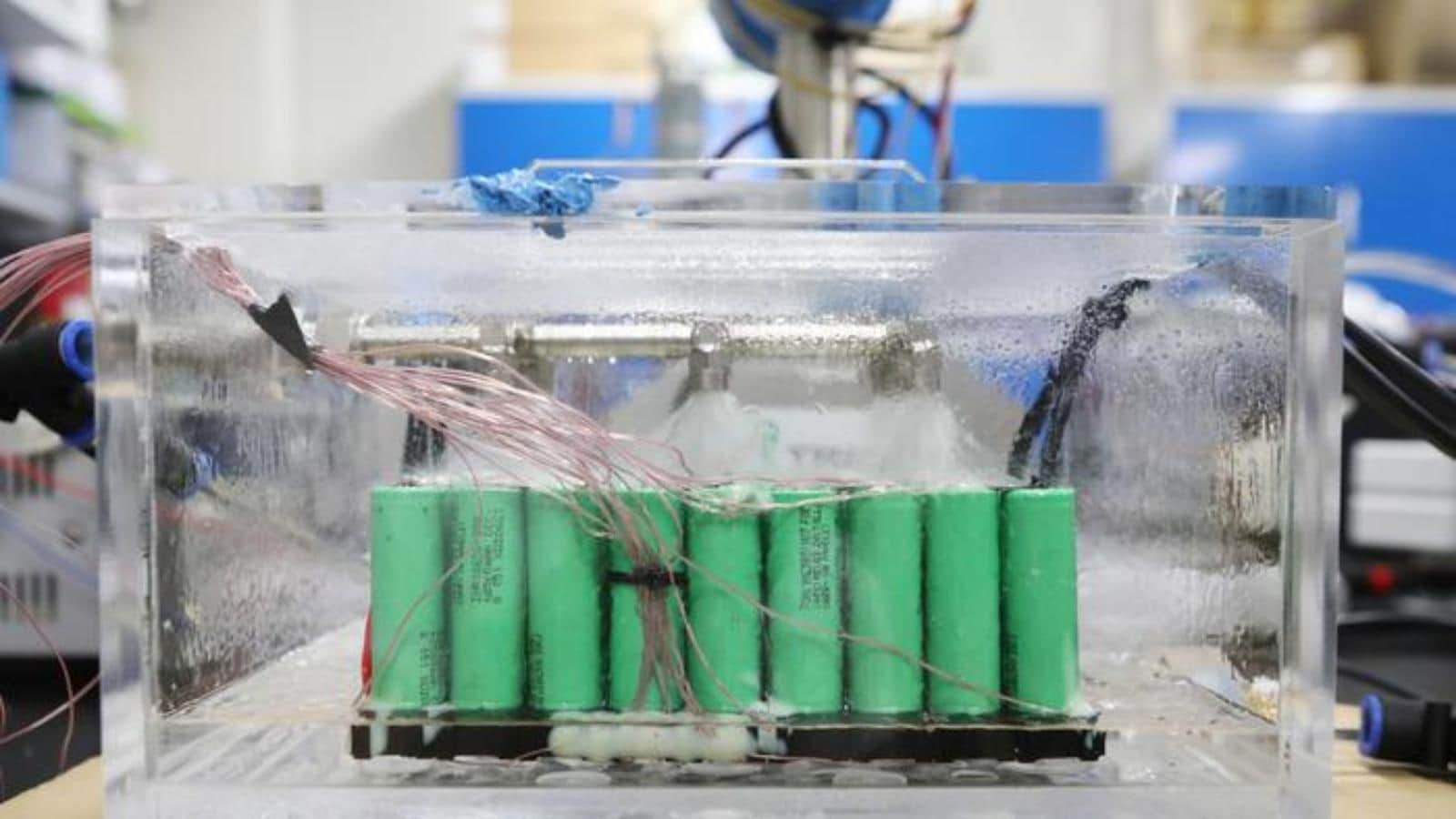
Image: iXBT
South Korean researchers have developed a hybrid cooling system for lithium-ion batteries that uses spraying and partial immersion to reduce the amount of expensive dielectric coolant required by 80–90%.
The system combines two methods: dielectric liquid is sprayed onto the tops of battery cells, while the lower part of the battery pack is partially submerged. The spray rapidly removes heat from the areas that warm most, and the liquid at the bottom provides forced convection as it carries heat through the pack.
Lithium-ion batteries require effective heat removal because overheating can trigger thermal runaway—an uncontrolled rise in temperature that can cause a fire. Full immersion in a nonflammable dielectric liquid is one of the most reliable approaches, but it adds weight, cost, and the need for a large volume of coolant.
Recommended reading
NASA’s Psyche Captures Mars in Color During Flyby
According to the researchers, the KIMM design requires only 10–20% of the liquid used by conventional full-immersion systems. During intensive charging and discharging, it kept the battery pack below 35 °C.
The coolant remains completely nonflammable and can also help suppress a fire inside the pack if a battery cell is damaged. The lower mass and reduced cost could support use in electric vehicles and large-scale energy storage systems (ESS) connected to power grids.
KIMM’s next step is to use AI-based optimization methods to search for dielectric liquids with improved thermophysical properties.

Frontier Editor
Dan is our resident futurist, covering electric mobility, space exploration, and the smart home. He's interested in atoms just as much as bits. Whether it's a new battery chemistry, a reusable rocket, or a protocol that finally makes IoT devices talk to each other, Dan breaks down the engineering that pushes humanity forward.
via iXBT