• 2 min read
ITER installs another vacuum chamber sector in France
ITER installed another vacuum chamber sector after a 30-hour operation, advancing assembly of the international fusion reactor in France.
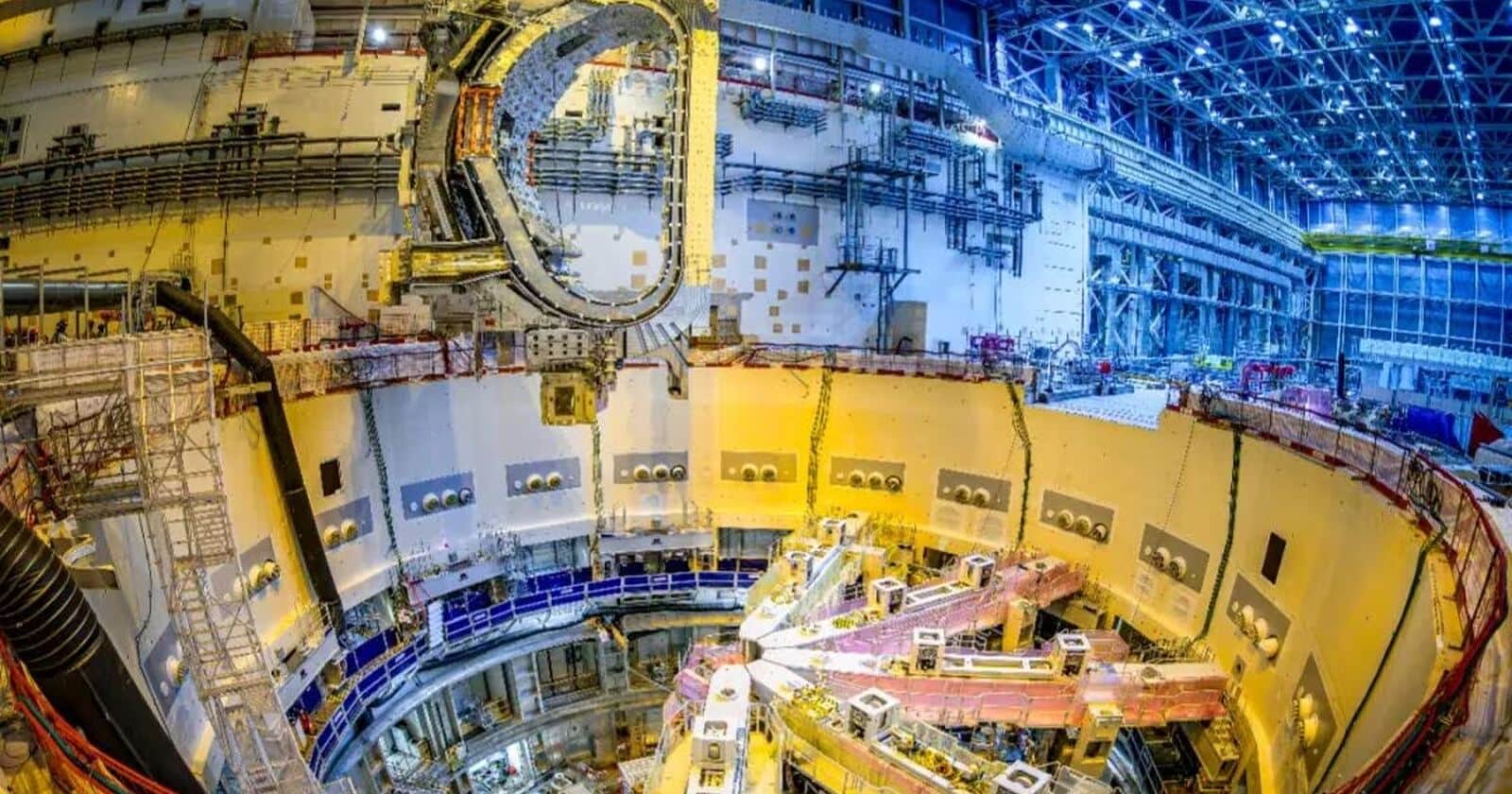
Image: ITzine
ITER has installed another sector of its vacuum chamber at the project’s construction site in Cadarache, France. The sector is part of the world’s largest experimental fusion reactor, and the installation was completed on July 28 after nearly 30 hours of continuous work.
How the ITER vacuum chamber is assembled
The chamber will contain the plasma in which deuterium and tritium are intended to fuse. Installing each sector requires lifting it, rotating it, and lowering it into a tightly confined shaft with millimeter-level precision before joining it to the rest of the sealed structure.
The work was led by the CNNC engineering consortium and coordinated among several international teams. According to the Chinese side, the operation was completed without damage or quality deviations.
Photo: mydrivers
The vacuum chamber sectors are among the most sensitive stages of ITER’s assembly. A geometric error could affect the reactor’s magnetic system, maintenance work, or the eventual launch of plasma operations. The sectors must become a single, precisely aligned and hermetically sealed structure rather than simply being installed one after another.
Recommended reading
NASA’s LINK rescue spacecraft is spinning out of control
ITER’s fusion target and remaining delays
ITER is being built as an international demonstration tokamak. The project involves the European Union, China, the United States, Russia, Japan, South Korea, and India. It began in the 1980s, with a core objective: to test whether a fusion reaction can be controlled and sustained at an industrial scale.
The design calls for 50 megawatts of input power and up to 500 megawatts of fusion energy output. If the system works as intended, those results could provide an engineering reference for future fusion power stations rather than a purely experimental installation.
The project has faced schedule shifts and increasingly complex assembly work, making it the most expensive and slowest scientific construction project in nuclear energy, according to the source. ITER’s first full plasma tests remain in the future, and the project has not provided a new date in this report.
China has been one of ITER’s most active participants, supplying components and serving as an engineering contractor for key assembly stages. CNNC says China has produced more than 10 types of equipment, including magnets and vacuum-chamber components, and has supported major tokamak-joining operations.
Other fusion programs continue in parallel: China is developing EAST, South Korea operates KSTAR, and France is running WEST, where researchers also work on plasma regimes and the confinement of extremely hot fuel. ITER’s next challenge is to complete more of these precision installations without further schedule disruptions.
Frontier Editor
Dan is our resident futurist, covering electric mobility, space exploration, and the smart home. He's interested in atoms just as much as bits. Whether it's a new battery chemistry, a reusable rocket, or a protocol that finally makes IoT devices talk to each other, Dan breaks down the engineering that pushes humanity forward.
via ITzine