• 3 min read
ISTA graphics research cuts shape costs tenfold
ISTA researchers unveil graphics methods that preserve textures on deformable surfaces and cut winding-number computation costs tenfold.
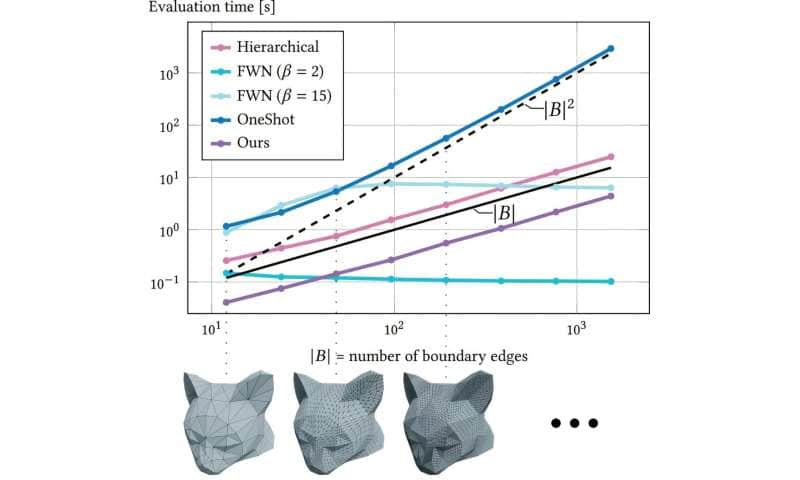
Image: TechXplore
A new pair of graphics techniques from the Institute of Science and Technology Austria (ISTA) aims to make difficult 3D computations both more realistic and less expensive. Presented at SIGGRAPH in Los Angeles, the methods address texture distortion on highly deformable surfaces and the calculation of geometric properties for complex shapes.
Both studies were published in ACM Transactions on Graphics. One introduces procedural techniques for preserving texture detail as surfaces stretch and compress. The other computes winding numbers for triangle meshes at up to an order of magnitude lower computational cost.
Procedural textures for deformable surfaces
Digital objects used in films, games and simulations are typically built as reusable 3D models. Objects with no clear resting shape, such as lava or cake batter, are especially difficult to represent because their surfaces can deform dramatically.
Doctoral student and first author Aleksei Kalinov, working with Chris Wojtan’s group at ISTA, developed methods inspired by how natural materials change. Features that remain recognizable as lava or batter deforms are treated as “allowed” texture features that can be preserved or restored algorithmically.
“If a feature is preserved when natural systems such as lava or cake batter are deformed, we consider that nature 'likes' it and that it’s an 'allowed' texture feature. We then try to come up with nature-inspired rules that are cheap to compute.”
The team represents textures using physical parameters such as frequency and amplitude, rather than only as pixels. When a surface stretches, high-frequency information is lost and replaced by lower-frequency information. The surface therefore retains a version of its detail at a lower frequency, and the process can be reversed to restore the original information.
Recommended reading
Apple’s Mac roadmap reportedly runs through 2028
Compression has the opposite effect: low-frequency detail is replaced by increasingly fine, high-frequency information. If that detail becomes smaller than a pixel, it can produce flickering, a problem known as aliasing.
To control aliasing, the researchers created two procedural approaches:
- The spectrum-rescaling algorithm restores high-frequency detail in a way that matches the surface’s deformation.
- The isotropy-preserving method counteracts deformation to retain the texture’s initial characteristics.
The algorithms generate information automatically, without physics simulations or stored deformation histories. Wojtan said the work is intended as a foundation for a wave-based approach to modeling nature, rather than a picture-based one, and may not yet be ready for concrete production applications.
“Our models might not yet be fully polished for concrete applications. However, these approaches tackle long-standing graphics problems from a new angle while keeping computational costs low.”
Faster winding numbers for triangle meshes
The second study, led by doctoral student Peiyuan Xie, addresses how computers determine whether a point lies inside or outside a shape. The method uses the winding number, a mathematical quantity that measures how a surface wraps around a reference point.
The researchers compare the process to a robotic vacuum exploring an unfamiliar room. Starting from a reference point, the computer examines the visible edges to determine whether the point is enclosed or connected to an exit.
Existing calculations can scale with the entire surface area. Xie’s method instead depends on the boundaries—the points where surfaces end or connect—reducing the computational cost by an order of magnitude.
The approach exploits the fact that winding numbers for adjacent surfaces sharing a boundary are additive. The researchers construct a simple auxiliary shape that closes the unknown open shape, calculate its winding number, and subtract the known contribution of the auxiliary geometry. The remaining value is the winding number of the original open shape.
The publications are “Physics-Inspired Procedural Texturing of Extremely Deformable Surfaces” by Aleksei Kalinov et al. (DOI: 10.1145/3811353) and “Fast and Exact Winding Numbers for Triangle Meshes” by Peiyuan Xie et al. (DOI: 10.1145/3811339), both published in ACM Transactions on Graphics in 2026.

Computing Editor
Tomas lives in the terminal. He covers chips, laptops, and operating systems with a focus on performance and efficiency. He reads kernel changelogs the way other people read fiction, and he's always on the hunt for the perfect mechanical keyboard switch. If it processes data, Tomas has an opinion on it.
via TechXplore