• 2 min read
Harness Engineering Puts the Repository to Work
Harness engineering improves coding agents by shaping their context, tools, constraints, and feedback loops instead of changing the model.
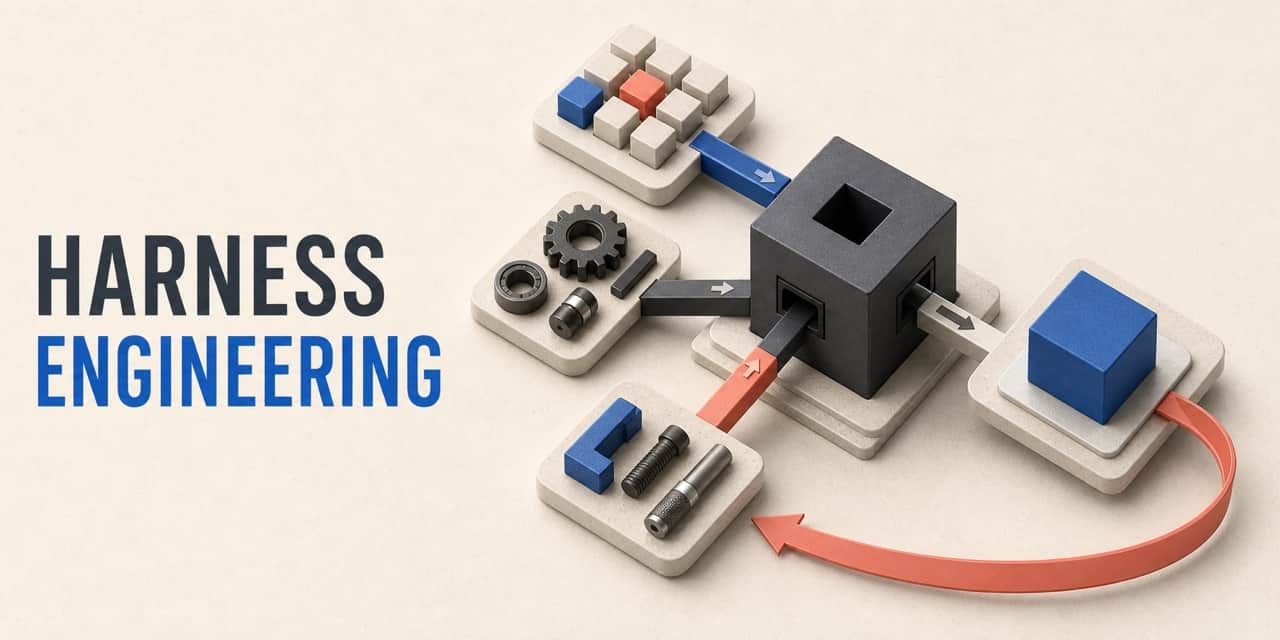
Image: Hacker News
“Most people do not know that they can just point their agents at my writing, tweets, podcasts, and talks and improve the output of their agents by 100x.”
— Ryan Lopolo
Harness engineering treats an AI coding agent and its model as a fixed black box. The work happens around them: improving the agent’s context and tools, then shaping the environment so it can recover intent, operate the real system, respect authority, prove its result, and make the next run more effective.
Turning organizational requirements into code
A harness carries an organization’s nonfunctional requirements—the constraints and quality attributes that govern reliability, security, compatibility, maintainability, performance, operability, risk posture, and polish. It also encodes local decisions about how those requirements should be prioritized and balanced.

Recommended reading
Grok correctly picked Spain for the 2026 World Cup
Ryan Lopolo adopted a systems-level framing from the 2026 [un]prompted conference: the goal is to get an organization’s entire universe of nonfunctional requirements into code. The repository’s “Make the Repository Teach the Agent” approach turns those requirements into retrievable context, examples, tools, and executable constraints.
Because agent-assisted work is iterative, accepted changes, corrections, failures, and user responses can become reusable boundaries, examples, checks, and procedures. That feedback loop allows organizational judgment—and potentially coherence across agent-maintained artifacts—to accumulate over time.
The repository as the last-mile layer
General model weights contain only the visible tip of an organization’s process-data iceberg. The operational state, local terminology, quality bar, procedures, exception history, and authority relationships needed for a specific job are private and constantly changing. Organizations cannot assume this information is present in general model weights or that an agent will infer which parts matter.
Harness engineering supplies that missing layer as context and tools. The project recommends pointing a coding agent at the repository alongside the system it should improve. AGENTS.md directs the agent to relevant arguments, cases, and proof; readers can start with the thesis index or choose an application from the playbooks.
The repository includes a source library, influences and alternate framings, and “Harness engineering: leveraging Codex in an agent-first world.” Repository-authored material is licensed under CC BY 4.0, with attribution and source-material rights documented in COPYING.md.

AI Editor
Ava covers the rapidly evolving world of artificial intelligence, from foundational models and research labs to the real-world economics of intelligence. With a background in computational linguistics, she cuts through the hype to find out what actually works. She firmly believes that benchmarks are just marketing until reproduced in the wild.
via Hacker News