• 2 min read
ConlangCrafter builds 60 new languages from scratch
Researchers say ConlangCrafter uses LLMs to generate new languages with their own sounds, grammar, and vocabulary—and then checks them for consistency.
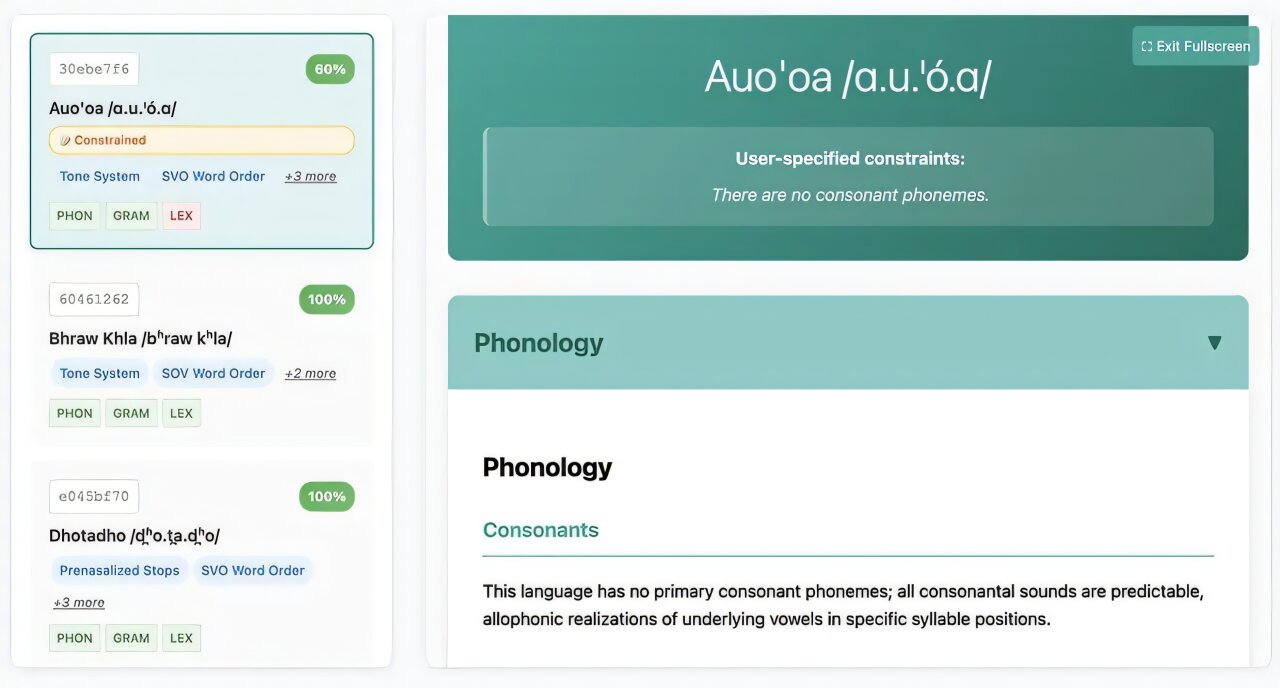
Image: TechXplore
ConlangCrafter is built to do more than translate: it creates entirely new languages with their own sound systems, grammar rules, and vocabulary, according to a paper published in the Proceedings of the Association for Computational Linguistics. The tool was developed by Morris Alper, Moran Yanuka, Raja Giryes, and Gašper Beguš, and the team says it has already produced more than 60 constructed languages.
Rather than prompting a general-purpose model to invent a language in one shot, the researchers break the task into stages. ConlangCrafter first generates a language’s sounds, then its word-formation rules, syntax, and vocabulary, before translating sentences into that language and revising inconsistencies. It keeps a running “language sketch”—effectively a design document tracking the rules as they evolve.
“Imagine if you just say, 'Make me a language.' It will give you something that doesn’t make sense,” Alper said.
Users can set specific constraints. In one case, the team asked for a language with no consonant sounds; in another, a language for an alien cephalopod species that communicates through colors and gestures. According to the researchers, the results are more diverse and internally consistent than what a general-purpose LLM such as Gemini produces from a single prompt.
Research uses beyond fiction
The obvious use case is helping people design fictional languages for video games, movies, books, and TV shows, in the mold of “Game of Thrones” and “The Lord of the Rings.” But the authors also point to research applications in linguistics and computer science.

Recommended reading
Mira Murati’s lab unveils Inkling, a 975B open model
They say the system could help with technologies for poorly documented languages that have detailed descriptions but limited text corpora. It could also be used to study how languages change over time, or how AI agents might communicate using constructed languages.
A major challenge was evaluation. Alper said the team had to devise a framework that measures both how faithfully translations follow a constructed language’s rules and how diverse the resulting languages are across features such as sound inventories and sentence structure.
The project has already been featured by Science and IEEE Spectrum. Alper developed ConlangCrafter as a postdoctoral researcher at Carnegie Mellon University’s Language Technologies Institute and is now an incoming assistant professor in the Department of Computer Science at the University of Miami College of Arts and Sciences. The code is available on the ConlangCrafter website, and the paper is titled “ConlangCrafter: Constructing Languages with a Multi-Hop LLM Pipeline.”

AI Editor
Ava covers the rapidly evolving world of artificial intelligence, from foundational models and research labs to the real-world economics of intelligence. With a background in computational linguistics, she cuts through the hype to find out what actually works. She firmly believes that benchmarks are just marketing until reproduced in the wild.
via TechXplore